
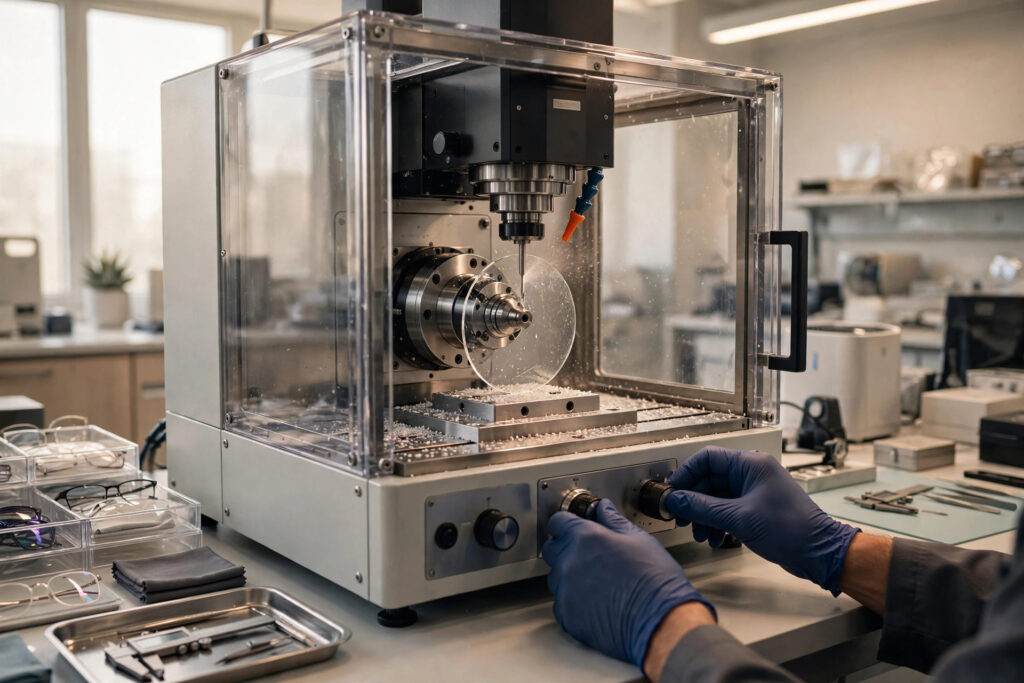
You’ve probably seen “digital” or “freeform” on a lens menu and wondered what you’re actually paying for. Digital freeform lenses explained simply: they’re eyeglass lenses whose surfaces are carved by computer-controlled equipment to your exact prescription — producing wider clear zones and sharper vision than conventionally manufactured lenses.
This guide covers how freeform surfacing works, how it differs from traditional lens making, which prescriptions benefit most, and whether the premium is justified.
Table of Contents
- What “Freeform” Means
- How Conventional Lenses Are Made
- The Freeform Manufacturing Process
- Optical Benefits
- Who Benefits Most
- Cost and Whether It’s Worth It
What “Freeform” Means
In lens manufacturing, “freeform” refers to a process where a diamond cutting tool, guided by computer software, carves the lens surface point by point — free to create virtually any shape, rather than being limited to the fixed curves of a mold or grinding lap. “Digital” describes the design side: your prescription is modeled in software that calculates the ideal surface for your eyes, frame, and wearing position.
Together, digital design plus freeform manufacturing means each lens is a one-off, optimized for you — not a semi-finished blank selected from inventory and tweaked. In 2026, freeform has become the standard for premium progressive lenses and is increasingly common for high-prescription single-vision lenses too. When comparing eyeglass lens options, “digital freeform” on the menu signals this individualized manufacturing.
How Conventional Lenses Are Made
Traditional lens manufacturing starts with semi-finished blanks: lens blanks with a finished front surface (in a limited set of base curves) and an unfinished back. The lab grinds the back surface to create your prescription using fixed-shape tools, then polishes it. This works well, but it involves compromises — the front curve is chosen from a small menu rather than calculated for you, and the grinding process can’t easily create complex, asymmetric surfaces.
The optical consequence is unwanted aberrations, especially in stronger prescriptions and at the edges of the lens. Conventional progressives, in particular, use pre-designed molds for the progressive surface — every wearer with the same “design” gets the same front surface regardless of their prescription or frame. It’s a one-size-fits-most approach that freeform was invented to replace.
The Freeform Manufacturing Process
Freeform starts with your full prescription plus personalization data: pupillary distance, fitting height, vertex distance (lens-to-eye distance), pantoscopic tilt, and frame wrap angle. Design software models how light will travel through the lens in its actual wearing position and computes the optimal back-surface shape — often a complex, non-symmetrical curve no mold could produce.
A computer-controlled generator then cuts this surface into the lens blank with a diamond tool, moving in tiny increments across the entire surface. The lens is polished to optical clarity, checked against the design with digital mapping equipment, then coated. The whole process is slower and more equipment-intensive than conventional grinding — which is why freeform lenses cost more — but the precision is on a different level, with surface accuracy measured in fractions of a micron.
Optical Benefits
The payoff is measurable. Freeform lenses deliver: wider clear zones — particularly noticeable in progressives, where the reading corridor can be substantially wider; reduced peripheral distortion — the “swim” effect is minimized because aberrations are calculated and compensated across the whole lens; better night vision — optimized optics reduce halos and glare; and truer prescription at every gaze angle — the lens accounts for how it actually sits on your face, not an idealized lab position.
For single-vision wearers, the difference is subtlest in low prescriptions and most dramatic in strong ones, where conventional lenses suffer the most edge distortion. Studies and wearer trials consistently show higher satisfaction and faster adaptation with freeform progressives versus conventional designs.
Who Benefits Most
Freeform’s advantages scale with prescription complexity. The biggest winners: progressive wearers (wider corridors, easier adaptation), high myopes and hyperopes (beyond about ±4.00 diopters, where edge aberrations become significant), high astigmatism (freeform handles complex cylinder corrections more accurately), and wraparound or highly tilted frames (where wearing position deviates most from standard assumptions).
Low-prescription single-vision wearers in standard frames will notice the least difference — conventional lenses already perform well there. Athletes and drivers who depend on crisp peripheral vision also tend to appreciate the upgrade. If you wear prescription sunglasses in wrapped sport frames, freeform is almost essential for accurate optics.
Cost and Whether It’s Worth It
Freeform typically adds $50–$150+ to lens cost versus conventional equivalents, with personalized progressives at the top of the range. Whether it’s worth it depends on your prescription and priorities: for progressives and strong prescriptions, most wearers and eye doctors consider it money well spent — the visual difference is genuinely noticeable. For mild single-vision prescriptions, it’s a nice-to-have rather than a need.
One caution: “digital” is sometimes used loosely as a marketing term. True freeform involves individualized design and computer-controlled surfacing — ask whether the lens is customized to your wearing measurements or just digitally surfaced from a standard design. The freeform lens guide at All About Vision offers additional detail. And remember: even the best-manufactured lens can’t outperform a stale prescription — keep up with regular comprehensive eye exams to make sure the numbers being manufactured are the right ones.