
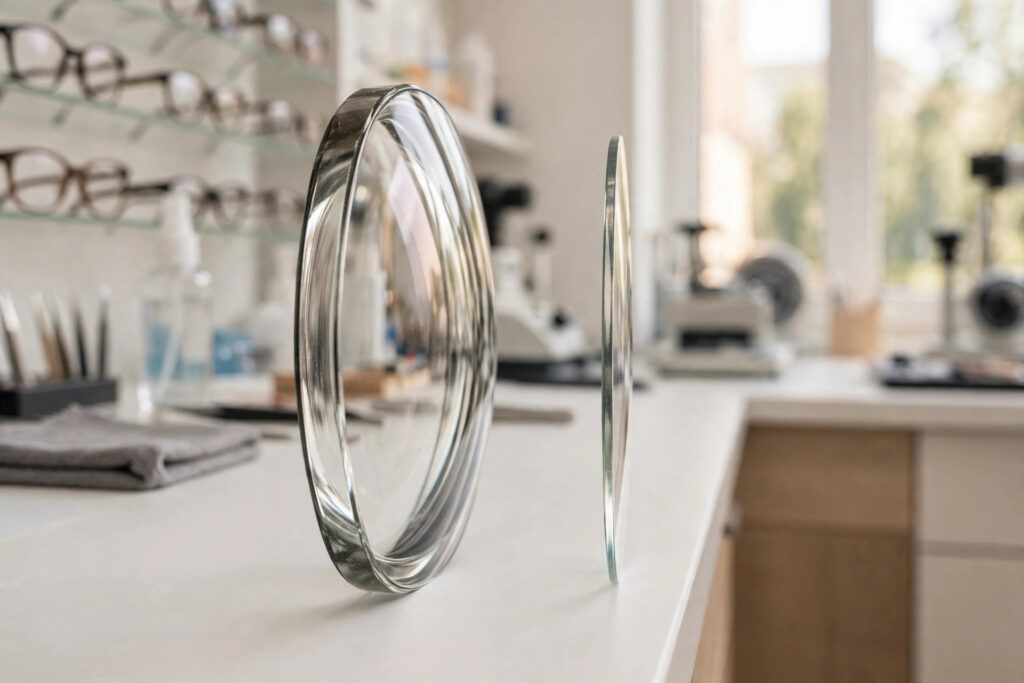
When ordering glasses, you may be offered “aspheric” lenses as an upgrade — often with a vague promise of thinner, lighter lenses. But what actually distinguishes aspheric vs spherical lenses, and when does the upgrade matter?
This guide explains the geometry behind both designs, the real-world benefits of aspheric lenses, who gains the most, and how to decide whether the extra cost is justified for your prescription.
Table of Contents
- What Spherical Lenses Are
- What Aspheric Lenses Are
- Optical Differences
- Cosmetic Differences
- Who Benefits Most From Aspheric
- Cost and Decision Guide
What Spherical Lenses Are
A spherical lens has surfaces shaped like sections of a sphere — a constant curvature across the entire surface, like a slice of a ball. This is the traditional lens shape, and it’s still standard for mild prescriptions because it’s simple to manufacture and optically well-behaved at low powers.
The problem with spherical surfaces emerges as prescription strength increases. To achieve higher powers with a spherical curve, the lens must become steeply curved — producing the thick, heavy “coke bottle” lenses associated with strong prescriptions. Spherical lenses also suffer from spherical aberration: light rays passing through the edge of the lens focus at a different point than rays through the center, degrading peripheral clarity. For mild prescriptions these effects are negligible, which is why spherical remains the default there. Shoppers comparing eyeglass lens materials and designs will usually encounter spherical as the baseline option.
What Aspheric Lenses Are
Aspheric lenses break the sphere rule: their curvature gradually flattens from the center toward the edge (for plus lenses) or follows a more complex profile (for minus lenses). This non-spherical geometry is computed to deliver the correct power at every point while using a flatter, thinner overall shape.
The result is a lens that looks noticeably flatter and more natural in the frame. For plus (farsighted) prescriptions, aspheric designs dramatically reduce the bulging “bug-eye” magnification effect. For minus (nearsighted) prescriptions, they reduce the thick edges and the minifying “small-eye” look. The flatter profile also sits closer to the face and fits better in modern frame styles. There’s also a related premium option — atoric (aspheric + toric) designs for astigmatism — and double-aspheric lenses that optimize both surfaces.
Optical Differences
Beyond cosmetics, aspheric lenses genuinely see better in stronger prescriptions. By varying curvature across the surface, the design corrects spherical aberration — peripheral rays focus correctly instead of smearing. Wearers typically report a wider field of clear vision and less distortion when glancing sideways.
Aspheric designs also reduce the oblique astigmatism that occurs when looking through the lens at an angle. In practical terms: the usable clear zone of the lens is larger, and the transition from center to edge is smoother. For prescriptions beyond about ±4.00 diopters, the difference is readily apparent; below ±2.00, most wearers can’t distinguish aspheric from spherical in blind comparisons. This is one reason aspheric designs pair so well with high-index lens materials for strong prescriptions — thin material plus optimized geometry compounds the benefit.
Cosmetic Differences
Let’s be honest: for many buyers, cosmetics drive the decision. Aspheric lenses can reduce center thickness in plus lenses by 20–30% and edge thickness in minus lenses by a similar margin compared to spherical equivalents in the same material. They look flatter, more natural, and less “prescription-y” — your eyes appear closer to their natural size to others.
The flatter profile has practical bonuses: less lens protruding from the frame (fewer chips on minus-lens edges), lighter weight, and a more stable fit. For plus-lens wearers especially, the reduction in magnification can be transformative — going from visibly enlarged eyes to a near-natural appearance. If appearance in glasses matters to you, aspheric is one of the highest-impact upgrades available, second only to material choice.
Who Benefits Most From Aspheric
The benefit curve is clear: strong prescriptions (±4.00 and above) gain the most in both optics and cosmetics. Moderate prescriptions (±2.00 to ±4.00) see worthwhile improvements, particularly in plus lenses where magnification is visible. Mild prescriptions (under ±2.00) gain little — the upgrade is mostly unnecessary.
Plus-lens (hyperopic) wearers benefit more visibly than minus-lens wearers at equivalent powers, because center thickness and magnification are more conspicuous problems. Children with strong prescriptions are excellent candidates — lighter, thinner, better-looking lenses improve comfort and willingness to wear them. And anyone choosing fashion-forward flat frames will find aspheric lenses sit more naturally in the frame. Teens weighing their options may also compare contact lenses as an alternative to thick glasses.
Cost and Decision Guide
Aspheric typically adds $30–$80 per pair over spherical in the same material — modest compared to the visual and cosmetic payoff for stronger prescriptions. Many lens manufacturers now include aspheric design as standard in their high-index products, so you may get it automatically when you upgrade material.
Decision rules of thumb: under ±2.00, skip it unless bundled free. From ±2.00 to ±4.00, consider it — especially for plus lenses or if appearance matters to you. Above ±4.00, get it; the improvement is substantial. Always combine aspheric design with anti-reflective coating, since flatter lenses can produce slightly more noticeable reflections. The aspheric lens guide at All About Vision has helpful illustrations of the geometry. And as always, the foundation is an accurate prescription from a current eye exam — even the best lens design can’t fix outdated numbers.