
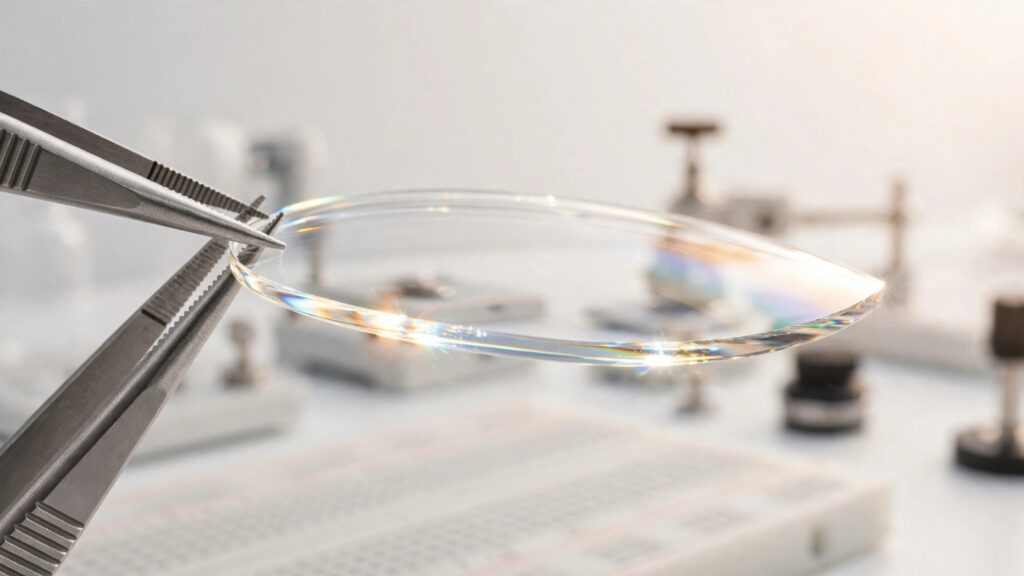
For strong prescriptions, lens thickness is the eternal enemy — and high index 1.74 lenses are the thinnest plastic option available in 2026. But what does “1.74” actually mean, and is this premium material right for your eyes?
This guide explains refractive index in plain language, compares 1.74 against other materials, covers the trade-offs (including one optical drawback most sellers don’t mention), and helps you decide whether the premium price is worth it.
Table of Contents
- What Refractive Index Means
- How 1.74 Compares to Other Materials
- The Thinness Advantage
- Trade-Offs: Chromatic Aberration
- Who Should Choose 1.74
- Cost and Buying Tips
What Refractive Index Means
Refractive index measures how much a material bends light. Standard plastic (CR-39) has an index of 1.49; polycarbonate is 1.59; high-index plastics run 1.60, 1.67, and 1.74. The higher the number, the more the material bends light — which means less material is needed to achieve the same prescription power.
Think of it like this: to focus light by a given amount, you can use a lot of weakly-bending material (thick lens) or a little strongly-bending material (thin lens). That’s the entire principle. The “1.74” is simply the index of refraction of this particular lens plastic — the highest available in standard eyewear plastics. When comparing lens material options, refractive index is the single number that predicts thinness.
How 1.74 Compares to Other Materials
CR-39 (1.49): the baseline — excellent optics, affordable, but thick and heavy in strong prescriptions. Best for mild prescriptions. Polycarbonate (1.59): thinner than CR-39, extremely impact-resistant, standard for children’s and safety glasses — but softer (scratches more easily) and with slightly lower optical clarity. Trivex (1.53): similar to polycarbonate in toughness with better optics. High-index 1.67: significantly thinner than polycarbonate, good optics, the sweet spot for moderate-to-strong prescriptions. High-index 1.74: the thinnest available — roughly 10–15% thinner than 1.67 and up to 40% thinner than CR-39 at the same prescription.
The jump from 1.67 to 1.74 is real but incremental; the jump from CR-39 or polycarbonate to 1.74 is dramatic. Diminishing returns apply — each step up in index costs more while delivering a smaller thinness gain.
The Thinness Advantage
For a −8.00 prescription, the difference is striking: CR-39 lenses might measure 8–9mm thick at the edge, while 1.74 lenses come in around 4–5mm. That translates directly to lighter weight (less pressure on nose and ears), a more natural appearance (less “coke bottle” effect), and better frame compatibility (thick lenses limit frame choices and can pop out of rimless mountings).
For plus prescriptions (farsightedness), 1.74 reduces center thickness and the magnified “bug-eye” appearance. Combined with aspheric design — standard in most 1.74 products — the cosmetic improvement over basic lenses is transformative for strong prescriptions. People who’ve worn thick lenses for years are often shocked by the difference.
Trade-Offs: Chromatic Aberration
Here’s the drawback sellers rarely emphasize: as refractive index rises, the Abbe value falls. Abbe value measures how cleanly a material focuses different colors of light — higher is better. CR-39 scores an excellent 58; polycarbonate a mediocre 30; 1.74 scores around 33.
Low Abbe value means chromatic aberration: color fringing (subtle rainbow edges) around high-contrast objects, most noticeable in peripheral vision. Most wearers adapt and stop noticing it, but sensitive individuals — particularly those who do precision visual work — may find it bothersome. This is the fundamental trade-off of high-index materials: thinness purchased with a small optical compromise. Premium anti-reflective coatings help by reducing the stray reflections that make fringing more visible.
Who Should Choose 1.74
Strong candidates: prescriptions beyond ±6.00 (where 1.74’s thinness advantage is dramatic), anyone prioritizing the thinnest possible appearance, and rimless or semi-rimless frame wearers with strong prescriptions (thin edges are structurally important here). Consider 1.67 instead: prescriptions from ±4.00 to ±6.00, where 1.67 delivers most of the benefit at lower cost with slightly better optics. Skip 1.74: mild prescriptions under ±3.00 — the difference versus 1.67 or even polycarbonate is barely visible and not worth the premium.
One more consideration: 1.74 is less impact-resistant than polycarbonate or Trivex. It’s fine for everyday wear but isn’t the choice for sports or safety applications. Athletes with strong prescriptions should discuss sports eyewear options with impact-rated materials instead.
Cost and Buying Tips
Expect 1.74 to cost $150–$300+ more than basic lenses, varying widely by retailer. Tips for buying smart: always pair 1.74 with premium anti-reflective coating (essential, not optional — high-index materials reflect more light without it); choose smaller frame sizes to compound the thinness benefit (large frames force thicker edges regardless of material); and confirm the lenses include aspheric design, which most 1.74 products do by default.
Don’t pay the 1.74 premium for a mild prescription because a salesperson upsold you — the physics doesn’t justify it below about ±4.00. The high-index lens guide at All About Vision offers comparison photos showing the thickness differences. And as with any lens purchase, everything starts with accurate numbers from a current comprehensive eye exam.