
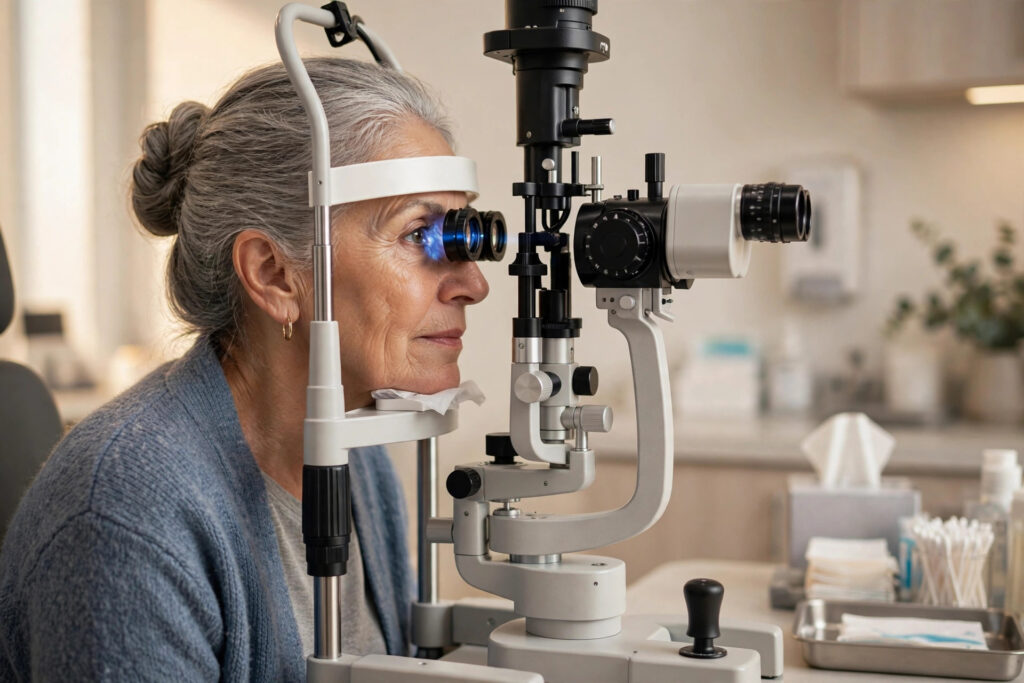
LASIK corrects your vision by reshaping the cornea, but it does nothing to prevent cataracts — the clouding of the eye’s natural lens that affects most people eventually with age. Sooner or later, many LASIK patients face a second vision procedure: cataract surgery after LASIK. The good news is that cataract surgery works just as well in eyes that have had LASIK. The complication is measurement, not healing — the reshaped cornea makes it harder to calculate the correct power for the artificial lens implant.
This article explains why cataract surgery after LASIK needs special planning, why your old LASIK records are so valuable, how surgeons solve the calculation puzzle, and what questions to ask at your consultation. If you had LASIK years ago and are now noticing cataract symptoms, this is the background that will make your surgeon’s explanations click.
Table of Contents
- Why Cataracts Still Happen After LASIK
- How LASIK Complicates Lens Power Calculations
- Why Your LASIK Records Matter
- Choosing the Right Intraocular Lens
- What Cataract Surgery Feels Like After LASIK
- Recovery and Vision Expectations
- Talking to Your Surgeon: Questions to Ask
Why Cataracts Still Happen After LASIK
It helps to picture the eye as a camera with two focusing lenses in series: the cornea at the front and the crystalline lens just behind the iris. LASIK reshapes only the first lens, the cornea. Cataracts form in the second lens, the crystalline lens, when its proteins gradually cloud with age. Because LASIK never touches the crystalline lens, it neither causes cataracts nor protects against them — the natural lens ages on its own schedule regardless of what was done to the cornea.
This surprises some patients who assumed their laser procedure was a permanent, once-and-done fix for vision. In reality, LASIK corrects the refractive error you had at the time of surgery; the eye continues to age afterward like any other eye. Cataracts typically become significant from the sixties onward, which for many LASIK patients means two or three decades of excellent vision between the two procedures. That long interval is worth remembering — it is the payoff of the original surgery, not a failure of it.
Early cataract symptoms after LASIK feel familiar and unfamiliar at once: glare and halos around lights at night, colors looking faded or yellowed, vision that seems to need a stronger prescription, and difficulty reading in dim light. If you notice these changes, a comprehensive How Often Should You Get an Eye Exam?“>eye exam can confirm whether a cataract is developing and how far it has progressed. Regular exams after age 60 catch cataracts at the stage when surgery planning is easiest.
How LASIK Complicates Lens Power Calculations
Cataract surgery replaces the cloudy natural lens with an artificial intraocular lens, or IOL. Choosing the right IOL power is a calculation based on precise measurements of the eye — its length and, critically, the curvature of the cornea. Standard calculation formulas were developed for corneas that had never been surgically altered, and they assume a normal relationship between the cornea’s front and back surfaces.
LASIK breaks that assumption. The laser flattens the front of the cornea (for nearsightedness) while the back surface stays as it was, so the normal front-to-back ratio no longer holds. Standard instruments measure only the front surface and infer the back, which leads the formulas to misjudge the cornea’s true focusing power. The classic error direction is well known to surgeons: using standard formulas on post-LASIK eyes tends to recommend too weak an IOL, leaving the patient unexpectedly farsighted after surgery — sometimes called a “refractive surprise.”
Surgeons today handle this with specialized post-refractive formulas and calculation methods developed specifically for eyes with prior laser vision correction. These methods use additional measurements, historical data when available, and adjusted mathematical models to estimate corneal power more accurately. Results are substantially better than with standard formulas, though surgeons are candid that predictions in post-LASIK eyes carry a wider margin of uncertainty than in virgin eyes. Understanding this helps set realistic expectations: the surgery itself is routine, but hitting an exact refractive target takes more expertise. The National Eye Institute’s cataract resources describe the standard procedure that these calculations support.
Why Your LASIK Records Matter
If there is one practical takeaway from this article, it is this: keep your LASIK records forever. The pre-operative measurements from your original laser procedure — your prescription, corneal curvature readings, and corneal thickness — are the single most useful data your cataract surgeon can have. Several of the best post-refractive calculation methods are “history-based,” meaning they use your original numbers to reconstruct what your cornea looked like before LASIK and derive its true power more accurately.
Many patients discover, decades after LASIK, that they have no idea where those records went. The clinic may have closed, changed ownership, or archived old files. If your LASIK was recent or you still have the paperwork, store it with your important documents and tell your family where it is — your future cataract surgeon will thank you. If the records are lost, all is not lost: modern “no-history” methods can still produce good results using current measurements alone, but having the history measurably improves the odds.
When you first discuss cataracts with any eye doctor, mention your LASIK history immediately — including roughly when it was done and, if you remember, whether it was LASIK, PRK, or SMILE. This changes which measurements the practice takes and which surgeon within the practice is best suited to your case. Not every cataract surgeon specializes in post-refractive eyes, and you want the one who does. Bring any records you have to that first visit rather than waiting to be asked.
Choosing the Right Intraocular Lens
Patients having cataract surgery after LASIK face the same IOL choices as everyone else: standard monofocal lenses (usually set for distance, with reading glasses for near), toric lenses that correct astigmatism, and premium multifocal or extended-depth-of-focus lenses that aim for a fuller range of vision. LASIK history does not rule any of these out, but it does add considerations to the discussion.
Because refractive predictions are slightly less certain in post-LASIK eyes, some surgeons lean conservative with premium lenses, which demand precise targeting to perform well. A small residual error that a monofocal patient barely notices can disappoint someone who paid for a multifocal’s full range. That said, many post-LASIK patients do very well with advanced lenses when the calculations are handled by an experienced surgeon — it is a conversation about probabilities, not prohibitions.
Your prior LASIK also means you have already lived the “which distance matters most” question once before. Think about how you actually use your vision now: night driving, computer work, reading, hobbies. Share those priorities with your surgeon, because IOL selection is fundamentally about matching the lens to your life. Advances in Anti-Reflective vs Anti-Glare: What’s the Difference?“>lens technology continue to expand the options, and a surgeon experienced with post-refractive eyes will know which designs behave most predictably in your situation. The American Academy of Ophthalmology’s cataract overview explains the lens options in patient-friendly terms.
What Cataract Surgery Feels Like After LASIK
The cataract procedure itself is essentially identical whether or not you had LASIK. It is an outpatient surgery, usually under topical numbing drops with light sedation, taking around 10 to 20 minutes per eye. The surgeon makes a tiny incision at the edge of the cornea, breaks up the cloudy lens with ultrasound, removes it, and inserts the folded IOL, which unfolds into place. Most patients describe pressure and bright lights rather than pain.
One difference post-LASIK patients sometimes notice is at the incision: the surgeon works through the cornea, and a cornea with an old LASIK flap needs slightly adapted technique. Experienced surgeons do this routinely — the flap, healed for decades, is not fragile in the way a fresh one is — but it is another reason to choose a surgeon who regularly operates on post-refractive eyes rather than one encountering it occasionally.
Eyes are typically done one at a time, days to weeks apart, which also gives the surgeon a valuable data point: the refractive result of the first eye can fine-tune the IOL calculation for the second. This staged approach is standard practice and particularly useful in post-LASIK cases, where every additional piece of information sharpens the targeting. If your surgeon suggests it, understand it as a precision strategy, not a complication.
Recovery and Vision Expectations
Recovery from cataract surgery is quick and, for most patients, easier than they feared. Vision often improves within a day or two, with full stabilization over a few weeks. You will use prescribed drops for several weeks, wear an eye shield while sleeping at first, and avoid rubbing the eye, heavy lifting, and swimming during the early healing period — restrictions that will feel familiar if you remember your LASIK aftercare.
Vision expectations deserve an honest framing. The goal is a clear lens and the best refractive result the calculations can deliver — and for the large majority of post-LASIK patients, that result is excellent. But the wider prediction margin means a small chance of needing a fine-tuning step afterward, such as a light glasses prescription for specific tasks, a laser touch-up, or in some cases an IOL exchange or piggyback lens. Your surgeon should discuss these possibilities before surgery, not after.
Many patients who have been through both procedures describe cataract surgery as the moment their LASIK “came full circle” — decades of freedom from glasses, then one more brief procedure restoring clarity. Keep up with Best Eyeglasses for Round Faces in 2026“>eyeglasses for any residual needs afterward; even a simple pair for night driving or fine print is a small price for the outcome. And continue regular eye exams, since cataract surgery does not prevent other age-related eye conditions.
Talking to Your Surgeon: Questions to Ask
Arrive at your cataract consultation as an informed patient. Key questions for anyone with LASIK history include: How many post-LASIK cataract cases have you handled? Which calculation formulas or methods will you use for my eyes? Do you want my old LASIK records, and what do you do if they are unavailable? What is your target for my vision after surgery, and how confident are you in hitting it? What are my IOL options given my corneal history?
Also ask about the plan if the result is not quite on target: what enhancement options exist, and at what point would you recommend them? How will you sequence the two eyes, and will the first eye’s result adjust the second? What does your follow-up schedule look like? A surgeon who welcomes these questions and answers them specifically — rather than in generalities — is demonstrating exactly the expertise your situation needs.
Cataract surgery after LASIK is one of the great success stories of modern ophthalmology: a routine, brief procedure that restores vision even in eyes whose measurements require extra skill to get right. Do your part by preserving your records, choosing a surgeon with real post-refractive experience, and going in with clear priorities for your vision. The combination of your preparation and their expertise is what turns a calculation challenge into an excellent outcome.