
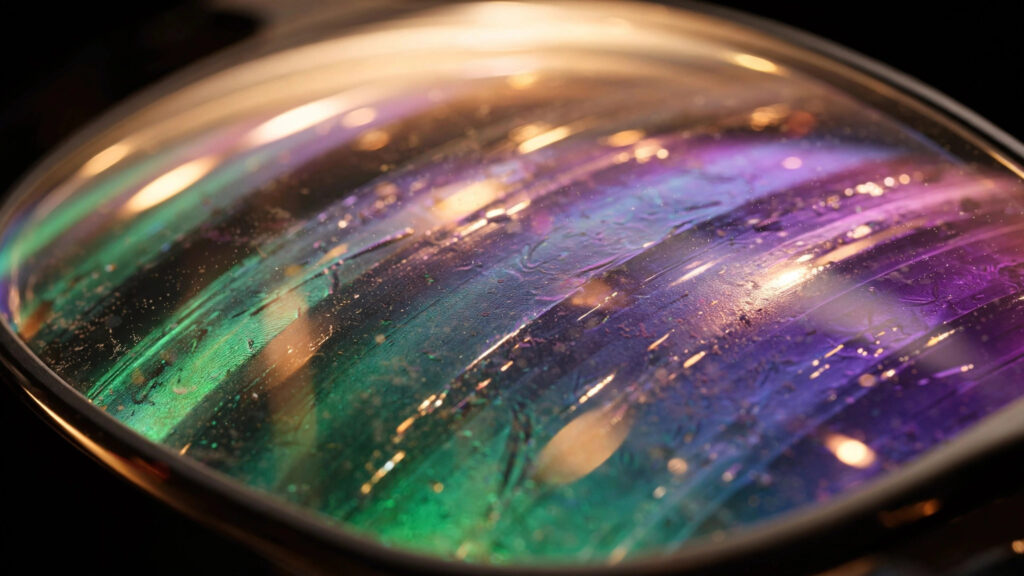
Anti-reflective (AR) coating is one of the most common upsells at the optical counter — and one of the most misunderstood. It promises to eliminate glare, improve night vision, and make your lenses look invisible. But is it worth the extra cost, or is it an overpriced add-on you can skip?
Short answer: for most glasses wearers, AR coating is genuinely worth it. But the value depends on your lenses, your lifestyle, and the quality of the coating itself. Here’s an honest breakdown of what AR coating does, what it doesn’t do, and how to decide.
Table of Contents
- What Anti-Reflective Coating Does
- Night Driving and Screen Benefits
- When AR Coating Is Essential
- Durability and Maintenance
- What AR Coating Can’t Do
- Cost and Quality Tiers
What Anti-Reflective Coating Does
AR coating is a microscopically thin multi-layer film applied to both surfaces of a lens. Its job is to reduce the reflections that naturally occur when light hits lens surfaces — untreated lenses reflect roughly 8–12% of incoming light, while quality AR coating cuts that to under 1%. The result: more light reaches your eyes, and fewer distracting reflections bounce back at you or at people looking at you.
Visually, the difference is striking. Without AR coating, your lenses show obvious white reflections in photos and under bright lighting; with it, lenses look nearly invisible. Functionally, you get clearer vision in challenging light — oncoming headlights, overhead fluorescents, and backlit screens all produce less ghosting and glare. It’s one of the most impactful upgrades in modern lens technology, and it works on every lens material.
Night Driving and Screen Benefits
Night driving is where AR coating earns its reputation. Halos and starbursts around headlights and streetlamps are amplified by lens reflections; AR coating strips away the reflected component, leaving a cleaner, higher-contrast view of the road. Many drivers report meaningfully less eye fatigue on night drives after adding AR coating — it’s one of the few lens upgrades with an immediate, obvious payoff.
For screen work, the benefit is real but subtler. AR coating reduces the reflections of windows and overhead lights on your lenses, which cuts the visual noise your eyes fight through all day. It won’t fix digital eye strain on its own — that’s more about blink rate, screen distance, and breaks — but combined with good habits and possibly computer vision care, it makes long screen days more comfortable.
When AR Coating Is Essential
AR coating moves from “nice to have” to “don’t skip” in a few situations. High-index lenses reflect significantly more light than standard plastic due to their denser material — without AR coating, they look perpetually smudged and produce distracting internal reflections. If you’re buying 1.67 or 1.74 lenses, consider AR coating mandatory.
It’s also strongly recommended for anyone who drives at night regularly, works under harsh office lighting, appears on video calls often (AR coating keeps your eyes visible instead of hidden behind white reflections), or wears progressive lenses, where clear optics across the whole lens matter most. Parents choosing glasses for children should know that AR coating makes lenses easier to see through in classrooms — though kids’ coatings take more abuse, so durability matters.
Durability and Maintenance
The biggest complaint about AR coating is that it can peel, craze, or scratch — and historically, cheap coatings did exactly that. The good news: premium AR coatings in 2026 are dramatically more durable than the first-generation coatings that earned the bad reputation. Top-tier coatings now include hardened scratch-resistant layers and hydrophobic topcoats, and they typically carry warranties of one to two years.
Maintenance matters enormously. AR-coated lenses must be cleaned properly — rinse first, then use a microfiber cloth and lens spray. Paper towels, shirt tails, and dry-wiping grit across the surface will destroy any coating, premium or not. Never use household glass cleaner or alcohol-heavy products. With proper care, a quality AR coating lasts the full life of the lenses. The American Academy of Ophthalmology’s lens-care guide covers the cleaning routine that protects coatings.
What AR Coating Can’t Do
AR coating is not a magic shield. It doesn’t make lenses scratch-proof — it reduces reflections; scratch resistance comes from separate hard-coat layers. It doesn’t block UV light on its own (though it’s often bundled with UV protection). It doesn’t filter blue light unless specifically formulated to, and the evidence for blue-light filtering remains mixed anyway.
It also won’t fix a bad prescription, poor frame fit, or lenses that are simply worn out. If your vision feels off, get a current eye exam before blaming the coating. And be skeptical of dramatic marketing claims — AR coating improves clarity and comfort, but it won’t give you superhuman night vision or eliminate eye strain by itself.
Cost and Quality Tiers
AR coating pricing spans a wide range. Basic coatings are inexpensive but tend to be less durable and less effective; mid-tier coatings hit the sweet spot for most wearers; premium branded coatings cost the most but offer the best clarity, easiest cleaning (thanks to superior hydrophobic layers), and longest warranties. Online retailers have compressed these tiers — you can now get genuinely good AR coating at prices that once bought only the basics.
Our recommendation: don’t buy the cheapest coating available, and don’t assume the most expensive is automatically worth it. Ask about the warranty — a coating backed by a one-to-two-year warranty signals the manufacturer stands behind its durability. For most people, a solid mid-tier AR coating with a hydrophobic topcoat is the value winner: noticeably better vision day and night, lenses that look great in photos, and durability that lasts until your next prescription change.