Vision changes usually creep up gradually, which makes them easy to ignore. You hold your phone a little farther away, squint at road signs a little harder, and chalk up the headaches to stress. But these small adaptations are often signs you need glasses, and recognizing them early protects both your vision and your quality of life.
This article covers the ten most common signs that your eyes need corrective lenses, explains what each symptom means, and tells you exactly what to do next. If several of these sound familiar, it is time for an eye exam.
Table of Contents
- Blurry Vision Near and Far
- Frequent Headaches and Eye Strain
- Squinting to See Clearly
- Night Vision Problems, Halos, and Glare
- Double Vision
- Reading Difficulty and Frequent Eye Rubbing
- What to Do Next
Blurry Vision Near and Far
The classic sign of myopia (nearsightedness) is clear near vision paired with blurry distance vision. Road signs stay fuzzy until you are close, faces across the room lack detail, and classroom whiteboards or presentation screens are hard to read. If you find yourself moving closer to see things others see easily, your distance vision likely needs correction. Myopia often develops in childhood and can progress through the teen years, but adult-onset myopia happens too, sometimes related to intensive near work.
At the other end of the range, trouble reading up close points to presbyopia or hyperopia. If small print, phone screens, and restaurant menus have become harder to read, especially in dim light, you may be experiencing presbyopia, the age-related loss of near focusing ability that typically begins in the early to mid-40s. The telltale behavior is holding reading material at arm’s length to find the focus sweet spot. Hyperopia (farsightedness) causes similar near-vision difficulty at any age, often accompanied by eyestrain during prolonged close work.
Do not simply accept blurry vision as normal at any distance. Uncorrected refractive errors cause unnecessary strain and can be a safety issue while driving. A simple eye exam and a pair of well-fitted glasses resolve most blurriness completely. The National Eye Institute’s presbyopia resources explain age-related near vision changes and their treatments in detail.
Frequent Headaches and Eye Strain
Recurring headaches, especially in the forehead and temple area after reading, computer work, or driving, frequently signal uncorrected vision problems. When your eyes struggle to focus, the extra muscular effort triggers tension headaches that painkillers only temporarily relieve. These headaches typically worsen as the day progresses and improve with rest. If you notice the pattern correlates with visual tasks, your eyes are telling you something.
Closely related is the feeling of eyes that are tired, sore, or heavy after visual tasks. Digital eye strain compounds the problem: uncorrected vision plus hours of screen time is a recipe for burning, aching eyes by evening. You may also notice difficulty concentrating on visually demanding tasks. Eye fatigue from uncorrected vision differs from ordinary tiredness because rest does not fully resolve it; the strain returns as soon as you resume the visual task.
While headaches have many causes, vision-related headaches resolve remarkably fast once the underlying refractive error is corrected. Proper correction often produces an almost immediate sense of relief that wearers describe as not realizing how hard their eyes were working. Mention the headache pattern at your eye exam so the doctor can connect the symptoms to the findings.
Squinting to See Clearly
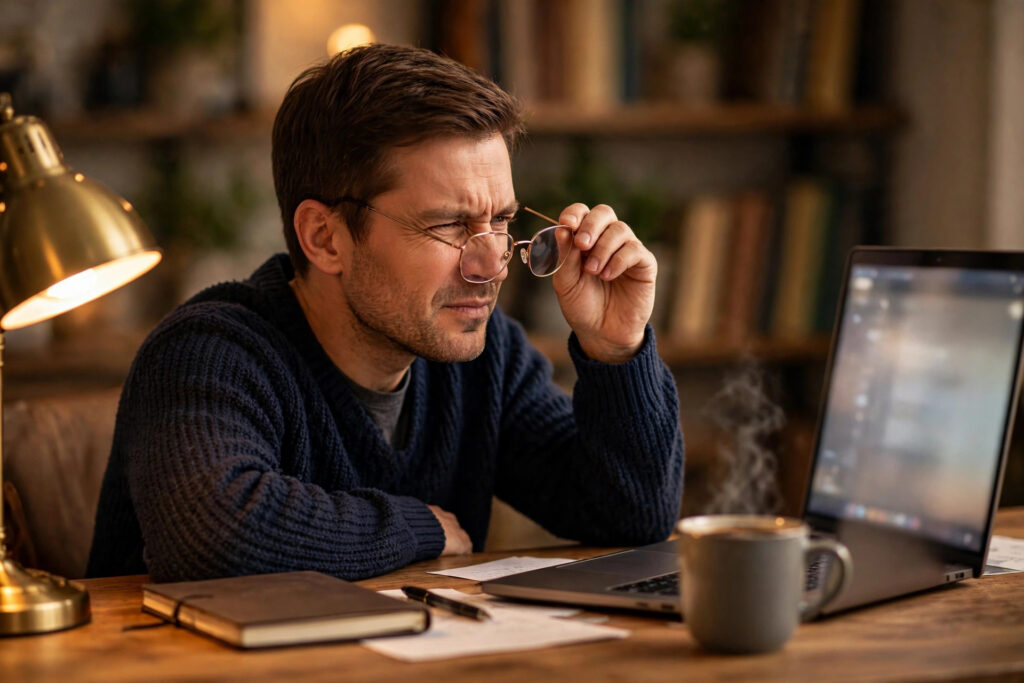
Squinting is your eyes’ crude autofocus: narrowing the eyelids reduces the blur circle and temporarily sharpens vision. If you catch yourself squinting at signs, screens, or faces, you are compensating for a refractive error that glasses would correct properly. Chronic squinting causes its own problems, including tension headaches, premature wrinkles around the eyes, and eye fatigue. It is also socially conspicuous; people notice when you are constantly screwing up your face to see.
Squinting in bright light is normal and calls for quality sunglasses, but squinting to resolve detail in normal light is a clear sign you need glasses. Do not train yourself to squint when a simple correction exists. Children who squint habitually should be evaluated promptly, since they rarely complain about vision directly and the behavior is often the clearest clue parents get.
Night Vision Problems, Halos, and Glare
Difficulty seeing while driving at night is one of the most important signs you need glasses because it directly affects safety. Uncorrected myopia and astigmatism both worsen dramatically in low light, when pupils dilate and optical imperfections have greater effect. If you have started avoiding night driving, or if oncoming headlights seem blindingly intense, get your eyes checked promptly. Night vision problems can also indicate cataracts in older adults, which an exam will identify.
Related symptoms include seeing halos or starbursts around lights and finding normal brightness painfully glaring. Uncorrected astigmatism is a common cause, scattering light into the characteristic starburst pattern. Increased light sensitivity can also accompany dry eye, corneal problems, or inflammation. If bright environments that never bothered you now cause discomfort, something has changed and deserves investigation.
Many people are surprised by how dramatically glasses improve their night vision. What felt like dangerous glare often resolves into manageable brightness with proper correction and anti-reflective lens coatings. The American Academy of Ophthalmology offers guidance on these symptoms and when they warrant an exam.
Double Vision
Seeing double, whether constant or intermittent, always warrants prompt professional evaluation. It can result from uncorrected refractive error or astigmatism, but it can also signal more serious conditions affecting eye muscles or nerves. Do not wait on this symptom. Note when the doubling occurs: with one eye open or only with both eyes open. Double vision in one eye alone usually indicates an optical problem in that eye, while double vision only with both eyes open suggests an alignment issue. This detail helps your doctor diagnose the cause.
While some causes are benign and correctable with glasses or prisms, others require urgent treatment. Treat new double vision as a reason to call your eye doctor promptly rather than a wait-and-see situation. Sudden onset double vision accompanied by other neurological symptoms should be treated as an emergency.
Reading Difficulty and Frequent Eye Rubbing
Frequently losing your place, skipping lines, or needing to use a finger to track text while reading can indicate uncorrected vision or an eye teaming problem. When the eyes cannot maintain clear, single, comfortable focus, the brain struggles to track smoothly across the page. In children, this symptom is sometimes mistaken for a reading or attention problem when the real issue is visual. A child who avoids reading, reads slowly, or complains that words move on the page should have a comprehensive eye exam before any other intervention.
Constantly rubbing your eyes signals fatigue and strain, often from uncorrected vision forcing your eyes to work overtime. While occasional rubbing is harmless, habitual rubbing can damage the cornea over time and is associated with conditions like keratoconus. In children, frequent eye rubbing is one of the most reliable observable signs of vision problems, since kids rarely articulate what they are experiencing. Parents should treat persistent eye rubbing as a prompt for an exam, not just a habit to discourage.
What to Do Next
If you recognized yourself in several of these ten signs, the next step is simple: schedule a comprehensive eye exam. The exam is painless, usually takes under an hour, and gives you definitive answers. Most vision problems are easily correctable, and many people wonder why they waited so long once they experience clear, comfortable vision.
For children showing these signs, our guide to children’s vision symptoms covers what parents should watch for at each age. Early action protects vision during the critical developmental years when treatment works best. Do not let a busy schedule turn a simple prescription update into years of unnecessary strain.