
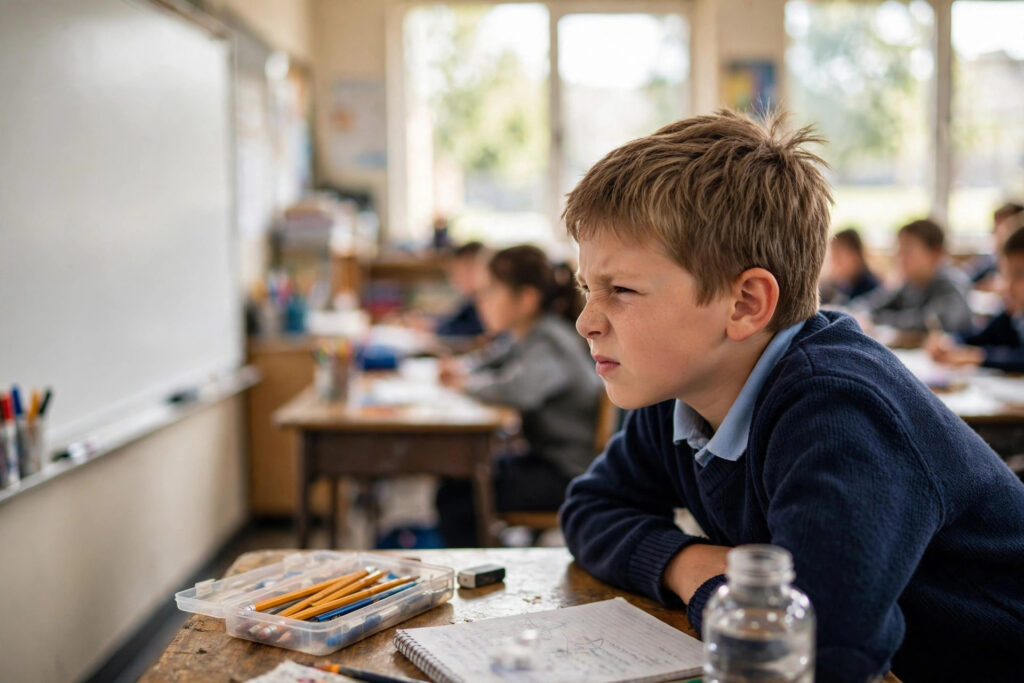
Children rarely tell you they cannot see well. They have no basis for comparison; blurry vision is simply how the world looks to them. That is why parents need to recognize the behavioral signs your child needs glasses and act on them. Early detection protects not just vision but learning, confidence, and development.
This guide details the seven most reliable signs of vision problems in children, explains what each one means, and tells you exactly what to do when you spot them. Trust your observations; parents are often the first to notice.
Table of Contents
- Sign 1: Squinting
- Sign 2: Sitting Too Close
- Sign 3: Headaches and Eye Rubbing
- Sign 4: School and Reading Struggles
- Sign 5: Covering or Closing One Eye
- Sign 6: Light Sensitivity and Watery Eyes
- Sign 7: Clumsiness, Eye Turning, and Next Steps
Sign 1: Squinting
When a child squints to see the board, the television, or distant objects, they are using the same crude focusing trick adults use: narrowing the eyelids to sharpen the image. Occasional squinting in bright sunlight is normal, but habitual squinting to resolve detail signals a refractive error, most commonly myopia or astigmatism.
Watch for squinting patterns. Does it happen with distance viewing, near work, or both? Distance-only squinting suggests myopia; squinting during reading suggests hyperopia or astigmatism. Note when you observe it and mention the pattern at the eye exam.
Squinting children are working harder than they should to see. The longer it continues uncorrected, the more it affects their comfort, school performance, and willingness to engage in visual activities. These are classic signs your child needs glasses, and they deserve prompt evaluation.
Sign 2: Sitting Too Close
A child who sits inches from the television, holds books or tablets against their nose, or hunches over homework is compensating for blurry vision. For distance, moving closer is the natural response to myopia. For near work, holding things extremely close can indicate high hyperopia or focusing problems.
The old warning that sitting close to the TV damages eyes is a myth; the behavior does not cause vision problems. But it reliably signals existing ones. Children do not choose uncomfortable viewing positions for fun; they do it because it is the only way they see clearly.
Compare your child’s viewing distance to their peers. If they consistently need to be much closer than other children to see the same things, schedule an exam. This sign is especially telling because it is objective and easy for parents to observe. Early correction with properly fitted children’s glasses resolves the behavior quickly.
Sign 3: Headaches and Eye Rubbing
Frequent headaches in children, particularly after school or homework, often originate in the eyes. Uncorrected hyperopia forces the focusing system into overtime, producing frontal headaches that parents and teachers misattribute to stress, dehydration, or dislike of schoolwork. The timing correlation with visual tasks is the diagnostic clue.
Chronic eye rubbing signals fatigue and strain. While some rubbing is normal tiredness, persistent rubbing during or after visual activities suggests the eyes are struggling. Excessive rubbing can also indicate allergies or dryness, which the exam will differentiate.
Take headaches seriously as vision symptoms. A child who dreads homework because it hurts is not lazy; they may be in genuine discomfort every time they try to focus. Among the signs your child needs glasses, this one most directly affects their daily happiness.
Sign 4: School and Reading Struggles
Vision problems masquerade as learning problems with alarming frequency. A child who cannot see the board falls behind in class. A child whose eyes cannot track text smoothly reads slowly and avoids reading. A child with uncorrected vision may be labeled inattentive, unmotivated, or learning-disabled when glasses would change everything.
Watch for specific behaviors: losing place while reading, using a finger to track text, skipping lines, reversing letters beyond the typical age, short attention span for visual tasks, and declining grades disproportionate to effort. Teachers may report that the child does better with large-print materials or when seated near the front.
Before pursuing learning disability evaluations, rule out vision problems with a comprehensive exam. The two can coexist, but correcting vision first clarifies the picture enormously. Many families discover that “reading problems” were vision problems all along. Our guide to children’s eye exams explains what the evaluation involves.
Sign 5: Covering or Closing One Eye
A child who covers one eye to see, tilts their head dramatically, or closes one eye during visual tasks may be suppressing double vision or favoring a stronger eye. This behavior can indicate strabismus (eye misalignment), significant prescription differences between eyes, or binocular vision problems.
Head tilting deserves special attention. A consistent tilt to one side often represents the child’s discovered angle of clearest vision, compensating for astigmatism or alignment issues. Photograph the behavior if possible; showing the doctor exactly what you observe is more useful than describing it.
These signs warrant prompt evaluation because some underlying causes, like amblyopia, have limited treatment windows. The earlier intervention begins, the better the outcome. Do not wait for a school screening to catch what you are already seeing at home.
Sign 6: Light Sensitivity and Watery Eyes
Excessive light sensitivity beyond normal squinting in bright sun can indicate vision or eye health issues. Children who complain that lights are too bright indoors, or whose eyes water excessively, may have uncorrected refractive errors, corneal problems, or inflammation.
Watery eyes during visual tasks sometimes accompany the strain of uncorrected vision, as the irritated eyes overproduce tears. Distinguish this from allergy-related watering by noting whether it correlates with visual effort or with environmental triggers like pollen.
While sunglasses help with genuine brightness sensitivity outdoors, persistent indoor light sensitivity needs professional evaluation. The American Academy of Ophthalmology’s children’s vision resources help parents distinguish normal from concerning symptoms while protecting overall eye health.
Sign 7: Clumsiness, Eye Turning, and Next Steps
Unusual clumsiness, poor hand-eye coordination, or difficulty with ball sports can reflect depth perception problems from uncorrected vision or poor eye teaming. Children who seem accident-prone or avoid sports may simply not see well enough to judge distances accurately.
Visible eye turning, where one eye drifts inward, outward, upward, or downward, is never normal beyond early infancy and always warrants prompt evaluation. Even intermittent turning that appears only when the child is tired indicates a problem needing treatment. Strabismus treatment is most effective when started early.
If you recognized any of these seven signs your child needs glasses, schedule a comprehensive pediatric eye exam promptly. Choose an optometrist or ophthalmologist experienced with children, bring notes on the behaviors you have observed, and prepare your child by explaining the exam is painless and even fun. Early action on these signs protects vision during the critical developmental years when treatment works best. The National Eye Institute offers family-friendly eye condition information for further reading.