
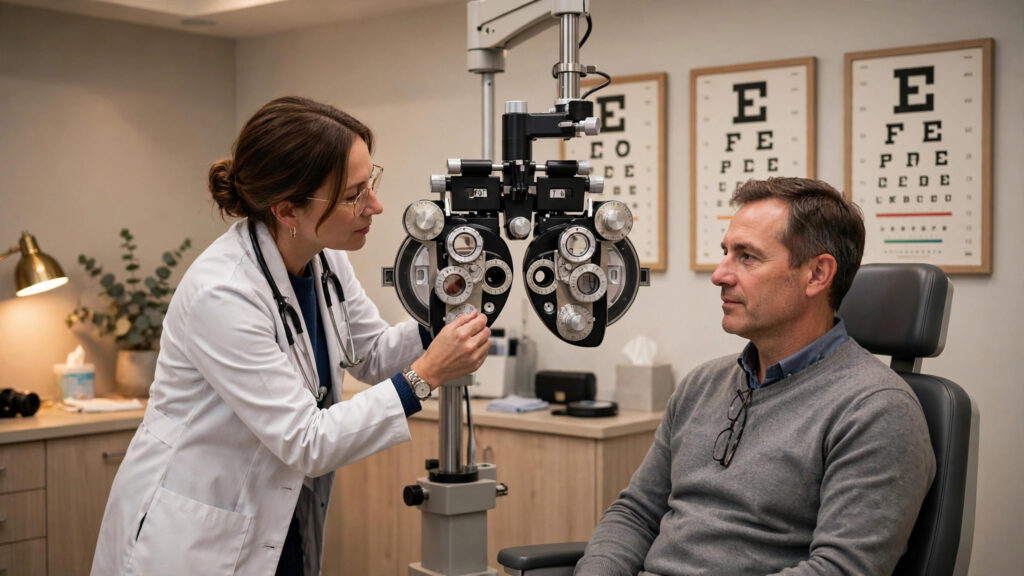
If you have never had a comprehensive eye exam, or if it has been years, you might wonder what actually happens during one. Is it painful? How long does it take? What are all those machines for? This step-by-step guide explains what happens during an eye exam so you can walk in confident and get the most from your visit.
We will walk through each stage in order, from the initial questions to the final prescription, explain what the common tests measure, and share tips for preparing. A comprehensive exam is one of the highest-value health appointments you can make.
Table of Contents
- Before the Exam: Preparation
- Step 1: History and Symptoms
- Step 2: Visual Acuity Testing
- Step 3: Refraction — Finding Your Prescription
- Step 4: Eye Health Evaluation
- Step 5: Dilation and Retinal Examination
- Step 6: Results and Next Steps
Before the Exam: Preparation
Preparing for your eye exam takes only a few minutes and improves the visit. Bring your current glasses and contact lenses, including the packaging or prescription details if you have them. List any vision symptoms you have noticed, when they occur, and how long they have persisted. Note your medications, since many drugs affect vision or eye health.
Gather your family eye health history, particularly glaucoma, macular degeneration, and retinal problems, which have hereditary components. Bring your vision insurance information and a list of questions you want answered. If you wear contacts, ask the office whether to wear them to the appointment or bring them along; some doctors prefer examining you without lenses in.
Arrange your schedule assuming possible dilation, which blurs near vision and increases light sensitivity for several hours. Bring sunglasses and consider having someone drive you if you are sensitive to bright light. Most exams take 45 to 60 minutes for new patients. Understanding why regular exams matter for eye health can motivate keeping the appointment you might otherwise postpone.
Step 1: History and Symptoms
What happens during an eye exam begins with conversation. The doctor or technician asks about your vision concerns, general health, medications, family history, and lifestyle factors like screen time, outdoor activities, and occupational visual demands. This history guides which tests receive emphasis.
Be specific and honest. Mention headaches, eye strain, night driving difficulty, dryness, flashes, floaters, and any vision changes, even subtle ones. Describe your daily visual tasks: hours of computer work, reading habits, sports, and driving patterns all influence the ideal correction.
This is also your chance to state your goals. Want contact lenses? Interested in laser surgery someday? Concerned about a family history of glaucoma? Voicing these upfront lets the doctor tailor the exam and the discussion to your needs rather than delivering a generic assessment.
Step 2: Visual Acuity Testing
The familiar eye chart test measures visual acuity: how clearly you see at distance. You will read progressively smaller letters with each eye separately and then together, first without correction and then with your current glasses if you wear them. Results are expressed as fractions like 20/20, where the top number is your viewing distance and the bottom is the distance at which a normal eye reads the same line.
Additional tests assess near vision with a handheld card, color vision with patterned plates, and depth perception with 3D images. Peripheral vision may be screened with a confrontation test, where you indicate when you see the doctor’s moving fingers at the edges of your vision, or with automated visual field testing for more detailed mapping.
Eye muscle and alignment tests check how your eyes work together. The cover test reveals strabismus or phorias, and smooth pursuit testing evaluates tracking. These binocular vision assessments catch problems that affect reading comfort and depth perception even when each eye sees clearly alone.
Step 3: Refraction — Finding Your Prescription
Refraction determines your exact lens prescription and is the part most people picture when they think about eye exams. The phoropter, the large mask-like device full of lenses, is placed before your eyes while you view the chart. The doctor flips between lens options asking “which is clearer, one or two,” progressively refining sphere, cylinder, and axis.
Many offices start with autorefraction, where an automated instrument estimates your prescription in seconds by analyzing light reflected from your retina. This gives the doctor a precise starting point, making the subjective refinement faster and more accurate. Retinoscopy, the manual version using a handheld light, serves the same purpose for children and patients who cannot respond reliably.
The refraction result becomes your glasses or contact lens prescription. If you are interested in new glasses, this prescription is what the optical shop uses to make your lenses. Accuracy here determines everything about your visual outcome, so take your time with the choices and speak up if options seem unclear.
Step 4: Eye Health Evaluation
What happens during an eye exam goes far beyond vision testing; the eye health evaluation is arguably the most important part. The slit lamp, a specialized microscope, lets the doctor examine your eyelids, cornea, iris, and lens in magnified detail, checking for dry eye, cataracts, infections, and corneal problems.
Tonometry measures intraocular pressure, the key screening metric for glaucoma. The common methods are the air-puff test and applanation tonometry, where a small probe gently touches the numbed cornea. Neither is painful, and both take seconds. Elevated pressure does not diagnose glaucoma alone but flags the need for further testing.
Modern exams often include retinal imaging, where a camera photographs the back of your eye, creating a baseline record for tracking changes over years. Optical coherence tomography (OCT) provides cross-sectional views of the retina and optic nerve, detecting glaucoma and macular degeneration earlier than ever. These technologies have revolutionized preventive eye health care. The National Eye Institute describes what comprehensive exams include and why each component matters.
Step 5: Dilation and Retinal Examination
Dilation involves eye drops that widen your pupils, giving the doctor a panoramic view of the retina, optic nerve, and retinal blood vessels. This is how early signs of diabetic retinopathy, macular degeneration, retinal tears, and even systemic conditions like hypertension are detected. The drops sting briefly, take 15 to 30 minutes to work, and wear off over four to six hours.
With dilated pupils, the doctor examines the retina using a bright light and magnifying lens, sometimes with a special contact lens placed on the numbed eye. They look for tears, detachments, abnormal blood vessels, optic nerve changes, and macular abnormalities. This examination catches problems years before symptoms appear.
The temporary side effects, blurry near vision and light sensitivity, are why you brought sunglasses. They resolve completely as the drops wear off. Some patients worry about dilation, but it is brief, safe, and among the most valuable preventive steps in all of medicine. Retinal imaging does not replace dilation; the two complement each other.
Step 6: Results and Next Steps
The exam concludes with a discussion of findings. The doctor explains your prescription, any eye health issues discovered, and recommended actions. You will receive your glasses prescription, which by law is yours to fill anywhere, and a separate contact lens prescription only after a dedicated contact lens fitting if you want contacts.
If everything is healthy, the doctor recommends your next exam interval based on age and risk factors. If issues were found, you will discuss treatment options, referrals to specialists, or monitoring plans. Ask questions until you understand your situation; good doctors welcome engaged patients.
Leave with a clear plan: updated correction ordered, follow-up scheduled, and any prescribed treatments understood. For families, our guide to children’s eye exams covers the pediatric version of this process. A comprehensive eye exam is quick, painless, and profoundly informative; if you are overdue, this is your sign to book one.