
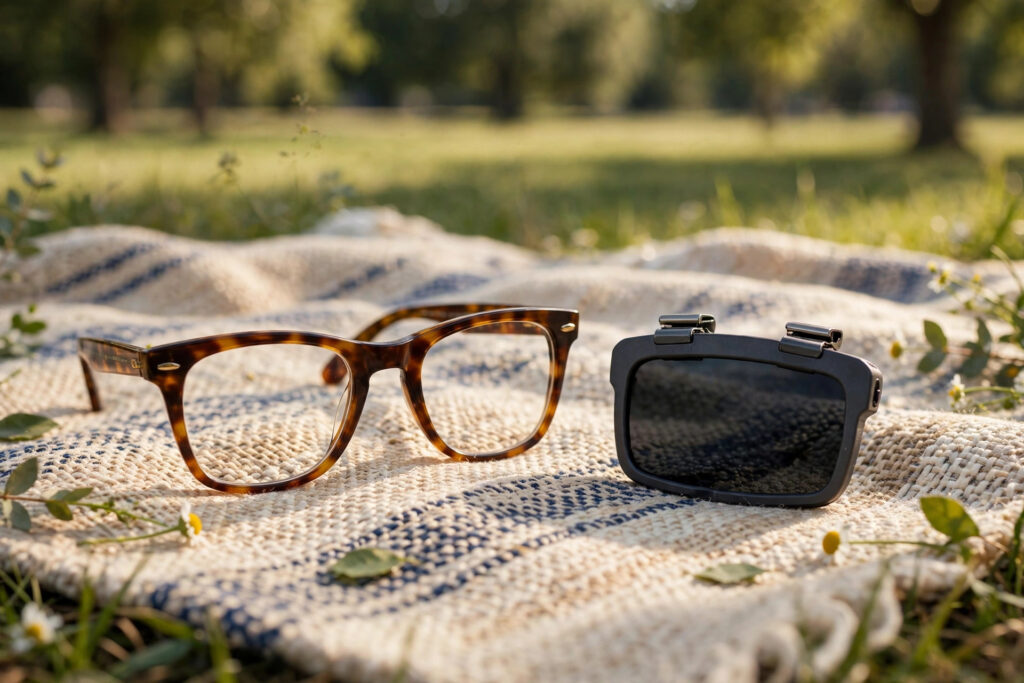
Glasses wearers face a sunny-day dilemma: invest in dedicated prescription sunglasses, or clip shades onto your regular frames? The prescription sunglasses vs clip-ons decision involves optics, convenience, cost, and style — and the right answer depends on how you live.
Both options have loyal fans and legitimate drawbacks. Here’s the honest comparison to help you choose — or decide you need both.
Table of Contents
- Prescription Sunglasses: The Case For
- Prescription Sunglasses: The Drawbacks
- Clip-Ons: The Case For
- Clip-Ons: The Drawbacks
- Optical Quality Compared
- Which Should You Choose?
Prescription Sunglasses: The Case For
Dedicated prescription sunglasses deliver the best experience: full vision correction in a purpose-built sun frame, with your choice of lens materials, tints, polarization, and coatings. No compromises on optics, no extra layer between you and the world — just clear, protected, comfortable vision. The American Optometric Association advises keeping prescriptions current for any corrective sun eyewear.
They also open the style door: your sun pair can be a completely different look from your everyday eyeglasses — bolder, sportier, more fashion-forward. For people who spend serious time outdoors, prescription sunglasses aren’t a luxury; they’re the correct tool, with optics engineered as a single integrated system using the best available lens technology.
Prescription Sunglasses: The Drawbacks
Cost is the obvious one: a quality pair with polarization runs $150-400+, and prescriptions change, potentially dating the investment. You also carry two pairs everywhere — forgetting the sun pair on a bright day means squinting or going without correction.
Transitions between environments require a swap, which is mildly annoying for people constantly moving indoors and outdoors. And if your prescription is complex (strong powers, prism, specialized progressives), the sun pair adds meaningful expense each time it updates. These are practical frictions, not dealbreakers — but they’re real.
Clip-Ons: The Case For
Clip-ons win on economics and convenience: $20-60 for polarized shades that attach to the glasses you already own, with zero prescription concerns when your correction changes — the clips transfer to your next frames (if the shape still fits). One pair of glasses, instant sun mode.
Modern clip-ons have improved enormously: custom-shaped options matched to popular frame models, magnetic systems that attach seamlessly, and polarized lenses with real optical quality. For occasional sun use — the drive home, a lunch outing — they’re brilliantly practical. Flip-up versions add on-demand flexibility that even dedicated sunglasses can’t match.
Clip-Ons: The Drawbacks
Optics suffer from the two-layer system: light passes through both the clip lens and your glasses lens, and any gap, reflection, or misalignment between layers degrades clarity. Cheap clips introduce distortion; even good ones can’t match a single integrated prescription sun lens. Reflections between the layers can cause ghosting in certain light.
Aesthetics are the other compromise — clips visibly sit atop your frames, and the look ranges from “clever” to “grandpa” depending on the design and your frames. Fit-over sunglasses (which enclose the whole frame) solve the attachment issue but add bulk. For all-day outdoor wear, the layered system also traps heat and can fog more readily.
Optical Quality Compared
Head-to-head, prescription sunglasses win on pure optics: single-lens clarity, precise optical centering, full polarization integration, and proper base curves for the frame. Clip-ons are optically adequate for casual use but measurably inferior for extended wear — the difference shows up as subtle haze, reduced contrast, or eye fatigue on long bright days.
The gap narrows with quality: premium custom clip-ons with polarized polycarbonate lenses perform respectably. But physics favors the integrated lens — fewer surfaces, fewer reflections, better alignment. If you drive for hours or spend full days outdoors, the optical difference is worth feeling in person before deciding.
There’s also a middle path gaining popularity: magnetic clip-on systems designed for specific frame models. These attach nearly invisibly, with custom-shaped sun lenses that match the frame’s exact geometry. They cost more than generic clips but deliver a far more integrated look and better optical alignment.
Fit-over sunglasses deserve mention too. These larger shades enclose your entire glasses frame, offering wraparound-style protection without clips. They’re bulkier but excellent for sensitive eyes, post-surgery protection, or anyone wanting maximum coverage on a budget.
Which Should You Choose?
Choose prescription sunglasses if: you’re outdoors for hours regularly, you drive extensively, you value the best optics, or you want a distinct style. The investment pays off in comfort and clarity for heavy users. Discuss lens options during your regular eye exams — your provider can match tint and polarization to your activities.
Choose clip-ons if: sun exposure is occasional and brief, budget is tight, your prescription changes frequently (looking at you, kids vision patients), or you want a backup for your car and bag. Many people sensibly own both: prescription sunglasses for serious outdoor days, clip-ons as the always-there backup. And contact lens wearers, of course, sidestep the whole debate with non-prescription shades — one more point in the contacts column for the outdoorsy.