
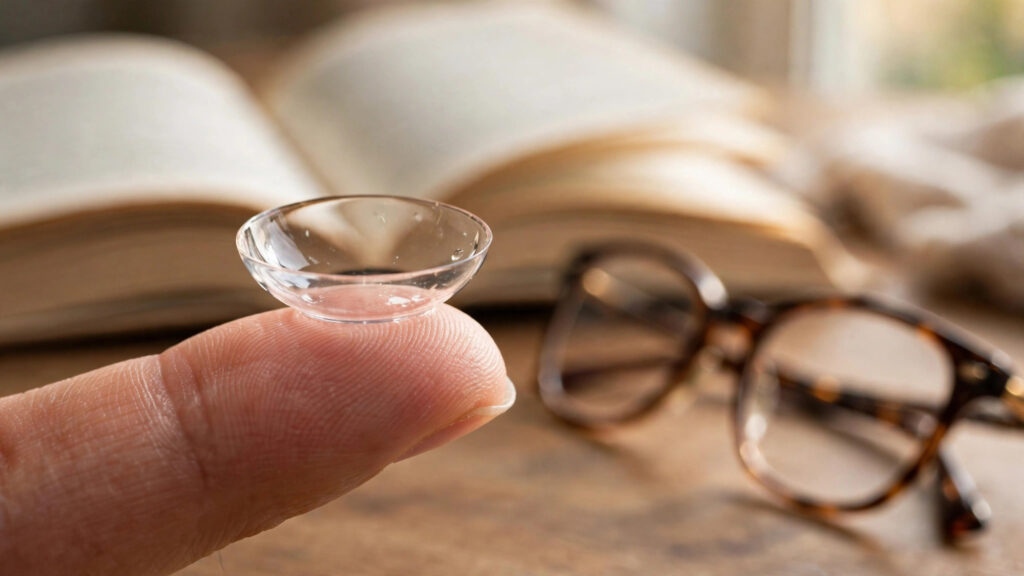
Presbyopia forces a choice: reading glasses, bifocals, or… multifocal contact lenses that handle distance and near vision simultaneously, with no glasses at all. Modern multifocal contacts are dramatically better than early generations, and they’ve freed millions of over-40 wearers from the readers-on-a-chain lifestyle.
Here’s how multifocal contact lenses work, the designs available, what adaptation really feels like, and how to decide if they’re right for you.
Table of Contents
- How Multifocal Contacts Work
- Design Types: Concentric and Aspheric
- Multifocal vs Monovision
- Adaptation: What to Expect
- Who Is a Good Candidate?
- Costs and Practical Tips
How Multifocal Contacts Work
Unlike bifocal glasses (look up for distance, down for near), multifocal contacts use “simultaneous vision”: distance and near powers coexist across the lens, and your visual system learns to select the right focus. It sounds impossible, but the brain is remarkably good at this — within days to weeks, most wearers stop noticing the transition entirely.
The trade-off for this convenience is a small compromise in contrast: because both images reach the retina simultaneously, neither is quite as crisp as a dedicated single-vision correction. Modern designs minimize this beautifully, but it’s why multifocal contacts rarely match the razor sharpness of glasses at any single distance. For most wearers, the lifestyle freedom outweighs the subtle optical compromise.
Design Types: Concentric and Aspheric
Concentric (ring) designs alternate distance and near powers in rings — like a bullseye. Your pupil size determines which rings dominate: in bright light (small pupil), the center zone rules; in dim light, outer rings contribute. Center-distance designs suit most wearers; center-near designs help those prioritizing close work.
Aspheric (progressive-like) designs blend powers gradually from center to edge, similar to progressive glasses. They tend to feel more natural with smoother transitions but can be fussier about centration. Both designs come in daily and monthly modalities from major manufacturers, and advances in lens design software have steadily improved real-world performance — today’s multifocals bear little resemblance to the compromised early versions.
Multifocal vs Monovision
The main alternative is monovision: one eye corrected for distance, the other for near. It’s simple, cheap (standard single-vision lenses), and works well for many — but it sacrifices true binocular vision, reducing depth perception and low-light performance. Night driving in monovision is notably worse, which matters for safety.
Multifocals preserve binocular vision at all distances — both eyes work together — which most wearers prefer once adapted. However, monovision has a higher immediate success rate (less adaptation needed) and costs less. Some fitters trial monovision first as a quick test of presbyopic contact tolerance. There’s also “modified monovision” — a multifocal in one eye, single vision in the other — blending both approaches for tricky prescriptions.
Adaptation: What to Expect
Adaptation takes days to weeks — longer than single-vision contacts, shorter than progressive glasses. Early on, expect: slightly soft distance vision (especially at night), halos around lights, and a learning curve for near tasks. These typically resolve as your visual system adapts. Good lighting helps enormously during adaptation; dim restaurants are the hardest test.
Keys to success: wear them consistently (sporadic wear resets adaptation), give it a full two weeks before judging, and communicate honestly with your fitter — small power tweaks often transform the experience. About 70–80% of properly fitted wearers succeed with multifocals; the rest usually do better with monovision or glasses-based solutions. There’s no failure in finding your right answer.
Who Is a Good Candidate?
Best candidates: emerging presbyopes (early 40s, low ADD powers — adaptation is easiest), motivated wearers willing to invest two weeks in adaptation, people with healthy eyes and realistic expectations, and those whose lifestyles demand glasses-free convenience (sports, professions, aesthetics). A current prescription and healthy tear film are prerequisites.
Challenging cases: very high ADD powers (+2.50 and above), significant astigmatism (toric multifocals exist but are fussier), perfectionists who can’t tolerate any visual compromise, and people doing precision near work (surgeons, jewelers) where maximum clarity matters. Your fitter’s assessment — including a trial period — is the definitive test, not any article’s checklist.
Costs and Practical Tips
Multifocal contacts cost more than single-vision lenses — typically 50–100% more — and fitting fees are higher due to the trial-and-adjust process. Dailies offer the healthiest, simplest option; monthlies cost less per day for full-time wear. Manufacturer rebates frequently soften the price; ask your fitter.
Practical tips: keep backup glasses (every lens wearer needs them), use good lighting for near tasks during adaptation, be patient with night driving (it improves), and maintain your fitting appointments — multifocal success often comes from the second or third power refinement, not the first. The All About Vision contacts section has brand-specific comparisons when you’re ready to explore options with your doctor.
Finally, set expectations with your household: adaptation affects evening activities most, so plan the trial during a normal routine rather than before a big trip or event. Most wearers who push through the first two weeks wonder why they waited so long — glasses-free reading, driving, and everything between is worth the patience.