
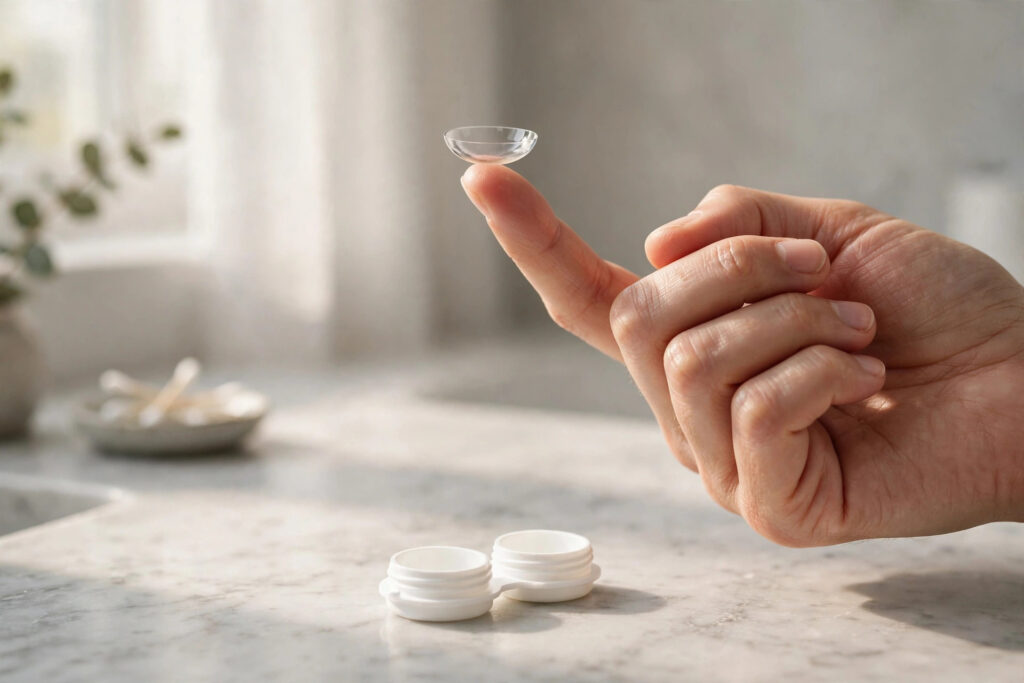
Rigid gas permeable (RGP) lenses are the survivors of the contact lens world — largely replaced by soft lenses for convenience, yet still prescribed because they do certain things better than any soft lens can. They offer the sharpest vision correction available in a contact lens, last far longer, and solve problems soft lenses can’t touch.
But they demand patience and commitment. Here are the honest pros and cons of RGP lenses, who they’re best for, and what to expect from the fitting process.
Table of Contents
- What RGP Lenses Are
- The Pros: Sharp Vision and Durability
- The Cons: Comfort and Adaptation
- Who Benefits Most
- Fitting and Adaptation Period
- Costs and Longevity
What RGP Lenses Are
RGP lenses are small, rigid plastic lenses — about a third the diameter of soft lenses — that float on your tear film rather than draping over the cornea. “Gas permeable” means oxygen passes through the material to the cornea, a major advance over the old PMMA hard lenses that blocked oxygen entirely. Modern RGP materials offer excellent oxygen transmissibility, making them healthy for regular wear.
Because they’re rigid, RGP lenses maintain their shape on the eye, creating a smooth new refractive surface over the cornea. This is their superpower: they mask corneal irregularities that soft lenses — which conform to the cornea’s shape — cannot correct. A comprehensive eye exam with corneal topography determines whether your eyes are candidates.
The Pros: Sharp Vision and Durability
Vision quality is the headline advantage. RGP lenses typically deliver crisper, more stable vision than soft lenses — especially for astigmatism, where the rigid surface neutralizes irregular curvature completely. Many wearers report their RGP vision rivals or exceeds their glasses, with excellent night vision and minimal halos.
Durability is the second win: a single pair of RGP lenses lasts 1–2 years (sometimes longer) with proper care, versus boxes of disposables. They’re resistant to protein deposits, less prone to tearing, and cheaper long-term despite higher upfront cost. They also don’t dehydrate like soft lenses, making them excellent for dry environments — and their small size means less lens-to-eye contact overall, which benefits long-term corneal health.
The Cons: Comfort and Adaptation
Comfort is the honest downside. RGP lenses are noticeably less comfortable than soft lenses initially — you feel them, especially when blinking, and dust under the lens is more irritating because the rigid edge doesn’t seal like a soft lens. Adaptation takes one to three weeks of gradually increasing wear time, and some people never fully adjust.
They’re also less forgiving of an imperfect fit and can dislodge more easily during sports or vigorous activity (though they rarely “pop out” once adapted). If a lens does come out, the small size makes it harder to find than a soft lens. And while vision is superb when centered, a decentered RGP lens blurs significantly until it recenters — soft lenses are more forgiving of minor movement.
Who Benefits Most
RGP lenses shine for specific wearers: people with keratoconus or other corneal irregularities (often the only non-surgical option for good vision), high astigmatism that soft torics can’t fully correct, those seeking the absolute sharpest vision, dry-eye sufferers who can’t tolerate soft lens dehydration, and anyone wanting the most economical long-term lens option.
They’re also the foundation of orthokeratology — specially designed RGP lenses worn overnight to temporarily reshape the cornea, providing glasses-free daytime vision and slowing myopia progression in children. For young myopes, ortho-k is one of the most exciting applications of rigid lens technology, and parents exploring myopia control should discuss it alongside the glasses-based options with their eye doctor.
Fitting and Adaptation Period
RGP fitting is a craft requiring corneal topography, trial lenses, and fluorescein evaluation of the tear film pattern under the lens. Expect multiple visits: initial fitting, a one-week check, and periodic evaluations. A skilled fitter is non-negotiable — RGP success depends more on fitting expertise than any other lens type.
Adaptation requires commitment: start with a few hours daily, increasing gradually. Wear them consistently — sporadic wear resets adaptation. Most wearers turn the corner within two weeks, transitioning from awareness to forgetting the lenses entirely. Don’t judge RGP lenses on day one; judge them at week three. Your fitter will guide the schedule and troubleshoot issues like edge awareness or variable vision.
Costs and Longevity
RGP lenses cost more per lens than soft lenses — but each pair lasts 1–2 years, making the annualized cost highly competitive, often cheaper than premium soft lens regimens. Fitting fees are higher due to the expertise and visits involved. Replacement is infrequent unless the prescription changes or a lens is lost/damaged.
Care is straightforward: daily cleaning with RGP-specific solutions (not soft-lens multipurpose in most cases), proper storage, and regular replacement of cases. The AAO’s eye health resources cover safe handling across lens types. For the right wearer, RGP lenses remain unmatched — decades-old technology that still outperforms modern soft lenses where it counts most: the clarity of your vision.