
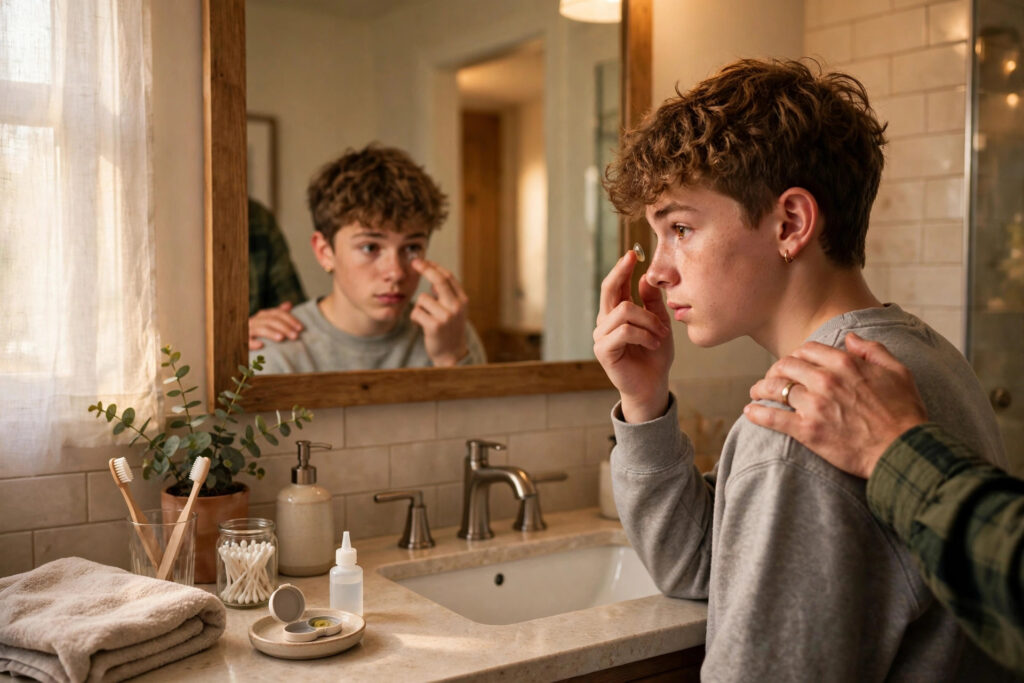
“Can I get contacts?” is a question most parents of teens hear eventually — driven by sports, self-consciousness about glasses, or simple curiosity. As a parent, you want to say yes confidently, but you also worry: are they responsible enough? Will they follow hygiene rules? What’s the right age?
This guide answers those questions honestly: readiness signs that matter more than age, safety non-negotiables, costs, and how to set your teen up for successful, safe contact lens wear.
Table of Contents
- What Age Is Appropriate?
- Readiness Signs That Matter
- Benefits for Teenagers
- Safety Rules for Teen Wearers
- Costs and Practical Considerations
- Supporting Your Teen
What Age Is Appropriate?
There’s no magic age — eye doctors routinely fit responsible 11- and 12-year-olds, while some 16-year-olds aren’t ready. Research shows that children as young as 8 can wear contacts safely with proper supervision, and teens’ complication rates are comparable to adults’ when they follow instructions. Maturity and motivation matter far more than the birthday.
The eye doctor is the final arbiter: a good fitter assesses not just the eyes but the teen’s ability to handle insertion, removal, and hygiene during the fitting appointment. If the doctor has concerns, they’ll say so — and “not yet” is a perfectly fine answer. A comprehensive eye exam including contact lens fitting is the required starting point regardless of age.
Readiness Signs That Matter
Look for: personal motivation (they want contacts for themselves, not because friends have them), demonstrated responsibility (handles chores, homework, and routines without constant reminders), good hygiene habits generally, comfort touching their eyes (squeamishness can be overcome, but extreme aversion is a red flag), and willingness to follow rules even when inconvenient.
Warning signs: chronic forgetfulness, resistance to routines, poor hygiene, or wanting contacts purely as a fashion statement without understanding the commitment. Be honest about your teen — starting contacts before they’re ready leads to abandoned lenses (wasted money) or worse, infections from poor compliance. Our kids’ vision resources cover the broader picture of children’s eye care milestones.
Benefits for Teenagers
The benefits are real and go beyond vanity. Sports are the biggest: contacts don’t shatter, fog, bounce, or limit peripheral vision — transformative for basketball, soccer, swimming (with goggles), and martial arts. Self-confidence matters too; teens who feel better about their appearance often engage more socially and academically.
There’s also a medical angle: for progressive myopia, certain contact lens designs (orthokeratology and multifocal soft lenses) can slow myopia progression — a genuine eye health benefit worth discussing with your doctor if your teen’s prescription worsens yearly. Contacts aren’t just cosmetic for teens; they’re a legitimate vision tool with developmental benefits.
Safety Rules for Teen Wearers
Establish non-negotiables before the first pair: wash hands before handling lenses, never sleep in lenses (unless specifically prescribed), never swim or shower in lenses, replace on schedule (no stretching monthlies), never share lenses, use only fresh solution, and remove lenses immediately if eyes hurt or turn red. Write them down. Post them in the bathroom.
Daily disposables are the safest choice for teens: no cleaning, no cases, fresh sterile lens daily — they eliminate the most common compliance failures. They’re more expensive per lens but often cheaper than treating an infection, and many parents find the safety premium worth it. The AAO’s eye health resources reinforce these safety fundamentals for families.
Costs and Practical Considerations
Budget for: fitting fees (higher than a standard exam, often $100–200+), the lenses themselves (dailies cost more annually than monthlies), solutions and cases (for reusable lenses), and backup glasses (non-negotiable — every lens wearer needs them). Annual teen lens costs typically exceed glasses, but many families find the value obvious.
Check your vision insurance — many plans include a contact lens allowance. Manufacturer rebates help. And frame it as a responsibility contract: you’ll fund the lenses as long as they follow the safety rules and replacement schedule. Teens who have skin in the game (chores, partial payment) tend to take better care of their lenses.
Supporting Your Teen
Your role: supervise without hovering. Check in on compliance casually in the first months, keep backup glasses accessible (not buried in a drawer), ensure solution is always stocked (running out causes dangerous improvisation), and model calm problem-solving when issues arise — a lost lens or irritated eye shouldn’t become a crisis.
Watch for red flags: frequently red eyes, complaints of discomfort, lenses “lasting” suspiciously long (a sign of overwearing), or reluctance to remove lenses at night. Address issues early and without shaming — the goal is a teen who tells you about problems, not one who hides them. With proper fitting, daily disposables, and clear rules, teen contact lens wear is safe, successful, and often genuinely life-improving.
One last piece of advice: revisit the conversation yearly. Responsibility grows, prescriptions change, and a teen who needed supervision at 13 may be fully independent at 16. Annual check-ins — paired with their regular eye exams — keep the safety habits fresh and give you both confidence that the privilege is being handled well.