
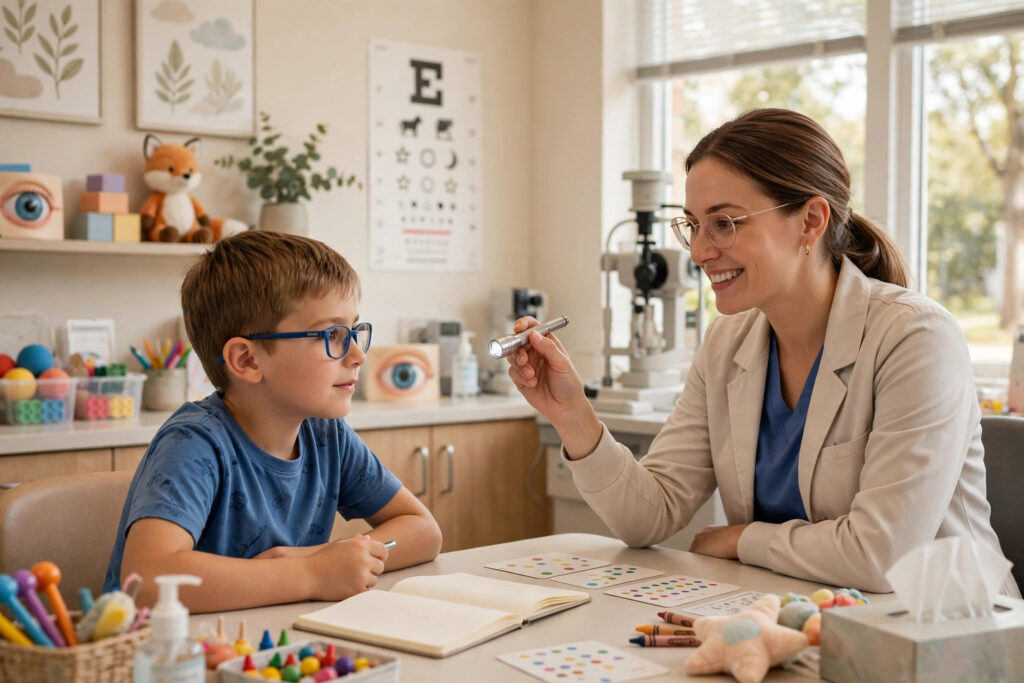
Amblyopia — commonly called lazy eye — is the leading cause of vision loss in children, affecting 2-3% of kids. It happens when the brain favors one eye over the other during visual development, causing the weaker eye’s vision to deteriorate. The encouraging news: when caught early, lazy eye is highly treatable.
This guide explains what causes lazy eye, how patching and other treatments work, what the evidence shows about timing, and what parents can expect during treatment.
Table of Contents
- What Lazy Eye Is
- Causes and Risk Factors
- Why Early Treatment Matters
- Patching: How It Works
- Atropine Drops: The Alternative
- Glasses and Vision Therapy
- What Parents Can Expect
What Lazy Eye Is
Amblyopia is not a problem with the eye itself — it is a developmental problem in the brain’s visual processing. When the two eyes send mismatched images during early childhood (because one is blurrier, misaligned, or blocked), the brain suppresses the weaker eye’s input to avoid double vision. Over time, the neural pathways for that eye fail to develop normally, and its vision declines.
Crucially, the weaker eye often looks perfectly normal from the outside. There may be no visible sign at all — which is why lazy eye is frequently discovered only at a vision screening or comprehensive eye exam. A child with amblyopia typically functions fine using the stronger eye and has no idea anything is wrong.
There are three main types: strabismic amblyopia (from misaligned eyes), refractive amblyopia (from unequal prescriptions between eyes, or high uncorrected prescription in both), and deprivation amblyopia (from something blocking vision, like a congenital cataract or droopy eyelid). Each requires treating the underlying cause plus retraining the brain.
Causes and Risk Factors
Strabismus (eye misalignment) is the most visible cause — when eyes point in different directions, the brain ignores one image. Refractive causes are sneakier: anisometropia (significantly different prescriptions between eyes) means one eye always sees a blurrier image, and the brain gradually disregards it. High farsightedness or astigmatism in both eyes can cause bilateral amblyopia.
Risk factors include family history of lazy eye or strabismus, premature birth, low birth weight, developmental delays, and childhood cataracts or ptosis (droopy eyelid). Children with these risk factors need earlier and more frequent eye examinations — ideally starting in infancy.
Because amblyopia develops silently, screening is essential. The National Eye Institute recommends vision screening for all children, noting that amblyopia detected before age 5 responds best to treatment.
Why Early Treatment Matters
The visual system has a critical period of plasticity — roughly birth to age 7-8 — during which the brain’s visual pathways are still malleable. Treatment during this window can often restore vision in the weaker eye to normal or near-normal. After the critical period closes, improvement becomes much harder, though recent research shows some plasticity persists into the teens and even adulthood.
The landmark Amblyopia Treatment Studies (ATS) by the Pediatric Eye Disease Investigator Group established that treatment works best before age 7, remains effective through the early teens for many children, and that less intensive treatment often works as well as aggressive regimens — findings that made therapy far more tolerable for families.
The stakes of untreated amblyopia are real: permanently reduced vision in one eye, impaired depth perception, and vulnerability — if the good eye is ever injured or diseased later in life, there is no strong backup. Early treatment is one of the clearest wins in all of preventive eye care.
Patching: How It Works
Patching — covering the stronger eye with an adhesive patch for prescribed hours daily — forces the brain to use the weaker eye, stimulating its neural pathways to develop. It remains the most common and best-studied amblyopia treatment, with decades of evidence behind it.
Modern patching is less grueling than its reputation. The ATS trials showed that 2 hours of daily patching works as well as 6 hours for moderate amblyopia — a finding that transformed compliance. Treatment duration averages 3-6 months for significant improvement, with some children needing longer. Patches are worn during waking hours, ideally during visually engaging activities like reading, drawing, or crafts.
Compliance is the make-or-break factor, and it is genuinely hard with toddlers who peel patches off. Strategies: patch during favorite activities, use reward charts, try different patch brands (some are gentler on skin), and consider patching during school hours for older children so it does not consume home time. Decorated patches and “pirate” framing help young children accept the routine.
Atropine Drops: The Alternative
Atropine penalization uses daily drops in the stronger eye to blur its near vision, achieving the same goal as patching — forcing use of the weaker eye — without a visible patch. The ATS trials found atropine (typically weekend-only dosing for moderate amblyopia) essentially as effective as patching for moderate cases.
Atropine suits children who will not tolerate patches, school-age kids who face teasing, and families for whom patch logistics are unworkable. Side effects include light sensitivity (the treated pupil dilates — sunglasses help outdoors) and occasional mild irritation. Because it blurs near vision in the good eye, atropine is less ideal when the weaker eye’s deficit is severe.
Some children do better with a combination or sequential approach — patching on some days, atropine on others — tailored by the treating doctor. The choice between patching and atropine often comes down to the child’s age, severity, and family practicalities rather than one being universally superior.
Glasses and Vision Therapy
Corrective glasses are the mandatory first step for refractive amblyopia — and sometimes the only treatment needed. A significant proportion of children improve substantially with glasses alone as the brain receives clear images from both eyes for the first time. Doctors typically allow 12-16 weeks of full-time glasses wear before adding patching or atropine, since “refractive adaptation” alone resolves many mild cases.
Underlying causes must be addressed: strabismus may need glasses, prism, or surgery to align the eyes; congenital cataracts require prompt surgical removal (within weeks of birth for dense cataracts) followed by amblyopia therapy; ptosis blocking the pupil may need surgical correction.
Vision therapy — supervised eye exercises — and newer digital therapeutics (dichoptic games and videos that train both eyes together) are active research areas. Early results for binocular digital treatments are promising, particularly for older children past the traditional critical period, but they remain supplements to, not replacements for, standard therapy. Discuss options with a pediatric eye specialist.
What Parents Can Expect
Treatment begins with a comprehensive exam including cycloplegic refraction (dilating drops that fully relax focusing) to get accurate measurements. Glasses are prescribed first if needed; patching or atropine follows after the adaptation period. Follow-up visits every 6-12 weeks monitor progress and adjust the regimen.
Improvement is usually gradual — measurable gains over weeks to months, not days. Do not stop treatment when vision seems “good enough”; premature stopping risks regression. Your doctor will define the endpoint: typically equal or near-equal acuity maintained over several visits, followed by a weaning period and long-term monitoring for recurrence (which happens in about 25% of cases, usually within the first year off treatment).
Support your child emotionally: amblyopia treatment coincides with ages when peer awareness is acute. Normalize the patch or glasses, coordinate with teachers (seating, understanding), and celebrate milestones. The American Academy of Ophthalmology emphasizes that with early detection and consistent treatment, most children with lazy eye achieve excellent long-term vision — a profoundly reassuring prognosis for worried parents.