
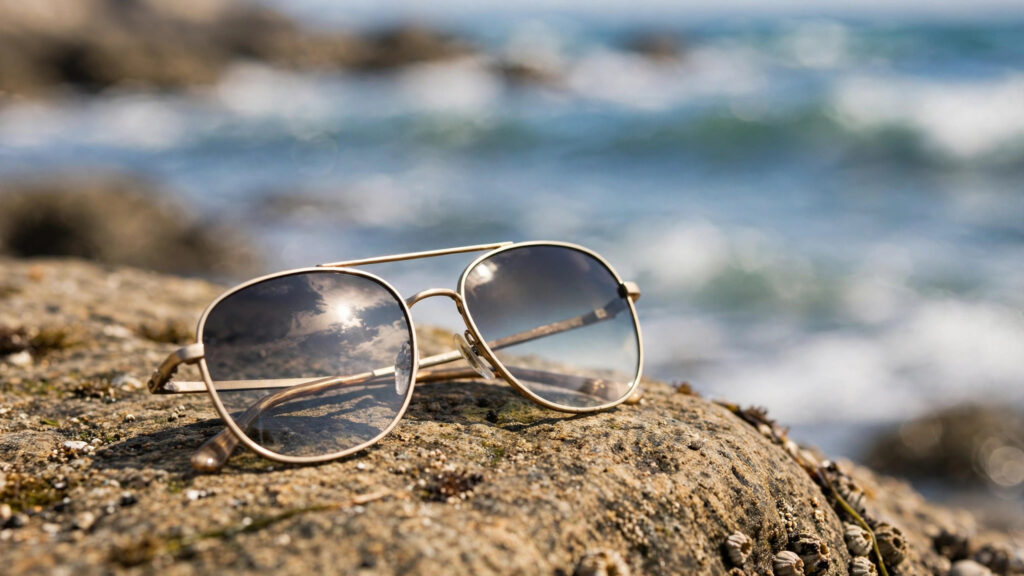
Dark on top, clear on the bottom — the gradient tint is one of eyewear’s most versatile and enduring lens treatments. Part fashion statement, part functional design, gradient tints serve drivers, fashion lovers, and anyone who moves between bright and shaded conditions.
This complete guide explains how gradient tints are made, their practical advantages, the densities and styles available, and how to choose the right gradient.
Table of Contents
- How Gradient Tints Are Made
- Functional Benefits
- Gradient Tints for Driving
- Fashion and Style
- Densities and Color Options
- Limitations and Buying Tips
How Gradient Tints Are Made
Gradient tints are created by dipping the lens into tint dye at a controlled rate — the top spends the most time submerged (darkest), and the lens is gradually withdrawn so the bottom receives minimal dye (lightest). Modern computer-controlled dip processes produce smooth, consistent fades; premium manufacturers can create single, double (dark top and bottom, clear middle), and custom gradient profiles.
The gradient can be applied to nearly any lens material, including prescription lenses — making gradient tints one of the most accessible customizations in eyewear. The fade is permanent (it’s dye absorbed into the lens material, not a surface coating), so it won’t peel or wear off. Quality gradients show a smooth, even transition with no banding or blotchiness — inspect the fade in good light before accepting a pair. Gradient options pair well with many sunglass frame styles, from classic aviators to modern oversized fashion frames.
Functional Benefits
The gradient’s genius is situational adaptation: dark where the sun attacks (overhead and horizon), clear where you need to see detail (dashboard, phone, reading material, the ground at your feet). This makes gradients uniquely practical for transitional lighting — partly cloudy days, driving through alternating sun and shade, moving between indoors and outdoors.
Compared to solid tints, gradients reduce the “too dark indoors” problem: you can glance down through the clear portion to read your phone or navigate a dim restaurant without removing your sunglasses. For presbyopes, gradient tints on progressive lenses are particularly clever — the reading zone at the bottom stays clear while the distance zone up top stays shaded. The design also flatters faces: the fade draws attention upward and the lighter lower portion keeps the eyes subtly visible, which many wearers prefer over the hidden-eye look of dark solid tints.
Gradient Tints for Driving
Driving is the gradient tint’s signature use case. The dark upper portion cuts sky glare and sun glare through the windshield; the lighter lower portion keeps the dashboard, mirrors, and instruments clearly visible. This matches the actual light distribution a driver faces — bright above, moderate below.
For driving-optimized gradients, gray and brown are the top color choices: gray preserves natural color perception (important for reading traffic signals), while brown enhances contrast and depth perception (popular with drivers in variable conditions). Polarized gradients exist and combine the best of both technologies — glare-cutting polarization with the situational versatility of the fade. Note that very dark gradients may be too dim for night driving — no tinted lens, gradient or otherwise, should be worn after dark. Dedicated driving glasses with clear or lightly-tinted lenses serve better at night.
Fashion and Style
Gradients have been a fashion mainstay for decades — from 1970s oversized glamour frames to today’s minimalist styles. The fade elongates the perceived lens shape, complements most face shapes, and offers a softer alternative to the boldness of solid dark lenses or mirrors.
Fashion gradients go beyond the functional dark-to-clear: fashion tints include pink, blue, purple, and amber fades chosen purely for aesthetics. Double gradients (dark top and bottom) create a distinctive retro look. When choosing fashion gradients, remember that heavy fashion tints still need 100% UV protection — tint darkness and UV blocking are independent properties, and a dark fashion tint without UV protection is worse than no sunglasses at all (dark lenses dilate pupils, admitting more UV).
Densities and Color Options
Gradient density is described by the darkness at the top: a “70% gradient” might go from 70% absorption at top to 10% at bottom. Common configurations: subtle gradients (light fade, mostly fashion) for everyday wear; medium gradients for driving and general outdoor use; dark gradients for bright conditions where the top approaches full sunglass darkness.
Color options: gray — neutral, true color perception, best all-rounder; brown/amber — contrast-enhancing, excellent for driving and variable light; green (G-15) — the classic Ray-Ban tint, natural color with good contrast; rose/pink — fashion-forward, can enhance contrast in flat light; blue/purple — primarily fashion. The base color affects your view far more than any mirror flash on top — choose the base for function, the mirror (if any) for style.
Limitations and Buying Tips
Gradients aren’t ideal everywhere: in uniformly bright conditions (open water, snow, beach), a solid dark tint protects better — the clear bottom of a gradient admits light exactly where reflected glare attacks from below. For extreme brightness, solid tints or mirrors outperform gradients functionally.
Buying tips: verify 100% UV protection regardless of tint style; check the fade is smooth and even; for prescription gradients, confirm the gradient orientation will align correctly in your chosen frame (the fade must run top-to-bottom as worn); consider polarization for driving gradients; and remember that gradient + progressive is a particularly smart combination for presbyopes. The lens tint guide at All About Vision covers the full tint spectrum. As with any sunglass purchase, the foundation is healthy eyes — keep up with regular comprehensive eye exams to protect the vision behind the tint.