
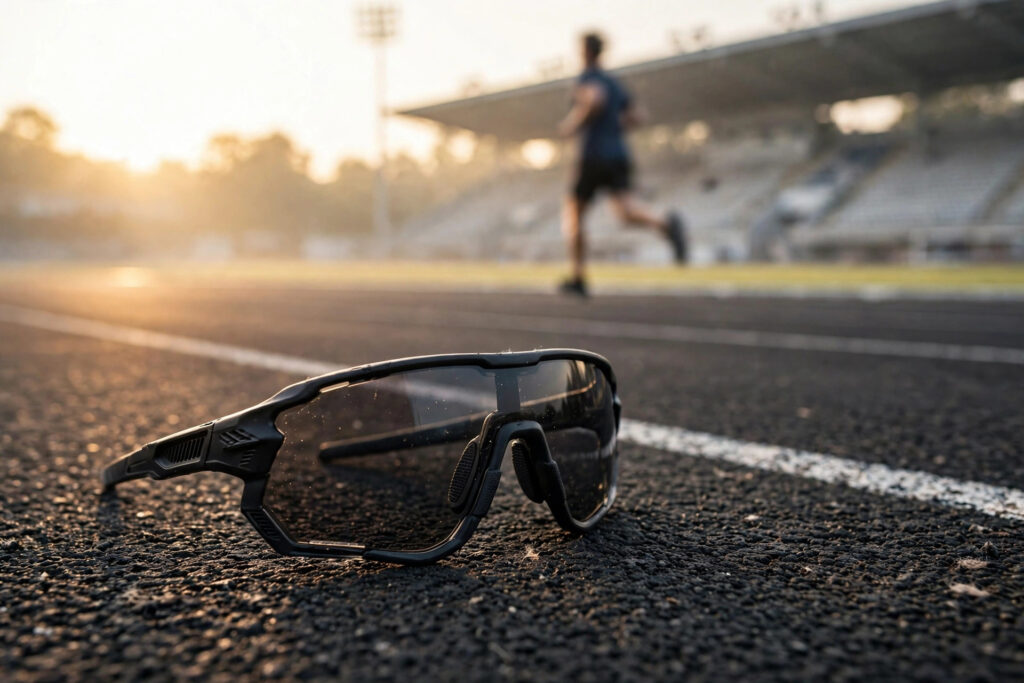
Regular sunglasses bounce, fog, and slide the moment your heart rate climbs. The best sunglasses for running and sports are engineered differently: grippy nose pads, wraparound coverage, ventilated lenses, and tints tuned for reading terrain at speed.
Whether you’re logging miles, cycling, or playing court sports, the right pair protects your eyes and actually improves performance. Here’s what separates sport optics from fashion shades, and how to choose.
Table of Contents
- Why Regular Sunglasses Fail Athletes
- Fit Features That Matter
- Lens Tints for Different Sports
- Polarized vs Non-Polarized for Sports
- Prescription Options for Athletes
- Care and Durability
Why Regular Sunglasses Fail Athletes
Motion exposes every weakness in a sunglass design. Standard frames slide with sweat, bounce with each stride, and fog when you stop moving. Their flat lenses leave the sides open to wind, dust, and peripheral UV — exactly what a runner or cyclist needs blocked most.
Sport sunglasses solve this with systems thinking: the frame, lens curvature, ventilation, and grip materials are designed as one unit. The result stays stable through sprints, keeps airflow moving to prevent fog, and shields the full eye area. All About Vision offers detailed guidance on choosing sport-specific protective eyewear. It’s the difference between eyewear that tolerates sport and eyewear built for it — a distinction grounded in real lens technology, not marketing.
Fit Features That Matter
Prioritize these fit features: hydrophilic rubber nose pads and temple grips that get grippier with sweat; a wraparound 8-base curve that hugs the face; adjustable nose pieces for a customized seal; and lightweight materials (under 30 grams is ideal) that disappear during long efforts. Ventilation cutouts or lens coatings prevent the fogging that blinds you at stoplights.
The fit test is dynamic: shake your head, jump, look down — the glasses shouldn’t budge. They should seal against wind without pressing on temples or cheekbones. And they must work with your other gear: helmet compatibility for cyclists, hat compatibility for runners. A pair that fights your helmet will live in a drawer.
Lens Tints for Different Sports
Tint choice is sport-specific. Runners do well with rose, copper, or brown tints that boost contrast on pavement and trails, making cracks and roots pop. Cyclists favor similar contrast enhancers for reading road surfaces at speed. Golfers need green or brown tints that preserve green-spectrum definition for reading greens.
Water sports demand gray or green-gray polarized lenses for true color and maximum glare cut. Snow sports need darker, often mirrored lenses — snow reflects up to 80% of UV. Many athletes now use interchangeable lens systems: one frame, multiple tints for changing conditions. It’s the most versatile setup for multi-sport people.
Polarized vs Non-Polarized for Sports
Polarized lenses eliminate blinding horizontal glare — transformative for water, snow, and road sports. But polarization isn’t universal: it can make it harder to read LCD screens (bike computers, boat instruments) and can mask the slick sheen of icy patches that skiers and winter runners need to see. Some athletes keep both options.
For most runners and general fitness, polarized is excellent. For technical activities where surface sheen carries information — downhill skiing, ice awareness, reading certain instruments — non-polarized contrast tints may be safer. Match the lens to the sport’s actual visual demands, not to a blanket rule.
Prescription Options for Athletes
Athletes who need vision correction have better options than ever: direct prescription sport lenses (available in surprisingly strong powers thanks to freeform surfacing), prescription inserts that clip behind a shield lens, and contact lenses paired with non-prescription sport shades. Each has trade-offs in optics, cost, and convenience.
Contact lens wearers should note that wind and dryness hit lenses hard during sport — wraparound shades double as wind protection for your contacts. Whatever route you choose, keep the prescription current with regular eye exams; athletic performance depends on sharp distance vision more than most people realize.
Night and low-light runners need a different solution: clear or yellow-tinted safety lenses that protect from wind, debris, and bugs without dimming vision. Many interchangeable-lens systems include a clear lens precisely for this. Never wear dark sunglasses after sunset — impaired night vision is a genuine safety hazard.
Consider a dedicated running pair even if you own lifestyle sunglasses. The fit, ventilation, and grip engineering of true sport eyewear makes a noticeable difference past the first few miles, and keeping running shades separate preserves your everyday pair. Your eyes work hard on every run; equip them accordingly.
Care and Durability
Sport sunglasses live hard lives: tossed in gym bags, splashed with sweat and sunscreen. Rinse with fresh water after salty or sweaty sessions, clean with microfiber and lens spray (never shirt tails), and store in a hard case. Replace worn nose pads — they’re cheap and restore the grip that keeps everything stable.
Look for impact-resistant polycarbonate or Trivex lenses; they double as eye protection against balls, branches, and debris — a genuine eye health benefit. Inspect frames seasonally for stress cracks, especially at hinge points. Quality sport eyewear is an investment in both performance and protection; treat it like the equipment it is.