
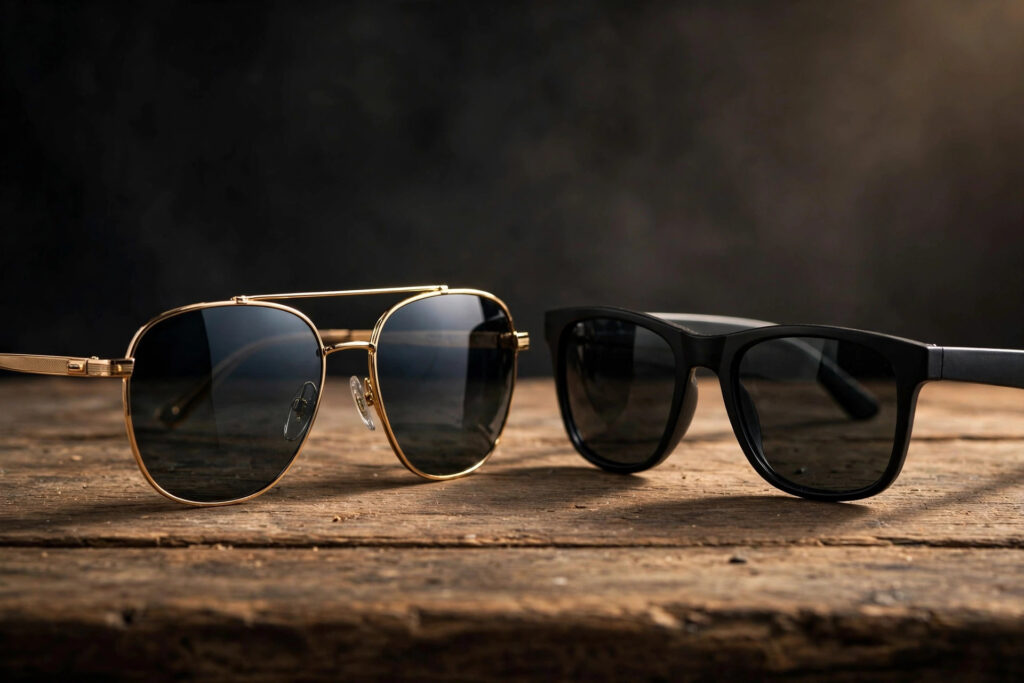
Is a $200 pair of sunglasses really ten times better than a $20 pair? The cheap vs expensive sunglasses debate has a more nuanced answer than either side admits: sometimes you’re paying for real optical quality, and sometimes you’re paying for a logo.
This guide separates what actually differs — UV protection, optical clarity, polarization quality, materials, and durability — from what doesn’t, so you can spend wisely at any budget.
Table of Contents
- UV Protection: Price Is Not the Guarantee
- Optical Clarity and Distortion
- Polarization Quality Gaps
- Frame Materials and Build Quality
- Lens Coatings and Durability
- When to Save and When to Splurge
UV Protection: Price Is Not the Guarantee
Start with the surprise: UV protection is cheap to manufacture. A $15 pair with a legitimate “100% UVA/UVB” or “UV400” label protects your eyes as well as a $300 pair with the same rating. The chemistry of UV absorption doesn’t care about the price tag.
The catch is accountability. Reputable budget brands (sold through optical retailers) label accurately; no-name street-vendor pairs may claim protection they don’t deliver. The American Academy of Ophthalmology emphasizes verifying the UV claim rather than assuming price equals protection. A labeled cheap pair beats an unlabeled expensive fashion pair every time — this is the core eye health fact of the whole debate.
Optical Clarity and Distortion
This is where price often shows. Cheap lenses may have uneven thickness, poor surface quality, or inconsistent tinting that introduces subtle distortion — waviness at the edges, a swimmy feeling, or mild headaches during long wear. Quality lenses use optically correct materials (CR-39, polycarbonate, Trivex, high-index) manufactured to tight tolerances.
For most casual wearers, the difference is subtle; for anyone wearing sunglasses for hours (drivers, boaters, athletes), it becomes noticeable as eye fatigue. Hold lenses up and look through them at a grid pattern — distortion shows immediately. Premium lens technology like freeform surfacing delivers measurably cleaner optics, especially in wraparound and prescription designs.
Polarization Quality Gaps
Polarization is another real differentiator. Quality polarized lenses use a properly aligned polarizing film laminated within the lens, blocking 99%+ of reflected glare uniformly. Cheap polarized lenses may use thinner films with uneven coverage — glare reduction that varies across the lens or degrades quickly.
Test polarization by looking at a reflective surface (a car hood, water) and rotating the glasses 90 degrees — glare should dramatically change. Inconsistent results suggest a weak filter. If you fish, boat, or drive extensively, polarization quality alone can justify stepping up from the bargain bin.
Frame Materials and Build Quality
Frames reveal price differences physically. Expensive sunglasses typically use acetate (plant-based plastic that’s adjustable and durable), stainless steel, titanium, or high-grade nylon — with smooth, well-fitted hinges (often sprung) and quality screws. Cheap frames use brittle injection-molded plastics, crude hinges, and plating that flakes within months.
Build quality affects fit stability, adjustability, and lifespan. A well-made frame can be adjusted by an optician repeatedly and last years; a cheap frame often can’t be adjusted at all and snaps under normal stress. This is also where designer branding inflates prices most — a $150 frame and a $400 frame from the same factory may differ only in the logo.
Lens Coatings and Durability
Premium lenses usually include scratch-resistant hard coatings, and often hydrophobic (water-repelling) and anti-reflective backside coatings that reduce bounce-back glare. These coatings meaningfully extend lens life and improve the viewing experience. Budget lenses often skip them or apply thin versions that wear off quickly.
Scratch resistance deserves emphasis: scratched lenses scatter light, causing haze and eye strain. A quality hard coat can double or triple a lens’s useful life under normal handling. Combined with better hinges and materials, this is why expensive sunglasses often cost less per year of use than repeatedly replaced cheap pairs.
One often-overlooked factor is adjustability. Quality frames can be heated and reshaped by an optician to fit your face precisely; cheap injection-molded frames often can’t be adjusted without breaking. A proper fit affects comfort, stability, and how well the lenses stay aligned with your eyes — all of which influence your actual experience more than most buyers expect.
Also consider lens replacement programs. Several mid-range and premium brands offer affordable lens replacement when coatings wear or prescriptions change, extending the frame’s useful life significantly. A quality frame can serve through multiple lens generations.
When to Save and When to Splurge
Save when: you need beaters for the beach bag, kids who lose things (see our kids vision guidance), or a trendy style you’ll wear twice. Any labeled UV400 cheap pair works for occasional use — just verify the label.
Splurge when: sunglasses are daily drivers, you need prescription lenses (optical quality matters enormously here — discuss during your eye exams), you fish/boat/drive for hours, or you value durability and fit. The sweet spot for most buyers is the mid-range: $75-150 from optical brands, where you get genuine optical quality, real polarization, and solid build without paying the designer-logo tax.