
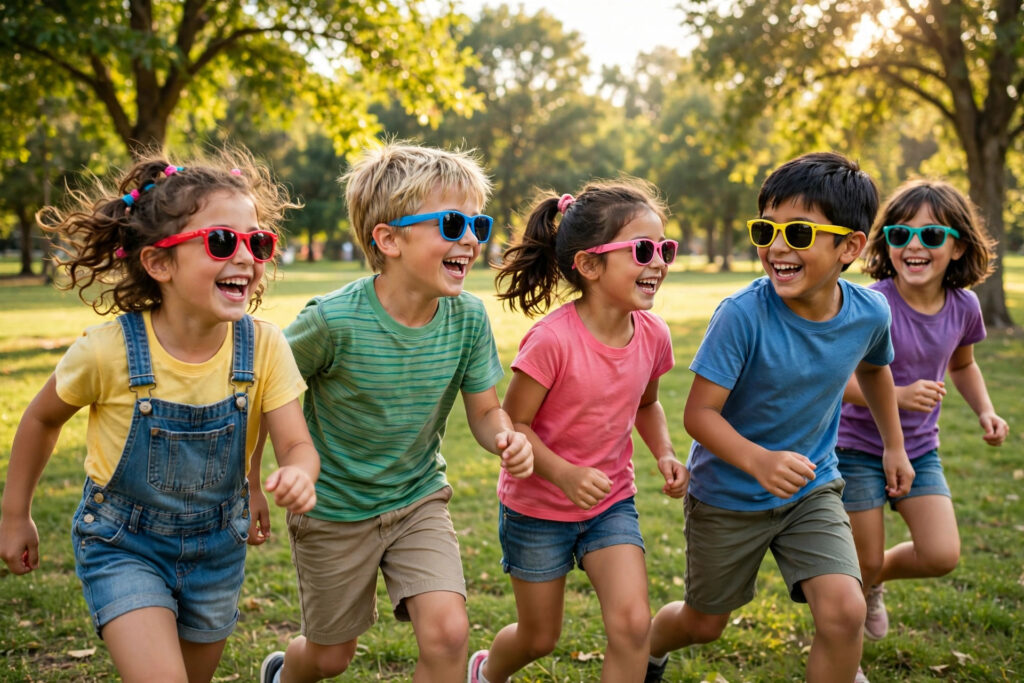
Children spend far more time outdoors than most adults, and their eyes are more vulnerable to the sun. A good pair of sunglasses is not a fashion extra for kids. It is basic protection, just like sunscreen and a hat. The problem is that many cheap toy sunglasses look the part but block little or no ultraviolet light.
This buying guide explains what to look for in children’s sunglasses, from UV ratings and lens materials to frame fit for different ages, so you can choose a pair that protects your child’s eyes and actually stays on their face.
Table of Contents
- Why Kids Need Sunglasses
- UV Protection: The Non-Negotiable
- Lens Materials and Tints
- Frames and Fit by Age
- Features Worth Paying For
- Buying Checklist and Final Verdict
Why Kids Need Sunglasses
A child’s eye lets through more ultraviolet light than an adult’s. The lens inside a young eye is clearer, and pupils tend to be larger, so more UV reaches the retina. Because children also spend many hours outside at play, at school and on holiday, they receive a large share of their lifetime UV exposure before adulthood.
Over time, UV exposure is linked to eye problems such as cataracts, pterygium (a growth on the white of the eye) and damage to the eyelid skin. In the short term, strong sunlight off sand, water or snow can cause photokeratitis, a painful sunburn of the eye surface. Sunglasses also reduce squinting and glare, which makes outdoor play more comfortable.
UV Protection: The Non-Negotiable
The single most important feature is full UV protection. Look for a label that says 100% UV protection, UV400, or that the lenses block both UVA and UVB. UV400 means the lens blocks light wavelengths up to 400 nanometres, which covers the full UV range.
Lens darkness does not tell you anything about UV protection. A very dark lens without a UV filter can actually be worse than no sunglasses at all, because the dark tint makes the pupils open wider and lets more UV in. If a pair has no clear UV rating, do not buy it, however cute the frame is.
Recognised standards can help. In Europe, look for the CE mark and a lens category (category 2 or 3 suits most sunny days). In Australia, look for AS/NZS 1067. In the United States, reputable brands will state UV400 or 100% UVA/UVB protection on the label.
Lens Materials and Tints
Polycarbonate and Trivex lenses
Children drop, sit on and throw their sunglasses, so lens material matters. Polycarbonate and Trivex lenses are lightweight, highly impact-resistant and block UV by nature. Avoid glass lenses for children, as they are heavier and can shatter.
Tint colour
Grey tints keep colours natural and suit most everyday use. Brown and amber tints boost contrast, which can help on changing terrain or at sport. Very bright fashion colours such as pink or blue are fine only if the lenses are still UV400 rated.
Polarised lenses
Polarised lenses cut reflected glare from water, sand, snow and wet roads. They are a good upgrade for beach holidays, boating and skiing. Polarisation does not add UV protection on its own, so you still need the UV400 label.
Prescription and photochromic options
If your child wears glasses, prescription sunglasses or photochromic lenses (which darken outdoors) protect their eyes without swapping pairs. Ask your optometrist which option suits your child’s prescription and routine.
Frames and Fit by Age
The best sunglasses are the ones your child will keep on. Fit changes a lot with age:
- Babies and toddlers (0 to 3 years): choose soft, flexible frames with an adjustable strap that goes around the head. Combine them with a wide-brimmed hat and shade, as babies under six months should be kept out of direct sun.
- Young children (3 to 7 years): look for flexible, bendable frames, rounded edges and rubber nose pads and temple tips. A detachable strap helps during active play.
- Older children (8 to 12 years): kids at this age care about style, so let them help choose. Sport wrap styles with grippy temples suit active children.
- Teenagers: many teens fit small adult frames. Keep checking for UV400 and impact-resistant lenses.
Check that the frame sits close to the face without touching the eyelashes, covers the eyes and some of the area around them, and does not pinch behind the ears. Wraparound styles block light coming in from the sides.
Features Worth Paying For
- Flexible or “unbreakable” frames: TR90 and rubber frames bend without snapping, so they last much longer.
- Scratch-resistant coating: scratched lenses blur vision and make children take their glasses off.
- Straps and cords: these keep sunglasses on during play and stop them getting lost.
- Warranty: some children’s brands replace broken frames, which saves money over a season.
- Hard case: teaches children to store sunglasses safely in a school bag.
You do not need to buy designer brands. Many mid-priced children’s sunglasses offer UV400 polycarbonate lenses and flexible frames. Spend your money on protection and durability rather than logos.
Buying Checklist and Final Verdict
Before you buy, check this list:
- Labelled UV400 or 100% UVA and UVB protection
- Polycarbonate or Trivex lenses, never glass
- Flexible frame with no sharp edges
- Comfortable fit that covers the eyes and stays on during play
- A strap for toddlers and active children
- Polarised lenses for beach, water and snow trips
Encourage good habits by wearing sunglasses yourself, keeping a spare pair in the car or school bag, and making sunglasses part of the routine whenever sunscreen goes on. Remember that UV is present on cloudy days too. If your child squints a lot, rubs their eyes or complains about light, book an eye test, as these can be signs of a vision problem.
The verdict: the right sunglasses for kids are UV400 rated, impact-resistant, flexible and comfortable enough to stay on. Choose a strap style for toddlers, a bendable sporty frame for school-age children and a small adult style for teens. The American Academy of Ophthalmology sunglasses advice has more tips on choosing sun protection for the whole family.