
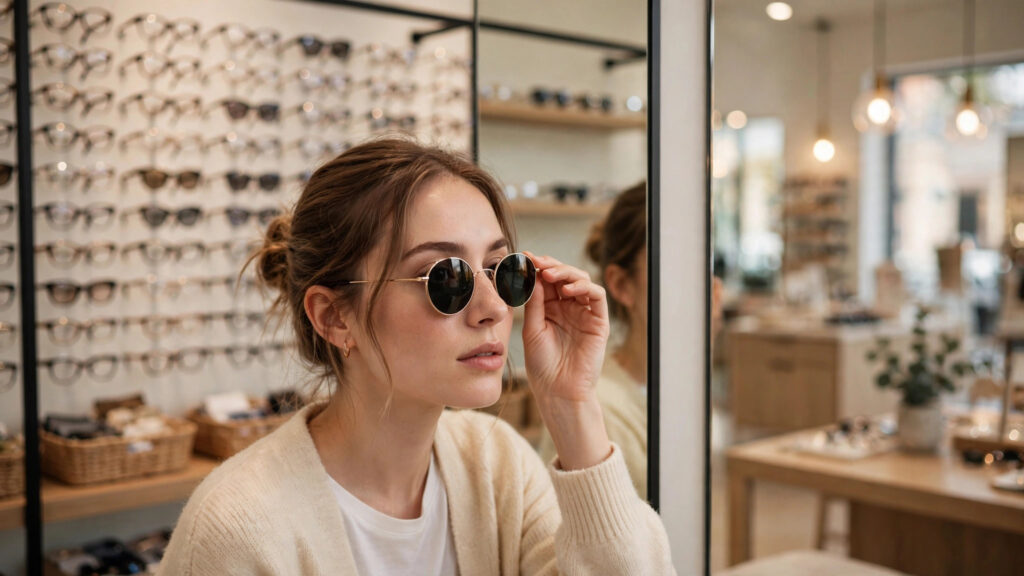
Shopping for sunglasses with a small face often means swimming in oversized frames that slide down your nose and swallow your features. The best sunglasses for small faces aren’t just scaled-down versions of standard frames — they’re designed with petite proportions, narrower bridges, and shorter temples.
Getting the fit right matters for more than looks. Properly fitted sunglasses stay put, block UV from the angles that count, and don’t leave you pushing them up all day. Here’s how to find your match.
Table of Contents
- Why Standard Frames Fail Small Faces
- Understanding Frame Measurements
- Flattering Shapes for Petite Features
- Fit Checklist for Small Faces
- Lens and Protection Considerations
- Shopping Tips
Why Standard Frames Fail Small Faces
Standard sunglasses are designed around average adult proportions: lens widths of 55-60 mm, bridge widths of 18-22 mm, temple lengths around 140-150 mm. On a small face, these dimensions cause the classic problems — frames wider than the face, lenses covering the cheeks, temples extending past the ears, and constant sliding.
Beyond aesthetics, poor fit compromises protection. Gaps at the temples and brow let UV leak in from the sides, and sliding frames mean the optical center shifts away from your pupils. For prescription sunglass wearers, that misalignment directly degrades vision — one more reason proper sizing is a functional issue, not vanity.
Understanding Frame Measurements
Learn the three numbers printed inside the temple arm: lens width, bridge width, temple length (e.g., 48-19-135). For small faces, target lens widths of 44-51 mm, bridge widths of 15-19 mm, and temple lengths of 125-140 mm. Total frame width should roughly match your face width — frames extending past your temples look oversized regardless of lens shape.
Many brands now label petite or narrow fits explicitly, and Asian-fit (low-bridge-fit) designs help anyone whose nose bridge sits lower, preventing the frames from resting on cheeks. Knowing your numbers turns online shopping from guesswork into a filtered search — and it’s the same sizing logic used for eyeglasses frames.
Flattering Shapes for Petite Features
Proportional shapes work best: classic wayfarer-inspired rectangles in smaller sizes, refined round lenses, subtle cat-eyes, and compact aviators. The key is balance — the frame should frame your eyes, not dominate your face. A good rule: your eyes should sit roughly centered in the lenses, with brows either just above the frame or lightly visible.
Avoid oversized trends unless the specific pair is scaled for small faces; a 58 mm “oversized” lens on a petite face reads as costume. That said, don’t fear all larger looks — a well-proportioned 52 mm round can look intentional and chic where a 58 mm rectangle looks borrowed. Shape matters as much as size.
Fit Checklist for Small Faces
Run this check with every candidate pair: the frame width matches your face width; the bridge sits comfortably without pinching or sliding; temples reach just past the ear bend without pressing; lenses don’t touch your cheeks when you smile; and the frames stay put when you nod and shake your head gently.
Adjustable nose pads are a small-face superpower — they let you fine-tune fit in ways fixed acetate bridges can’t. An optician can also adjust temple angles and pad positions; most do it free. The American Optometric Association recommends professional fitting to keep protective eyewear properly positioned. This hands-on fitting is part of why buying from an optical shop beats a fashion rack, especially when your eye exams include prescription sunglass consultations.
Online shoppers with small faces should use virtual try-on tools alongside real measurements — the combination is far more reliable than either alone. Check return policies before ordering, and order two sizes when uncertain; comparing side by side reveals fit differences that specs alone can’t convey.
Lens and Protection Considerations
Small frames still need full protection: 100% UVA/UVB blocking is non-negotiable regardless of lens size. Polarized lenses cut glare for driving and water activities. And because petite frames sit closer to the face, lens curvature matters — too flat and they look pasted on; a gentle base curve follows facial contours naturally.
Don’t assume small lenses mean weak protection. What matters is the UV rating and how well the frame seals against your face — a well-fitted petite frame with proper lens technology protects better than oversized fashion shades with gaps everywhere. Check the label, not the size.
Shopping Tips
Shop brands that offer explicit narrow or petite sizing rather than hoping standard frames run small. Try frames on in person when possible, and photograph yourself straight-on and in profile — fit issues show up clearly in photos. For online orders, use virtual try-on tools plus your known measurements, and favor retailers with free returns.
For kids and teens with small faces, durability matters as much as fit — flexible materials survive backpacks and sports bags. Our kids vision resources cover age-specific sunglass guidance. The right pair for a small face exists; it just takes measurements, not luck, to find it.