
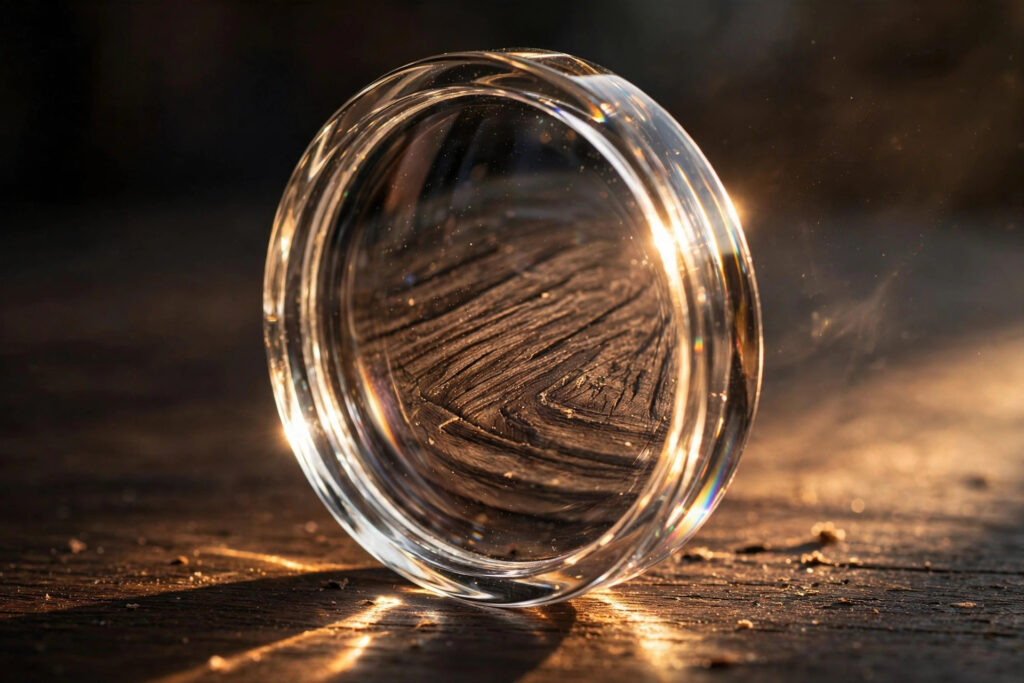
Before plastic took over eyewear, every lens was glass — and glass never fully left. In 2026, glass lenses’ pros and cons still make them a legitimate choice for certain wearers: optically superb and nearly impossible to scratch, but heavy and shatter-prone.
This honest assessment covers where glass shines, where it fails, who should still consider it, and the safety rules that govern its use.
Table of Contents
- The Optical Advantages
- Scratch Resistance
- Weight and Comfort Drawbacks
- Safety and Shatter Risk
- Who Should Still Choose Glass
- Cost and Availability
The Optical Advantages
Glass remains the optical gold standard. Crown glass (index 1.52) offers an Abbe value of 59 — essentially tied with CR-39 for the cleanest, most color-accurate vision of any lens material. High-index glass versions (up to 1.9) deliver extraordinary thinness for very strong prescriptions, thinner than any plastic.
For wearers who notice and are bothered by the chromatic aberration of polycarbonate or high-index plastics, glass is revelatory — colors stay true, night vision is crisp, and peripheral clarity is excellent. This is why glass persists in premium camera lenses, telescopes, and microscopes: when optics are the only priority, nothing beats it. Discerning wearers comparing lens materials for visual purity consistently rank glass at the top.
Scratch Resistance
Glass is dramatically harder than any plastic — it resists scratching in daily use to a degree plastics can only approach with coatings. Keys in a pocket, a drop on pavement, years of cleaning: glass shrugs off abuse that would frost a plastic lens. For people who are chronically hard on glasses and tired of replacing scratched lenses, this durability is glass’s most practical advantage.
The scratch resistance also means glass lenses maintain their optical quality for many years — plastics gradually accumulate micro-scratches that haze vision even with careful handling. A well-cared-for glass lens can outlast several prescription cycles optically (though you shouldn’t wear an outdated prescription just because the lenses still look fine — keep up with regular eye exams).
One practical tip: if you choose glass, invest in a sturdy hard case and make a habit of using it — most glass lens breakage happens not during wear but from drops onto hard floors and counters when glasses are set down carelessly.
Weight and Comfort Drawbacks
Here’s the deal-breaker for most people: glass is heavy — roughly twice the density of CR-39. In strong prescriptions, glass lenses become genuinely uncomfortable: pressure on the nose bridge, slipping down the face, headaches from frame weight, and red marks that last for hours.
High-index glass mitigates thickness but not density — a 1.9-index glass lens is thin but still heavy. Frame choice becomes critical: glass demands sturdy, well-fitted frames with proper weight distribution, ruling out delicate rimless styles. For all-day wear in moderate-to-strong prescriptions, most people find the weight unacceptable — which is the single biggest reason plastic conquered eyewear.
Safety and Shatter Risk
Glass shatters. Dropped or struck, it can break into sharp fragments near the eye — a risk plastics essentially eliminated. Modern glass lenses for eyewear must be heat- or chemically tempered to meet impact standards, which makes them break into duller chunks rather than shards, but they’re still far more fragile than polycarbonate or Trivex.
This is why glass is prohibited or strongly discouraged for: children’s glasses, sports eyewear, safety eyewear, and occupational eye protection. The FDA’s impact requirements apply to all lens materials, and tempered glass can pass — but “passes the minimum test” isn’t the same as “safe in real accidents.” For active lifestyles, impact-rated sports eyewear in polycarbonate or Trivex is the responsible choice.
Who Should Still Choose Glass
Glass makes sense for a specific wearer: mild-to-moderate prescriptions (where weight is manageable), a sedentary lifestyle with low impact risk, high sensitivity to optical aberrations, a history of scratching plastic lenses, and willingness to handle glasses carefully. It’s also chosen for specialty applications — very strong prescriptions where 1.9-index glass achieves thinness plastics can’t match, and certain industrial or laboratory settings where chemical resistance matters.
Glass is wrong for: children (never), athletes, anyone in impact-prone work, strong prescriptions where weight becomes punishing, and rimless frames. If you love the idea of glass optics but need toughness, Trivex offers the closest plastic approximation of glass-like clarity with real impact resistance.
Cost and Availability
Glass lenses typically cost $100–$250+ — premium-priced, partly because fewer labs still process glass and the tempering adds steps. Availability is shrinking: many chain optical shops no longer offer glass, so you may need an independent optician or specialty lab. Turnaround times run longer, and not all prescriptions or lens designs (particularly progressives) are available in glass.
The verdict: glass is a connoisseur’s choice in 2026 — unbeatable optics and scratch resistance for careful wearers with mild prescriptions, but impractical or unsafe for everyone else. If your priorities are optical purity above all and your lifestyle is low-risk, glass remains wonderful. For everyone else, modern plastics deliver 95% of the optics with far better safety and comfort.