
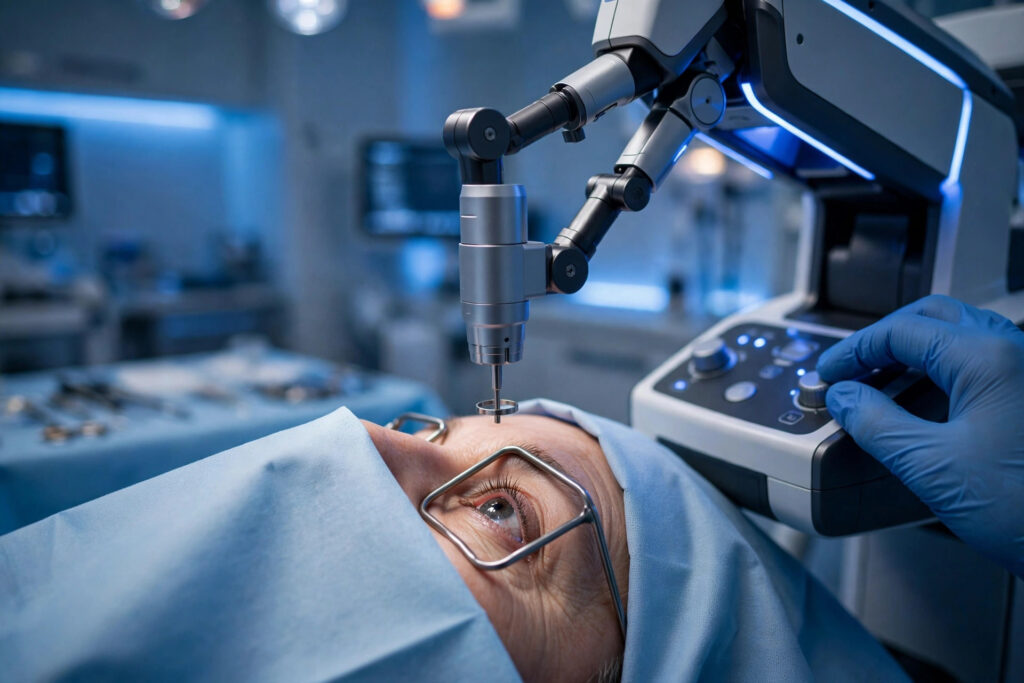
SMILE eye surgery, short for Small Incision Lenticule Extraction, is a newer form of laser vision correction that fixes nearsightedness and astigmatism through a tiny corneal incision instead of the larger flap used in LASIK. Since its introduction, it has become a well-established option offered by refractive surgeons worldwide, and newer refinements of the technique continue to appear in 2026. For the right candidate, it promises excellent vision with less disruption to the cornea.
This article explains how SMILE works step by step, where its real advantages over LASIK lie, who it suits best, what recovery feels like, and where its limitations are. Like any laser vision correction, SMILE is elective surgery, so the goal here is balanced information, not persuasion. Discuss everything with a qualified refractive eye surgeon before making any decision.
Table of Contents
- What SMILE Is and How It Differs from LASIK
- How the Procedure Works Step by Step
- Key Benefits of SMILE
- Who SMILE Suits Best
- Recovery Timeline
- Limitations and Drawbacks
- Cost and Availability in 2026
What SMILE Is and How It Differs from LASIK
The fundamental difference between SMILE and LASIK is how the surgeon accesses the corneal tissue that needs reshaping. LASIK creates a hinged flap roughly 20 millimeters around, lifts it, applies the reshaping laser, and replaces it. SMILE instead uses a single femtosecond laser to carve a thin, lens-shaped disc of tissue, called a lenticule, inside the cornea, then removes it through an incision only a few millimeters wide. No flap is created, and no excimer laser is needed.
That single-laser, flapless design has structural implications. The cornea’s front layers, which contribute most to its strength, remain largely intact in SMILE, while LASIK’s flap severs them in a near-complete circle. Biomechanical studies suggest SMILE preserves more corneal strength than LASIK for an equivalent correction, which is one reason surgeons sometimes recommend it for patients with borderline corneal thickness or those in high-impact occupations.
There is a trade-off in flexibility. LASIK’s two-laser platform, especially with wavefront or topography guidance, can treat a wider range of prescriptions, including farsightedness, and can fine-tune subtle optical imperfections. SMILE’s approved treatment range is narrower, focused on nearsightedness with or without astigmatism. Understanding this distinction helps explain why surgeons recommend different procedures for different eyes rather than defaulting to the newest option.
How the Procedure Works Step by Step
SMILE begins like other laser procedures: numbing drops, a reclined chair, and a laser bed. The femtosecond laser is applied to the eye for roughly half a minute, during which it creates the lenticule and the small entry incision with remarkable precision. Patients typically feel gentle pressure and see a soft white glow rather than anything alarming. The laser phase is slightly longer per eye than a LASIK flap creation, but the total procedure time is comparable.
After the laser finishes, the surgeon uses fine instruments to separate the lenticule from the surrounding tissue and draws it out through the small incision. This manual extraction step is the part that depends most on surgeon skill and experience; a seasoned SMILE surgeon completes it smoothly in a couple of minutes. The incision is so small it usually seals on its own without stitches, and the cornea’s shape is now permanently altered to focus light correctly.
Patients often describe the sensation afterward as mild grittiness or watering, similar to an eyelash in the eye, rather than real pain. Vision is typically hazy immediately after the procedure and then sharpens noticeably within the first day. Because there is no flap to dislodge, the post-operative restrictions on rubbing the eyes are somewhat less anxious than with LASIK, though surgeons still advise caution during early healing.
Key Benefits of SMILE
The most discussed benefit is dry eye. Corneal nerves, which drive tear production, are cut far less extensively in SMILE’s small-incision approach than in LASIK’s flap creation. Clinical comparisons generally show less post-operative dryness and faster recovery of tear film stability after SMILE. For patients who already experience borderline dryness, or who spend long hours in air-conditioned offices or on screens, this difference can be meaningful, though it does not eliminate dry eye risk entirely.
Corneal biomechanical strength is the second major advantage. Leaving the strong anterior corneal layers nearly intact means the eye retains more of its natural structural integrity. Surgeons cite this when recommending SMILE to athletes in contact sports, military personnel, and patients whose corneal thickness makes a LASIK flap less attractive. It is worth noting that serious weakening complications are rare with any modern procedure in properly screened patients.
The small incision also means fewer flap-related complications by definition: there is no flap to wrinkle, shift, or develop ingrowth beneath. Many patients also appreciate the slightly simpler aftercare. On the vision side, outcomes for suitable candidates are comparable to LASIK, with a large majority achieving excellent uncorrected vision. The American Academy of Ophthalmology’s SMILE overview summarizes the evidence for patients considering their options.
Who SMILE Suits Best
SMILE’s sweet spot is the moderately to highly nearsighted adult with a stable prescription, healthy corneas of adequate thickness, and no significant eye disease. Because the procedure spares more corneal tissue and nerves, surgeons often steer toward SMILE for patients with mild dry eye tendencies, thinner-than-average corneas that still meet safety thresholds, and lifestyles involving physical contact or eye injury risk. A comprehensive pre-operative eye exam with corneal mapping determines whether your eyes qualify.
SMILE is not suitable for farsightedness, which remains a LASIK or lens-based procedure domain, and its astigmatism correction range is more limited than LASIK’s. Patients with keratoconus or other corneal irregularities, uncontrolled dry eye, corneal scarring in the treatment zone, and autoimmune healing disorders are generally not candidates. As with LASIK, pregnancy, nursing, and unstable prescriptions are reasons to wait.
Age and expectations follow the same logic as other laser procedures: adults whose prescriptions have been stable for at least a year or two, who understand that reading glasses will still arrive with age, and who accept that no surgery guarantees perfection. A candid surgeon will sometimes recommend LASIK or another option over SMILE for a particular eye, and that recommendation should be welcomed as a sign of careful practice.
Recovery Timeline
SMILE recovery is quick, though typically described as slightly slower in the first day or two than LASIK. Most patients notice functional vision within hours and significant clarity by the next morning, with a routine check-up the day after surgery. The mild haze and watering of the first hours generally settle fast, and many people return to desk work within a day or two.
Over the first week, vision continues to sharpen as the small incision heals and any residual swelling resolves. Lubricating drops are used frequently, and surgeons usually advise against swimming, eye makeup, and dusty environments for the period they specify. Because there is no flap, the anxiety about accidentally dislodging anything is lower, but rubbing the eyes is still discouraged while healing.
Full stabilization generally takes a few weeks to a few months, during which minor fluctuations and occasional dryness are normal. Follow-up visits let the surgeon confirm the cornea is healing cleanly and vision is settling at the intended target. Most patients find that by the one-month mark, their eyes feel entirely normal, though the official all-clear timeline varies by clinic. Protecting healing eyes from UV light with quality sunglasses outdoors is sensible advice after any corneal procedure.
Limitations and Drawbacks
An honest account of SMILE eye surgery must include its limitations. The narrower treatment range is the main one: farsightedness cannot currently be treated with SMILE, and very high astigmatism may be better served by LASIK’s customizable platform. Enhancements, if a touch-up is ever needed, are less straightforward after SMILE than after LASIK, where lifting the existing flap is routine; a SMILE enhancement may require a different technique.
The manual lenticule extraction step introduces more surgeon dependence than LASIK’s highly automated ablation. SMILE has a recognized learning curve, and outcomes data tend to be best with experienced surgeons who perform the procedure regularly. When researching providers, asking how many SMILE procedures the surgeon has performed is a reasonable and common question.
Finally, SMILE is a younger procedure with a shorter long-term track record than LASIK’s multi-decade history. The data so far is reassuring, but LASIK simply has more years of follow-up behind it. None of this makes SMILE a poor choice; it makes surgeon selection and candidacy screening especially important, and it is why reputable clinics offer both procedures and recommend based on the individual eye rather than marketing.
Cost and Availability in 2026
SMILE typically costs about the same as, or slightly more than, contemporary LASIK at a given clinic, reflecting the specialized laser platform and the surgeon’s expertise. As with LASIK, pricing varies by region and practice, and patients should compare what is included: screening, the procedure, follow-up visits, and any enhancement policy. Prices quoted without follow-up care bundled in can be misleadingly low.
Availability has broadened considerably, and in 2026 many established refractive practices offer SMILE alongside LASIK and PRK. Newer iterations of the technique, marketed under names like SMILE Pro, promise faster laser times using updated platforms. These refinements are worth asking about, but the fundamentals of candidacy and surgeon experience matter far more than the specific platform generation.
As with all laser vision correction, take time with the decision. Get a thorough screening, ask about the surgeon’s SMILE-specific experience, understand the enhancement policy, and be wary of high-pressure sales tactics or prices far below the local norm. Advances in lens technology also mean that premium glasses and contact lenses remain strong non-surgical alternatives. The FDA’s page on laser vision correction procedures is a useful neutral reference before any consultation.