
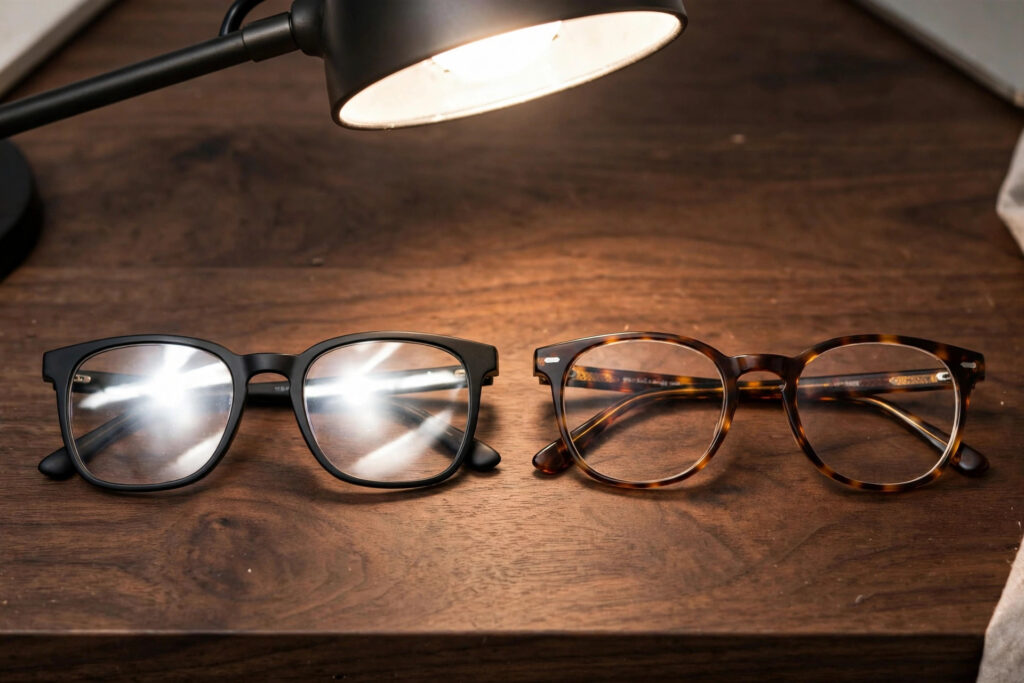
Shopping for lenses, you will encounter “anti-reflective” and “anti-glare” used almost interchangeably, often for the same product. This causes real confusion: are they different coatings, different technologies, or just marketing synonyms? The anti-reflective vs anti-glare question has a clear answer, and understanding it helps you buy the right coating with confidence.
This guide explains the terminology, the physics of how these coatings work, who benefits most, what they cost, and how to care for coated lenses. By the end, the marketing fog will be completely cleared.
Table of Contents
- Terminology: What’s in a Name?
- How the Coating Actually Works
- The Visible Benefits
- Who Benefits Most
- Cost and Whether It’s Worth It
- Caring for Coated Lenses
- Buying Tips
Terminology: What’s in a Name?
Here is the direct answer to anti-reflective vs anti-glare: they refer to the same coating. “Anti-reflective” (AR) is the technically accurate term describing what the coating does: it reduces reflections off the lens surfaces. “Anti-glare” is the consumer-friendly marketing term emphasizing the benefit you experience: less glare.
The eyewear industry uses both terms for the identical multi-layer thin-film coating applied to lenses. Some retailers say AR coating, others say anti-glare coating, and some use both on the same product page. There is no secret superior “anti-glare” technology distinct from AR; anyone suggesting otherwise is either confused or upselling.
Knowing this saves you from paying twice or agonizing over a nonexistent choice. When comparing lens coating options, treat the two terms as one and focus instead on coating quality tiers, which do vary meaningfully between manufacturers.
How the Coating Actually Works
Uncoated lenses reflect about 8 to 12 percent of incoming light off their surfaces. These reflections create the visible glare on the front of lenses that hides your eyes in photos, and more importantly, they bounce distracting reflections off the back surface into your eyes, superimposing ghost images over your vision.
AR coating uses multiple microscopic layers of metal oxides with alternating refractive indices. Each layer is precisely tuned to a fraction of light wavelengths so that reflected waves cancel each other through destructive interference. The result: reflections drop to under 1 percent, and more light transmits cleanly through the lens to your eye.
The characteristic greenish or purplish residual reflection you see on AR-coated lenses is the tiny fraction of light the coating does not cancel. Different manufacturers’ layer recipes produce slightly different residual tints, which is why AR coatings from different brands have subtly different hues. This residual color is cosmetic and does not affect performance.
The Visible Benefits
The most noticeable benefit is clarity. By eliminating back-surface reflections, AR coating removes the ghost images and veiling glare that uncoated lenses superimpose on your vision, particularly in challenging light. Night driving improves dramatically: halos around headlights shrink, and the distracting reflections of your dashboard disappear.
Computer work benefits similarly. Office lighting reflecting off the back of uncoated lenses creates a subtle haze that contributes to digital eye strain; AR coating eliminates it. Many wearers report that screens look sharper and their eyes feel less tired at day’s end, a meaningful eye health and comfort advantage for screen-heavy lifestyles.
Cosmetically, AR coating makes lenses nearly invisible, so others see your eyes instead of reflections. Photos look better, video calls look better, and high-index lenses, which reflect more light uncoated, look dramatically clearer. For strong prescriptions where lens reflections are most prominent, the cosmetic improvement alone justifies the coating.
Who Benefits Most
Night drivers top the beneficiary list. If oncoming headlights bloom into distracting starbursts, AR coating on your driving glasses is transformative. Anyone with high-index lenses benefits disproportionately because these materials reflect more light without coating.
Heavy computer users, people who work under bright office lighting, and anyone frequently photographed or on video calls gain clear advantages. People with astigmatism often notice particular improvement since their condition already amplifies glare and halos. And sunglass wearers benefit from backside AR coating that kills reflections off the inner lens surface.
Honestly, nearly every glasses wearer benefits to some degree. The question is rarely whether AR coating helps but whether its cost fits your budget. For most wearers in 2026, it is considered a standard recommendation rather than an optional luxury.
Cost and Whether It’s Worth It
AR coating typically adds $50 to $150 to lens cost depending on the tier and retailer, with premium coatings commanding the higher end. Many online retailers now include basic AR coating free, making it a non-decision at those sellers. When itemized, mid-tier coatings usually offer the best value.
Premium AR coatings justify their price with harder, more durable formulations, better hydrophobic and oleophobic topcoats that resist smudges, and warranties against defects. Budget AR coatings perform the core anti-reflective function but may scratch more easily and attract smudges that require frequent cleaning.
The value calculation is strongly positive for most wearers. If you drive at night, work on screens, or wear high-index lenses, AR coating is among the highest-value upgrades in eyewear. Even for casual wearers, the clarity and cosmetic improvements are immediately apparent. Skipping it to save $75 on glasses you will wear for two years is a poor trade.
Caring for Coated Lenses
AR-coated lenses need slightly more careful cleaning than uncoated ones because the coating shows smudges more visibly and can be damaged by harsh treatment. Always rinse lenses under lukewarm water before wiping to remove abrasive dust. Clean with microfiber cloths and lens spray; never use paper towels, tissues, or clothing.
Avoid household glass cleaners, which contain chemicals that degrade coatings. Do not expose coated lenses to excessive heat: leaving glasses on a car dashboard in summer can cause the coating to craze, developing a web of fine cracks that ruins the lens. This heat damage is the most common coating killer.
Store glasses in a hard case when not worn. With proper care, quality AR coatings last the full life of the prescription, typically two to three years. The hydrophobic topcoats wear gradually; when lenses start attracting smudges stubbornly, the topcoat is fading even if the anti-reflective layers remain functional.
Buying Tips
When ordering, confirm that AR coating is applied to both lens surfaces; backside coating matters most for visual comfort, front-side for cosmetics and photos. Ask about the coating tier and warranty. Reputable manufacturers warranty premium coatings against manufacturing defects for one to two years.
For sunglasses, specify backside AR coating, which some sunglass lenses omit by default. For computer glasses and night driving glasses, AR coating is essentially mandatory for the intended benefit. Pair it with properly fitted frames so the optical benefits are not undermined by poor positioning.
The American Academy of Ophthalmology’s eyewear guidance supports AR coating as a valuable lens enhancement. Whether the label says anti-reflective or anti-glare, you are buying the same proven technology; choose based on quality tier and price, not terminology.