Most parents know children need eye exams, but far fewer know when the first one should happen. The common assumption, that exams start when a child can read an eye chart, misses the most critical years of visual development. The answer to when should children have their first eye exam is earlier than most people think: between 6 and 12 months of age.
This guide lays out the expert-recommended exam schedule from infancy through the teen years, explains what doctors check at each stage, and clarifies how pediatric exams differ from school vision screenings. Getting the timing right protects vision during the years when treatment works best.
Table of Contents
- The First Exam: 6 to 12 Months
- The Preschool Exam: Ages 3 to 5
- School-Age Exams: Every 1 to 2 Years
- Teen Years: Monitoring Myopia
- What Pediatric Exams Actually Test
- Screenings vs Comprehensive Exams
- Finding the Right Provider
The First Exam: 6 to 12 Months
The American Optometric Association recommends a first comprehensive eye exam between 6 and 12 months. At this age, the exam does not involve reading charts; the doctor uses objective techniques like retinoscopy to measure refraction, observes eye alignment and movement, and examines the eye’s structures with specialized instruments.
This early exam screens for serious conditions that must be caught in infancy: congenital cataracts, retinoblastoma (a rare eye cancer), significant refractive errors, strabismus, and ptosis (drooping eyelid) that can block visual development. The visual system develops most rapidly in the first years of life, and problems caught now are the most treatable.
Many parents skip this exam because their baby seems fine, but infants cannot report vision problems and serious conditions often show no outward signs. The InfantSEE program historically provided free assessments for infants, and many providers continue offering affordable infant exams. When should children have their first eye exam is a question with a clear expert answer; the challenge is making sure parents hear it.
The Preschool Exam: Ages 3 to 5
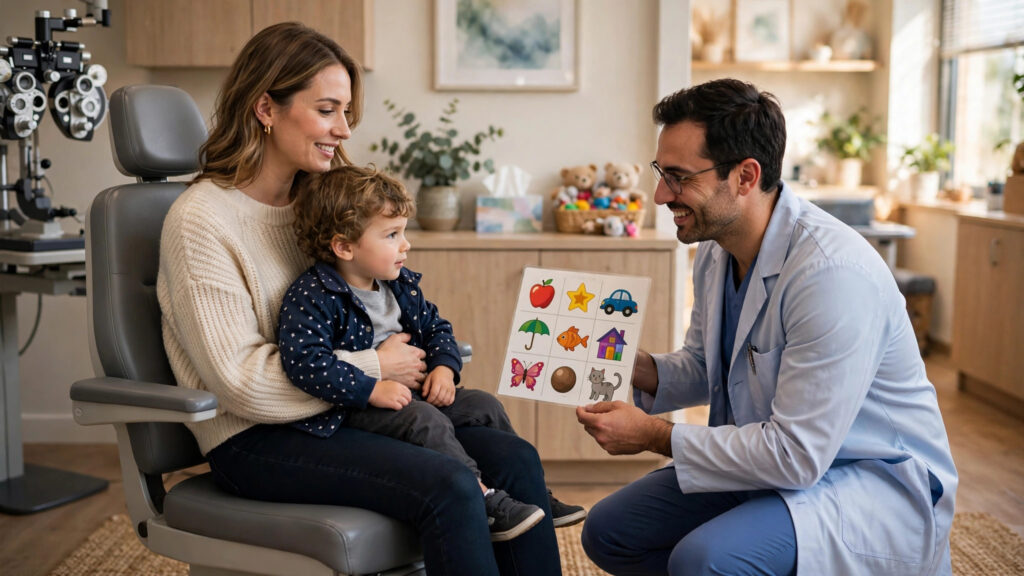
The second comprehensive exam should occur between ages 3 and 5, before the child starts school. By now, children can often participate in picture-based acuity tests, making the exam more interactive. The doctor checks for refractive errors, amblyopia (lazy eye), strabismus, focusing and teaming problems, and overall eye health.
This timing is strategic: it catches problems before they affect school performance while the visual system remains highly treatable. Amblyopia treatment, which typically involves patching or atropine penalization of the stronger eye, works best before age 7 and becomes progressively harder after that. A preschool exam that catches amblyopia can save a child’s vision in the affected eye.
Prepare your preschooler by explaining the exam is painless and involves looking at pictures and lights. Bring any observations about squinting, head tilting, or eye rubbing. A positive, relaxed first exam experience sets the tone for a lifetime of good eye health habits.
School-Age Exams: Every 1 to 2 Years
Once children start school, comprehensive exams every one to two years keep vision matched to growing eyes and increasing academic demands. Annual exams are recommended for children who wear glasses, have diagnosed conditions, or carry risk factors like family history of myopia or strabismus.
School-age exams evaluate the full range of visual skills that learning requires: not just clarity at distance and near, but eye teaming, tracking, and focusing stamina. A child can have 20/20 acuity yet struggle with the binocular vision skills reading demands, which is why comprehensive exams matter beyond what school screenings check.
Coordinate exam timing with the school year. A late-summer exam ensures any new prescription is ready before classes start, avoiding weeks of struggling with outdated glasses. Teachers appreciate knowing about vision corrections too, so share relevant findings that affect classroom seating or learning accommodations.
Teen Years: Monitoring Myopia
Teenagers should continue exams every one to two years, with annual visits for myopia management. The teen years are peak myopia progression territory, and regular monitoring tracks changes, keeps prescriptions current, and provides opportunities to discuss myopia control treatments like low-dose atropine or specialized lenses.
Teens face intense visual demands from academics and screens, making uncorrected or undercorrected vision particularly costly. They are also candidates for contact lenses, which many prefer for sports and social reasons. An annual exam supports safe contact lens wear with proper fitting and health monitoring.
Include teens in the conversation about their vision. They are old enough to report symptoms accurately and to take ownership of their eye care habits. Discussing contact lens options for responsible teens helps them transition to managing their own eye health after leaving home.
What Pediatric Exams Actually Test
Pediatric exams adapt techniques to the child’s age and cooperation level. For infants and toddlers, everything is objective: the doctor measures refraction with retinoscopy, assesses alignment with light reflex tests, evaluates eye movements by observation, and examines internal structures with handheld instruments. No verbal responses required.
Preschoolers graduate to picture charts and matching games that measure acuity in engaging ways. The doctor still uses objective techniques to verify results. School-age children handle standard testing much like adults, with age-appropriate explanations.
At every age, the exam covers refractive status, binocular vision, eye health, and developmental milestones. Dilation is common in pediatric exams because children’s strong focusing can mask refractive errors; the drops relax accommodation for accurate measurement. Parents sometimes worry about dilation drops, but they are safe and the effects wear off within hours.
Screenings vs Comprehensive Exams
School vision screenings check basic distance acuity and catch some obvious problems, but they miss hyperopia, binocular vision disorders, and eye diseases. They are a safety net, not a substitute. A child who passes a screening can still have significant vision problems affecting learning.
Pediatrician vision checks during well-child visits are similarly limited. They are valuable for flagging gross abnormalities but do not replace comprehensive exams by eye care professionals. Our detailed exam versus screening comparison explains the differences thoroughly.
The practical rule: never let a passed screening cancel a scheduled comprehensive exam, and never treat a screening as the exam itself. When should children have their first eye exam and subsequent exams is determined by professional guidelines, not by screening schedules.
Finding the Right Provider
Look for an optometrist or ophthalmologist with pediatric experience and a child-friendly practice. Ask your pediatrician for referrals, check with parent groups, and verify the provider sees children of your child’s age routinely. Comfort with young patients matters as much as credentials.
Prepare for the visit by noting any concerns, bringing previous prescriptions or records, and scheduling at a time when your child is rested and cooperative. Morning appointments often work best for young children. Bring a favorite toy or comfort item for toddlers.
After the exam, follow through on recommendations promptly, whether that means glasses, patching therapy, or a follow-up schedule. The National Eye Institute’s children’s eye health resources support families between visits. Getting the timing right on that first exam, and every exam after, is one of the simplest high-impact parenting decisions you will make.