
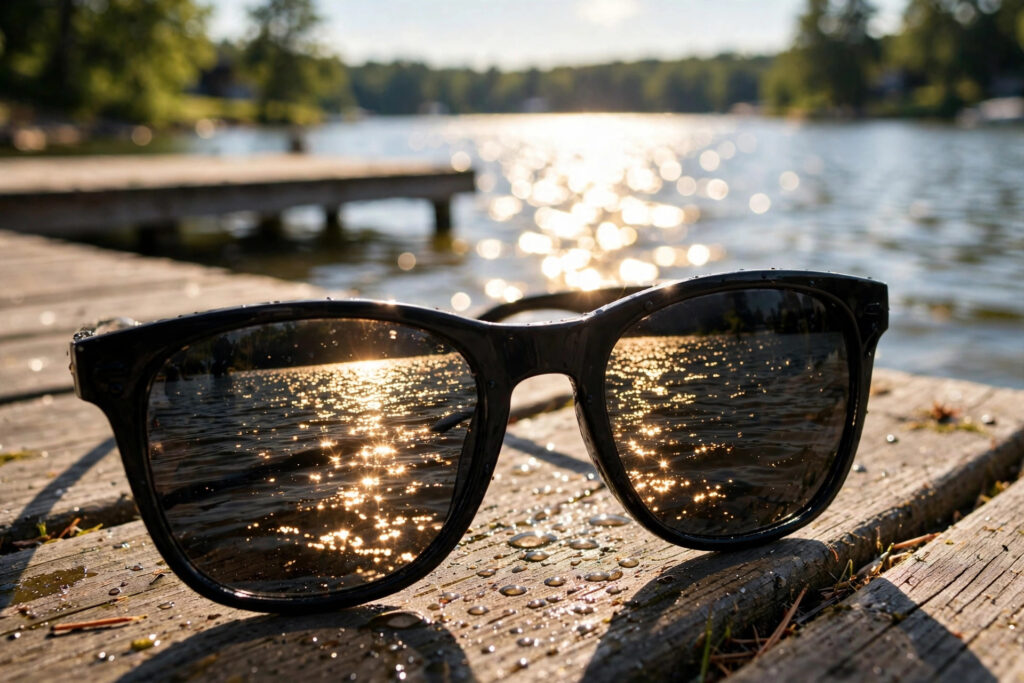
Glare off water, blinding reflections off wet roads, the white-out shimmer of snow — polarized lens technology explained in one sentence: it’s a filter that blocks the specific orientation of light we perceive as glare, while letting useful light through. The result is one of the most dramatic visual upgrades eyewear can offer.
This guide covers the physics, the real-world benefits, situations where polarization works against you, and how to choose polarized lenses wisely.
Table of Contents
- How Polarization Works
- What Polarized Lenses Do for Vision
- Best Activities for Polarized Lenses
- When Polarization Causes Problems
- Polarized vs Non-Polarized Sunglasses
- Buying Tips
How Polarization Works
Light from the sun vibrates in all directions. When it reflects off a flat, non-metallic surface — water, a road, snow, a car hood — the reflected light becomes polarized: its vibrations align predominantly in one (horizontal) plane. That horizontally-polarized light is what we experience as blinding glare.
A polarized lens contains a special filter film (typically polyvinyl alcohol treated with iodine) laminated within the lens, oriented with its transmission axis vertical. Like microscopic venetian blinds, it absorbs horizontally-vibrating light while passing vertically-oriented light. The glare gets blocked; the useful image gets through. This is fundamentally different from simply darkening a lens — a dark non-polarized lens reduces everything equally, including the image you want to see, while polarization selectively removes the glare component. Quality polarized sunglasses combine this filter with UV protection and optical-grade lens materials.
What Polarized Lenses Do for Vision
The effect is immediately obvious the first time you try them: reflections vanish from water surfaces (you can suddenly see fish, rocks, and shallow structure beneath), road glare on wet pavement disappears, snow glare softens dramatically, and overall contrast improves. Colors often appear richer because the washing-out veil of reflected light is gone.
Beyond comfort, there are genuine safety benefits: drivers see wet roads and puddles more clearly, boaters can spot underwater hazards, and skiers read snow texture better. Eye strain drops because you’re not squinting against glare all day. For anyone who spends significant time around water, snow, or reflective surfaces, polarization isn’t a luxury — it’s the single most impactful lens upgrade available. Anglers, in particular, consider polarized lenses essential equipment rather than optional eyewear.
Best Activities for Polarized Lenses
Fishing and boating: the canonical use case — seeing beneath the water’s surface transforms the experience. Driving: cuts dashboard reflections on the windshield and glare off wet roads (with caveats below). Water sports: kayaking, paddleboarding, sailing — glare reduction plus the ability to read the water. Snow sports: reduces the intense reflected glare that causes snow blindness discomfort. Everyday outdoor life: walking, golfing, outdoor dining — general comfort in bright conditions.
For prescription wearers, polarized lenses are available in single-vision, progressive, and most lens materials — there’s no prescription barrier. They’re also compatible with mirror coatings for extreme brightness and can be combined with photochromic technology in some products, though dedicated prescription sunglasses usually outperform combination lenses for serious glare environments.
When Polarization Causes Problems
Polarization isn’t universally ideal. The main issues: LCD screens — many liquid-crystal displays (car dashboards, ATMs, gas pumps, some phones, boat instrumentation) emit polarized light, which polarized lenses can dim or black out at certain angles. Tilting your head often restores visibility, but it’s annoying. Icy or oily patches: by removing the reflective sheen, polarized lenses can make black ice, oil slicks, or wet patches on roads harder to spot — some driving-safety experts note this trade-off. Skiing in flat light: reducing glare can flatten contrast further in already-flat overcast conditions, making terrain harder to read. Pilots: aviation authorities have historically cautioned against polarized lenses in cockpits because of instrument readability issues.
None of these are deal-breakers for most people — they’re situational trade-offs. But they’re worth knowing: polarization is a tool, not a universal upgrade. If your work involves constant LCD interaction, you may prefer non-polarized lenses for daily wear.
Polarized vs Non-Polarized Sunglasses
A quality dark lens without polarization still provides essential UV protection and brightness reduction — polarization is an addition, not a requirement for eye safety. The price premium for polarization has shrunk considerably; in 2026, many mid-range sunglasses include it standard.
Choose polarized when: you’re around water, snow, or roads regularly; you experience bothersome glare; you want maximum visual comfort outdoors. Choose non-polarized when: you primarily need UV protection and style; you work with LCD screens constantly; you’re buying a fashion pair where cost matters more than performance. Note that polarization quality varies — cheap polarized lenses can have uneven filters producing blotchy or rainbow effects.
Buying Tips
Test before you buy: hold the lenses up to a reflective surface (a car windshield, a phone screen, water) and rotate them — you should see reflections dramatically dim at one angle. Check that the polarization is uniform edge to edge. Verify 100% UV protection (polarization and UV blocking are separate features — a lens can be polarized without UV protection, though quality ones always include it).
For prescription wearers, polarized lenses add roughly $75–$150 to lens cost — well worth it if you’re outdoors regularly. Gray tints preserve natural color balance; brown/amber tints boost contrast (popular with anglers and golfers); green tints offer a middle ground. The polarized lens guide at All About Vision covers tint options in depth. Whatever you choose, keep the prescription behind the filter current with regular eye exams — even the best glare filter can’t fix outdated optics.