
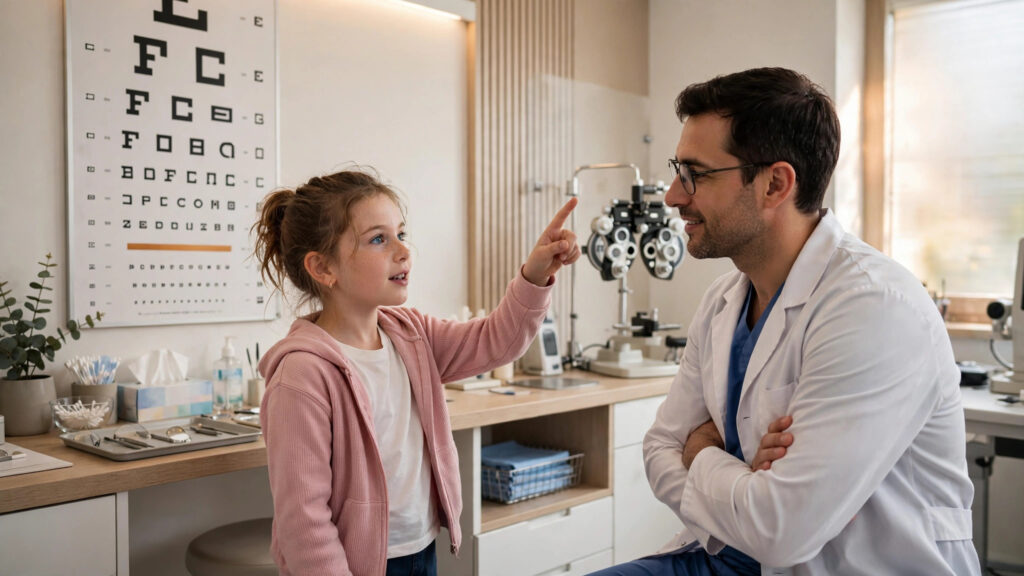
More children are becoming nearsighted than ever before, and at younger ages. In some countries, the majority of teenagers now have myopia. Understanding myopia in children, its causes, and why rates are climbing helps parents take effective action during the years when intervention matters most.
This guide explains the causes of childhood myopia, the evidence behind rising rates, the long-term risks of high myopia, and the proven strategies parents can use to slow progression. The science is clearer than ever, and so are the action steps.
Table of Contents
- What Childhood Myopia Looks Like
- Genetic Causes
- Environmental Causes
- Why Rates Are Rising
- The Risks of High Myopia
- Proven Ways to Slow Progression
- Your Parent Action Plan
What Childhood Myopia Looks Like
Childhood myopia typically appears between ages 6 and 14, often discovered when a child struggles to see the classroom board. Early signs include squinting at distance, sitting close to screens, complaining of headaches after school, and declining interest in distance activities like sports. Because onset is gradual, children rarely announce that their vision is changing.
Once myopia begins, it usually progresses through the teen years as the eye continues growing, stabilizing in the late teens or early twenties. The speed of progression varies: some children change little year to year, while others drop a diopter or more annually. Faster progression in childhood predicts higher final myopia and greater lifetime risk.
Diagnosis requires a comprehensive eye exam with cycloplegic refraction, where drops temporarily relax the focusing muscles for accurate measurement in children. This is the gold standard for pediatric myopia assessment and the baseline for tracking progression. Regular monitoring turns myopia from a surprise into a managed condition.
Genetic Causes
Genetics is the strongest single predictor of myopia in children causes. A child with one myopic parent faces roughly double the risk; with two myopic parents, the risk triples or more. Twin studies confirm high heritability, and researchers have identified over a hundred genetic variants associated with refractive error.
However, genetics cannot explain the speed of the myopia surge. Gene pools do not change in a single generation, yet myopia rates have doubled or tripled in many populations within decades. This proves environmental factors are driving the increase, acting on genetic susceptibility. A genetically predisposed child in a high near-work, low outdoor-time environment is at maximum risk.
Family history should prompt earlier and more frequent exams, not fatalism. Knowing your child is at genetic risk means you can deploy the environmental countermeasures below with extra diligence and discuss myopia control treatments at the first sign of nearsightedness.
Environmental Causes
Prolonged near work is the most discussed environmental cause of myopia in children. Reading, homework, and screen time all demand sustained focusing at close distance, and epidemiological studies consistently link more near work with more myopia. The leading mechanism involves the eye elongating in response to the defocus experienced during near tasks.
Insufficient outdoor time is now recognized as an equally important, independent factor. Bright outdoor light, far more intense than indoor lighting, stimulates retinal dopamine release that appears to inhibit excessive eye growth. Studies show that each additional hour outdoors daily significantly reduces myopia onset risk, independent of near work levels.
Other contributors include intensive early education, urban versus rural living, and possibly the spectral composition of indoor lighting. The common thread is modern childhood itself: more time indoors, more close-up visual demands, less bright outdoor light. Understanding these myopia in children causes points directly to the solutions.
Why Rates Are Rising
Global myopia prevalence has surged over the past half-century. In East Asia, rates among young adults exceed 80 to 90 percent in some populations, up from a fraction of that two generations ago. Western countries follow the same trajectory at lower absolute levels. Projections suggest half the world could be myopic by 2050.
The rise tracks lifestyle changes precisely: more years of schooling starting earlier, homework loads increasing, screen time exploding, and outdoor play declining. The COVID-19 pandemic accelerated the trend, with studies documenting faster myopia progression in children during lockdowns marked by remote learning and indoor confinement.
This is not merely a matter of more children needing glasses. Rising rates mean rising high myopia, the category carrying serious complication risks. The public health dimension is what has transformed myopia from a minor inconvenience into a priority for eye care worldwide, and why childhood eye health now emphasizes prevention alongside correction.
The Risks of High Myopia
Parents sometimes view myopia as just needing stronger glasses, but high myopia (over -6.00 diopters) significantly increases the risk of vision-threatening conditions. The elongated myopic eye stretches the retina thin, raising the lifetime risk of retinal detachment, a surgical emergency that can cause permanent vision loss.
High myopes face elevated risks of glaucoma, which damages the optic nerve, and myopic maculopathy, degeneration of the central retina that can severely impair vision. Early-onset cataracts are also more common. These risks scale with the degree of myopia, which is why slowing progression in childhood, when the final prescription is being determined, has lifelong value.
This risk profile reframes myopia control from optional to important. Every diopter of progression prevented in childhood reduces decades of cumulative risk. The goal is not just thinner glasses but healthier eyes for life.
Proven Ways to Slow Progression
Outdoor time is the best-supported preventive measure: aim for at least two hours of outdoor daylight daily. This single habit has the strongest evidence base, costs nothing, and benefits overall health. Schools in some countries have built outdoor time into the day specifically for myopia prevention.
Low-dose atropine eye drops (typically 0.01% to 0.05%) used nightly have strong clinical trial evidence for slowing progression with minimal side effects. They are now a mainstream option prescribed by pediatric eye specialists worldwide. Specialized myopia-control spectacle lenses and contact lenses use peripheral defocus designs with proven efficacy, giving families optical alternatives or complements to atropine.
Orthokeratology (overnight corneal reshaping lenses) both corrects daytime vision and slows progression. Managing near-work habits helps too: the 20-20-20 rule, good lighting, proper working distance, and regular breaks reduce accommodative stress. Our guide to children’s eye exams explains how doctors monitor progression and adjust treatments. The National Eye Institute provides family-friendly myopia information for deeper research.
Your Parent Action Plan
Start with awareness: learn the signs of vision problems in children and schedule comprehensive exams at recommended intervals, annually once myopia is diagnosed. Prioritize two hours of outdoor time daily as a non-negotiable family habit, as natural as brushing teeth.
At the first sign of myopia, discuss control options with your eye doctor rather than accepting passive annual prescription increases. Ask specifically about low-dose atropine, myopia-control lenses, and ortho-k candidacy. The earlier intervention starts, the more progression can be prevented.
Support good visual habits without anxiety: reasonable screen limits, breaks during homework, good lighting, and well-fitted glasses worn consistently. Stay engaged with follow-up appointments and track progression over time. Childhood myopia is manageable, and parents who act early give their children the gift of healthier eyes for life.