
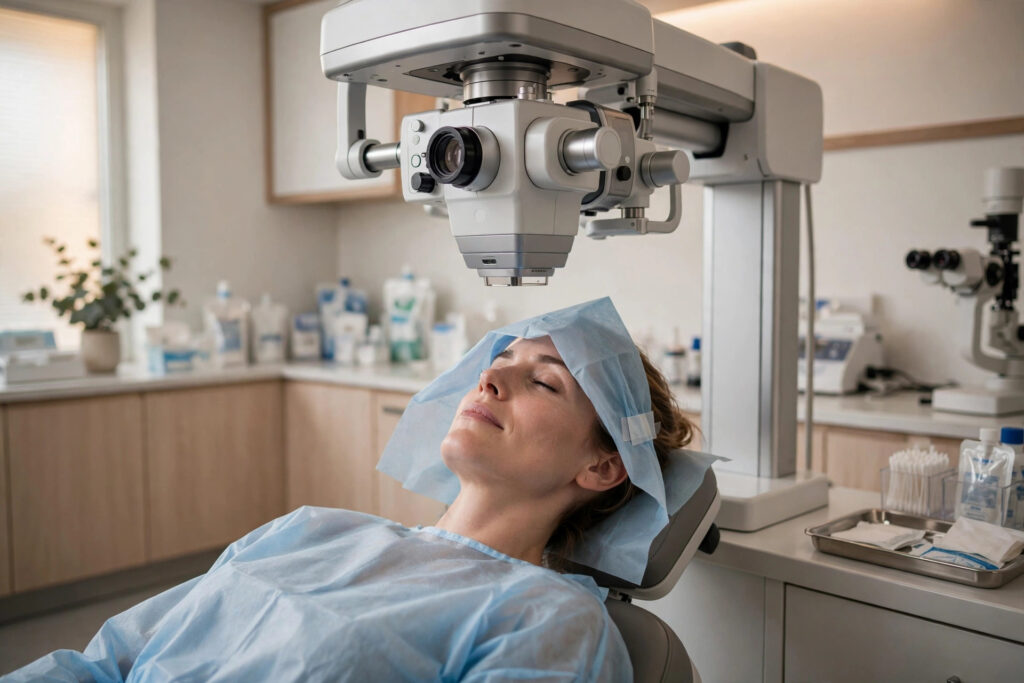
For most patients, the idea of LASIK is more intimidating than the reality. The entire procedure takes only minutes per eye, you remain awake and comfortable throughout, and there is no pain in the conventional sense. Understanding exactly what happens during LASIK removes the fear of the unknown, which is why surgeons encourage patients to learn the sequence before surgery day.
This walkthrough follows a typical LASIK surgery day from check-in to the ride home, describing what you will see, hear, and feel at each stage. Every clinic has its own choreography, but the underlying steps are the same everywhere. If anything here raises a concern, discuss it with a qualified refractive eye surgeon at your pre-operative visit rather than on the day itself.
Table of Contents
- Arriving and Checking In
- Numbing and Preparation
- Creating the Corneal Flap
- Reshaping the Cornea
- Repositioning and Final Checks
- The First Minutes After Surgery
Arriving and Checking In
Surgery day usually starts with a short check-in and a final round of measurements. The clinic confirms your identity and consent, re-verifies your prescription, and often repeats key scans to make sure nothing has changed since your consultation. Some clinics also re-check the treatment plan loaded into the laser against your file, a quiet double-verification that is easy to overlook but important for safety.
You will be given any pre-operative drops the surgeon prescribes, and a staff member walks you through what to expect and the aftercare routine you will follow at home. This is also when you will arrange the practical details: you must have someone drive you home, since your vision will be hazy afterward and the numbing drops are still wearing off. Wear comfortable clothing, skip makeup, perfume, and hair products that could shed particles near the sterile field.
Many patients feel nervous at this stage, which is completely normal. Clinics are used to it, and some offer a mild oral sedative to take the edge off; if anxiety is a concern for you, mention it at the pre-operative visit so it can be planned for. A thorough How to Prepare for an Eye Exam“>eye exam in the weeks before means the surgical plan is already settled, so surgery day itself is about execution, not decisions.
Numbing and Preparation
LASIK is performed with numbing eye drops, not injections or general anesthesia. The drops take effect within a minute or two, and the surgeon confirms the eye is fully numb before beginning. You will feel touch and pressure during the procedure but no sharp pain; the drops block the pain fibers of the cornea effectively.
You recline in a chair that slides beneath the laser platform, and the area around the eye is cleaned. A small instrument called a lid speculum gently holds your eyelids open so you cannot blink during the critical moments. Patients often worry about this part, but the speculum is not painful, and the numbing drops mean you feel it as mild pressure at most. The eye is kept moist with drops throughout.
Before the laser fires, an alignment system locks onto your eye. Modern platforms use eye-tracking that follows tiny involuntary eye movements hundreds of times per second and pauses or adjusts the laser if you move beyond a safe range. You will be asked to look at a small fixation light; holding your gaze there is your main job during the procedure, and it is easier than most people expect.
Creating the Corneal Flap
The first laser step creates the thin hinged flap in the cornea. In most 2026 practices this is done with a femtosecond laser, which delivers rapid pulses of light at a precise depth to separate tissue along a near-complete circle, leaving a small hinge. Older microkeratome blades are now uncommon, though the flap concept is the same either way.
During flap creation, a suction ring steadies the eye. This is the part of the procedure patients notice most: vision dims or goes dark for roughly half a minute and there is a sensation of firm pressure, sometimes described as a finger pressing on the eyelid. It is brief, and the surgeon talks you through it. Once the suction releases, the pressure sensation fades immediately.
The surgeon then gently lifts and folds back the flap, exposing the underlying corneal tissue that will be reshaped. The flap itself is only about a tenth of a millimeter thick, and this step takes well under a minute. What surprises many patients is how quickly it passes; the flap creation that loomed so large in their imagination is over before they have time to dwell on it.
Reshaping the Cornea
With the flap folded back, the excimer laser reshapes the exposed corneal tissue according to your treatment plan. The laser removes microscopic amounts of tissue with each pulse, flattening the cornea for nearsightedness, steepening it for farsightedness, or smoothing an irregular curve for astigmatism. You will hear a soft clicking or buzzing sound and may notice a faint odor, sometimes compared to singed hair, which is simply the laser interacting with tissue and is entirely normal.
The reshaping itself typically lasts well under a minute per eye, with the exact time depending on the size of your correction. You stare at the fixation light while the eye-tracker keeps the treatment centered. Because the cornea has no pain fibers active under the numbing drops, patients generally report feeling nothing during the ablation beyond awareness that something is happening.
Technology has refined this step considerably. Contemporary treatments often use wavefront- or topography-guided profiles customized to the individual eye’s optical fingerprint rather than a generic prescription-only plan. The American Academy of Ophthalmology’s LASIK page describes how these custom treatments fit into modern practice.
Repositioning and Final Checks
Once the reshaping is complete, the surgeon carefully folds the flap back into place. It adheres naturally to the underlying tissue without stitches, settling into its original position like a puzzle piece. The surgeon smooths it, checks the edges under the microscope, and irrigates beneath it to remove any microscopic debris or cells that could interfere with healing.
You will notice vision is already different, though hazy, as if looking through water or fog. The surgeon performs a final inspection to confirm the flap is smooth and centered, then the speculum is removed. Some clinics place a clear protective shield over the eye, which you will wear while sleeping for the first several nights to prevent accidental rubbing.
The whole sequence, both eyes, is typically finished within about fifteen minutes of entering the laser suite, with the lasers themselves active for only a small fraction of that time. Many patients laugh afterward at how anticlimactic it feels compared to the weeks of anticipation. Your driver takes you home, where the main instruction is simple: rest with your eyes closed.
The First Minutes After Surgery
As the numbing drops wear off over the first few hours, most patients experience a gritty, burning, or watery sensation, often compared to having an eyelash in the eye or to the aftermath of swimming in a chlorinated pool. This is the normal response of the corneal nerves waking up, not a sign of damage. Preservative-free lubricating drops and a nap are the standard remedies, and the discomfort typically peaks within a few hours and fades by the next morning.
Light sensitivity is common on day one, so dim rooms and Oversized Sunglasses: Face Shape Guide“>sunglasses help if you must go outside. Your clinic will give you a schedule of medicated drops, usually an antibiotic and an anti-inflammatory, and clear rules: no eye rubbing, no swimming, no eye makeup, and no dusty or smoky environments for the period the surgeon specifies. Follow these exactly; they protect the flap while it adheres.
Vision is usually functional by the evening of surgery and noticeably sharper the next morning, when most patients return for their day-one check. That appointment confirms the flap is in place and healing cleanly. In the following weeks, as healing settles, many patients find their vision continues to sharpen. Former Can You Wear Contacts With Pink Eye?“>contact lens wearers often describe the first clear morning as the moment the decision feels real. The FDA’s guide to what to expect during and after LASIK surgery covers the recovery milestones in more detail.