A LASIK consultation is not a sales appointment; it is the medical screening that determines whether laser vision correction is safe for your eyes. Even if you arrive certain you want the procedure, the consultation comes first, and a meaningful share of interested patients learn during it that LASIK is not right for them. That outcome is exactly what the screening exists to produce, and a clinic that turns away unsuitable candidates is a clinic worth trusting.
Knowing what happens at a LASIK consultation helps you arrive prepared and ask sharper questions. This guide walks through each stage of a typical refractive screening as practiced in 2026, from intake paperwork to the final recommendation, and explains what each test actually measures. As with any elective surgery, bring your questions and discuss your individual situation with a qualified refractive eye surgeon.
Table of Contents
- What a LASIK Consultation Is For
- Preparing for Your Visit
- Vision and Refraction Testing
- Corneal Mapping and Measurements
- Eye-Health Screening
- Discussing Results and Next Steps
What a LASIK Consultation Is For
The core purpose of a LASIK consultation is candidacy screening. The clinic needs to answer three questions: is your prescription stable enough to treat, is your cornea thick and regularly shaped enough to treat safely, and are your eyes otherwise healthy? Only when all three answers are yes does the conversation turn to scheduling. This gatekeeping role is why reputable surgeons describe the consultation as the most important part of the entire LASIK process.
Expect the visit to take longer than a routine What to Bring to Your First Eye Exam“>eye exam, often one to two hours, because the testing is far more detailed. A technician usually performs the measurements first, and the surgeon reviews the results with you afterward. Some clinics offer the screening at no charge, while others apply a fee that is credited toward surgery; either model is legitimate, but the quality of the testing matters far more than the price of the visit.
Be wary of any consultation that feels rushed or skips the detailed measurements described below. High-pressure tactics, same-day surgery scheduling before results are reviewed, and prices far below the local norm are all reasons to get a second opinion. A thorough consultation is slow, methodical, and transparent about risks.
Preparing for Your Visit
The single most important preparation is leaving your Are Contact Lenses Safe Long Term?“>contact lenses out for the period your clinic specifies. Contacts temporarily reshape the cornea, and measuring a cornea that has been molded by lenses produces inaccurate maps. Many clinics ask soft-lens wearers to switch to glasses for one to two weeks and hard or rigid gas-permeable wearers for several weeks, though the exact guidance varies by practice.
Bring your current glasses, a list of medications and supplements, and your eye history: previous diagnoses, injuries, surgeries, and how long your prescription has been stable. If you have records from a recent eye exam, bring those too. It also helps to write down your questions in advance, because the volume of information at the visit can make it easy to forget what you wanted to ask.
On the day itself, skip eye makeup and heavy facial moisturizers, which can interfere with measurements. Plan for your eyes to be dilated during the exam, which blurs near vision and increases light sensitivity for several hours, so arrange a ride home or bring sunglasses. Many patients bring a companion anyway, since two sets of ears help absorb the details.
Vision and Refraction Testing
The consultation opens with the familiar vision tests, done to a more exacting standard than at a routine checkup. You will read the letter chart with each eye to establish uncorrected and corrected acuity, then undergo a careful refraction, the “which is better, one or two” sequence, to pin down your exact prescription. The goal is precision, because the laser will be programmed from these numbers.
Many clinics also perform a cycloplegic refraction, where drops temporarily relax the eye’s focusing muscle before the prescription is measured. Younger patients especially can “push through” extra focusing effort and make their prescription look different than it really is; the drops reveal the true refractive error. The blurriness and light sensitivity from these drops wear off over several hours.
Pupil size is measured in dim light, since very large pupils were historically associated with a higher chance of nighttime glare and halos after treatment. Modern laser profiles have reduced this concern considerably, but it remains one of the data points the surgeon weighs. Your prescription history is also reviewed: surgeons generally want evidence of stability, often defined as little change over the previous year or two, before treating.
Corneal Mapping and Measurements
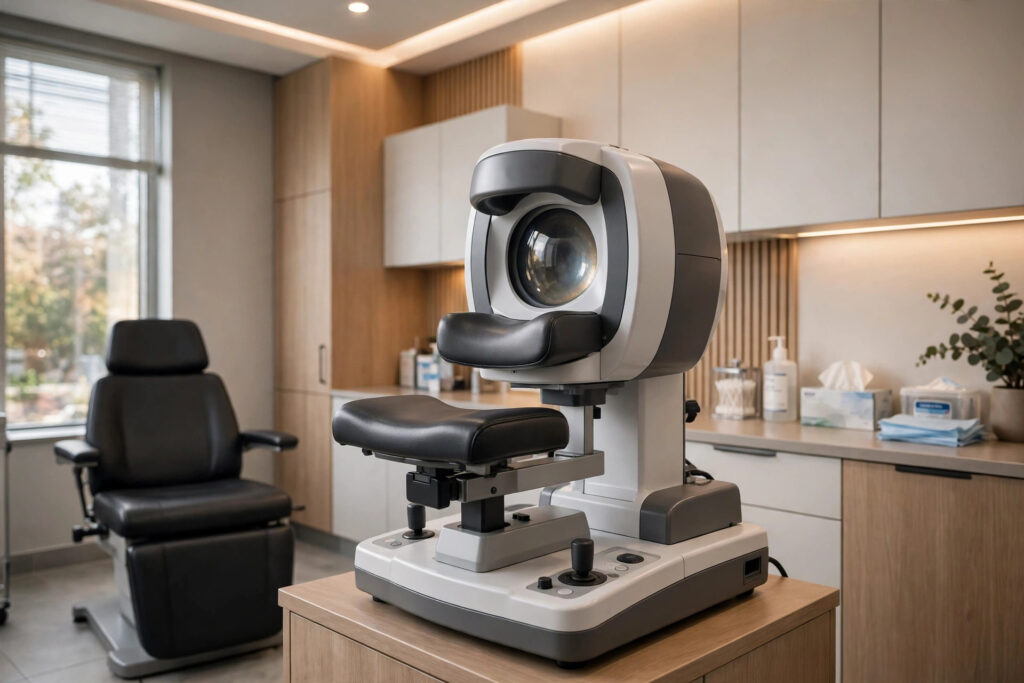
Corneal topography is the centerpiece of the screening. A topographer projects rings of light onto the cornea and builds a detailed color map of its curvature, revealing irregularities invisible to standard instruments. The surgeon studies this map for early signs of keratoconus or other ectatic conditions, which are among the firmest reasons to decline LASIK, since laser thinning of an already weak cornea can cause serious problems.
Corneal thickness, or pachymetry, is measured with equal care, because LASIK permanently removes tissue. The surgeon needs enough residual thickness beneath the flap to keep the cornea structurally sound. Thin corneas are not an automatic disqualification, but they narrow the safety margin, and many borderline patients are steered toward surface procedures or lens-based alternatives instead.
Additional measurements may include wavefront aberrometry, which maps subtle optical imperfections beyond basic nearsightedness, farsightedness, and astigmatism, and tear-film analysis to gauge dry eye. Together these maps let the surgeon choose whether to treat, which laser profile to use, and what outcome to expect. The FDA’s guidance on LASIK risks and choosing a surgeon explains why this measurement phase is so central to safety.
Eye-Health Screening
Beyond the refractive measurements, the consultation includes a full health check of the eye. A slit-lamp examination lets the surgeon inspect the cornea, lens, and eyelids under magnification, looking for scarring, inflammation, blepharitis, or lens changes. Tear production and tear-film stability are assessed because significant dry eye can worsen after laser treatment and may need to be managed first.
The retina is examined through dilated pupils. Retinal tears, lattice degeneration, or other peripheral weaknesses do not necessarily rule out LASIK, but they may need treatment before any elective procedure, since the suction applied during flap creation briefly raises eye pressure. Eye pressure itself is checked as part of glaucoma screening, and the optic nerve is evaluated.
Certain findings pause or end the LASIK conversation: uncontrolled dry eye, active eye infection or inflammation, keratoconus, significant cataract, uncontrolled glaucoma, and some autoimmune conditions that impair healing. Pregnancy and nursing are reasons to wait rather than permanent disqualifications. None of these judgments are made lightly, and a good surgeon explains the reasoning in plain language rather than simply saying no.
Discussing Results and Next Steps
After the testing, the surgeon reviews your results and gives a candidacy verdict. If you qualify, the discussion turns to which procedure fits best: standard LASIK, a topography- or wavefront-guided treatment, or sometimes an alternative such as PRK or an implantable lens. The surgeon should explain the expected outcome for your specific prescription, the realistic risks including dry eye and night-vision effects, and what the enhancement policy is if a touch-up is ever needed.
If you do not qualify, ask why, and ask what alternatives exist. Many patients who are poor LASIK candidates are excellent candidates for something else, and modern How to Measure Your Pupillary Distance (PD) at Home“>eyeglasses and contact lenses remain strong non-surgical options with none of surgery’s risks. A clinic that offers several procedures is better positioned to give unbiased advice than one that offers only LASIK.
You should never feel pressured to decide on the spot. Take the written information home, compare a second opinion if anything feels unclear, and be cautious of limited-time pricing designed to force a quick yes. Good questions to ask include how many procedures the surgeon performs annually, how complications are handled, and what the total cost covers. The American Academy of Ophthalmology’s LASIK overview is a solid neutral reference to read before and after your visit.