
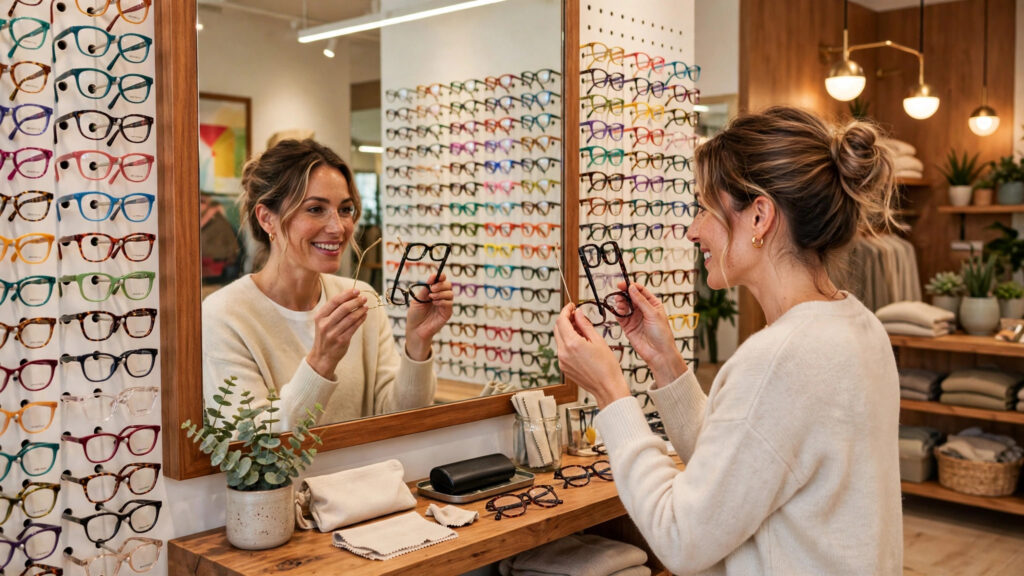
Finding the right eyeglass frames is about much more than picking a style you like off the shelf. The frames you wear sit at the center of your face, which means their shape, size, and proportions either work with your features or against them. When you learn how to choose eyeglass frames for your face shape, you end up with glasses that look intentional, feel comfortable, and give you confidence every time you put them on.
This 2026 guide walks you through the process step by step. You will learn how to identify your face shape, understand the simple contrast rule that professional stylists use, and discover which frame styles flatter round, square, oval, and heart-shaped faces. We will also cover sizing, fit, and the frame trends worth trying this year.
Table of Contents
- Identify Your Face Shape First
- The Golden Rule: Contrast Creates Balance
- Frames for Round Faces
- Frames for Square Faces
- Frames for Oval and Heart-Shaped Faces
- Size, Fit, and Comfort Matter Too
- 2026 Frame Trends Worth Trying
Identify Your Face Shape First
Before you can choose eyeglass frames for your face shape, you need to know what shape you are working with. Pull your hair back, look straight into a mirror, and trace the outline of your face with a washable marker or simply observe the proportions. The four most common face shapes are round, square, oval, and heart-shaped, and each has distinct characteristics that frame choices should respond to.
A round face has soft curves with roughly equal width and length, full cheeks, and a rounded chin. A square face features a strong jawline, a broad forehead, and angular proportions where the width of the forehead, cheekbones, and jaw are similar. An oval face is longer than it is wide, with balanced proportions and a gently rounded chin. A heart-shaped face has a wide forehead that narrows down to a pointed or narrow chin. Some people fall between two shapes, and that is completely normal; in that case, pick the shape that matches your most prominent features.
Getting this right matters because it sets the foundation for every decision that follows. If you are unsure, ask your optician during your next visit. They assess face shapes and frame proportions all day, and their advice is usually free when you are shopping for glasses.
The Golden Rule: Contrast Creates Balance
Professional frame stylists follow one core principle when helping people choose eyeglass frames for their face shape: pick frames that contrast with your facial features. Angular faces look best in rounded or curved frames that soften sharp lines, while round faces look best in angular or geometric frames that add definition. This contrast creates visual balance and keeps any single feature from dominating your appearance.
Contrast applies to proportions as well as shapes. If your face is wide, frames that are slightly wider than your face can create a slimming effect, while narrow faces benefit from frames that do not extend too far past the cheekbones. The goal is harmony: your glasses should complement your face rather than mirror it or overwhelm it.
There is one exception worth noting. Oval faces are considered the most versatile, so people with oval faces can experiment with almost any frame shape. The contrast rule is a starting point, not a prison. If you love a style that breaks the rule and you feel great in it, wear it with confidence.
Frames for Round Faces
Round faces benefit from frames with angles and clean lines that add structure. Rectangular frames are the classic recommendation because their straight edges create the illusion of a longer, slimmer face. Wayfarer-style frames work beautifully for the same reason, and square frames with slightly rounded corners strike a nice middle ground for people who want definition without harshness.
Geometric shapes like hexagons and octagons are increasingly popular options that give round faces a modern, fashion-forward edge. Avoid small round frames and oversized circular styles, which tend to emphasize fullness rather than balancing it. Clear or translucent frames can also work well since they add less visual weight to the face.
Frame width matters here too. Look for frames where the outer edges sit close to the widest part of your face without extending past it. A slightly upswept shape, such as a subtle cat-eye, can lift the cheek area and add welcome definition.
Frames for Square Faces
Square faces shine in round and oval frames that soften a strong jawline and angular forehead. The curves of these frames contrast with straight facial lines, creating a pleasing balance that draws attention to your eyes rather than your jaw. Rimless and semi-rimless styles are excellent choices because they add minimal visual weight and keep the overall look light.
If you prefer something with more presence, look for round frames in thinner materials like lightweight titanium or slim acetate. Oversized round frames are a fashion favorite that can work well on square faces as long as the proportions stay balanced. Avoid narrow rectangular frames and sharp geometric shapes, which can make an angular face look boxy.
Color can help as well. Softer tones like tortoiseshell, champagne, or muted blues reduce the visual sharpness of square features, while very dark, heavy frames can emphasize angularity. The American Academy of Ophthalmology notes that properly fitted eyewear should sit comfortably without pinching, which matters for both looks and long-term eye health.
Frames for Oval and Heart-Shaped Faces
Oval faces can wear nearly any frame shape, which makes shopping fun but can also feel overwhelming. The main guideline is proportion: choose frames that are as wide as or slightly wider than the broadest part of your face, and avoid frames that are excessively large or small. Walnut-shaped and rectangular frames maintain the natural balance of an oval face, while bold geometric shapes let you make a style statement.
Heart-shaped faces look best in frames that are wider at the bottom or have low-set temples, since these add width where the face narrows. Round frames, light-colored frames, and rimless designs all work well. Cat-eye shapes are a classic flattering choice for heart faces because their upswept corners balance a narrower chin. Avoid top-heavy frames or styles with heavy brow lines, which can make the forehead appear even wider.
Both shapes benefit from paying attention to bridge fit. A well-fitted bridge keeps glasses from sliding and prevents pressure marks. The same fitting principles apply when you shop for sunglasses with proper UV protection, so use what you learn here across all your eyewear.
Size, Fit, and Comfort Matter Too
Even the most flattering frame shape fails if the size is wrong. Check three contact points: the bridge, the temples, and the area behind your ears. The bridge should rest evenly without pinching or sliding, the temples should run straight back without pressing into your head, and the earpieces should curve gently without digging in. Glasses that constantly slide down your nose or leave red marks are the wrong size, no matter how good they look in the mirror.
Frame measurements, usually printed on the inside of the temple arm, tell you the lens width, bridge width, and temple length in millimeters. Knowing your numbers makes online shopping far more reliable. If you already own a comfortable pair, use its measurements as your baseline and look for similar sizes.
Comfort also depends on weight and materials. Titanium and memory metal frames are featherlight and durable, while acetate offers rich colors and patterns at a slightly heavier weight. Pair your chosen frames with the right lens technology for your prescription, such as high-index lenses for strong prescriptions or anti-reflective coatings for screen work, and the whole package will feel as good as it looks.
2026 Frame Trends Worth Trying
This year’s eyewear trends favor personality and craftsmanship. Translucent and crystal acetate frames remain strong, offering a modern look that suits many face shapes. Bold geometric shapes, including chunky hexagons and softened squares, are everywhere in designer collections. Sustainable frames made from recycled acetate and bio-based materials continue to grow, letting you choose eyeglass frames for your face shape while supporting eco-friendly manufacturing.
Vintage-inspired round frames in warm tortoiseshell and amber tones are having a major moment, and they work especially well on square and heart-shaped faces. For a minimalist look, ultra-thin metal frames in gold and rose gold remain timeless. Whatever trend catches your eye, run it through the principles in this guide: check the contrast with your face shape, verify the size, and make sure the fit is comfortable.
For more detailed guidance on specific frame materials and lens pairings, All About Vision offers in-depth eyeglass buying guides that complement what you have learned here. Take your time, try on plenty of pairs, and trust both the guidelines and your instincts.