
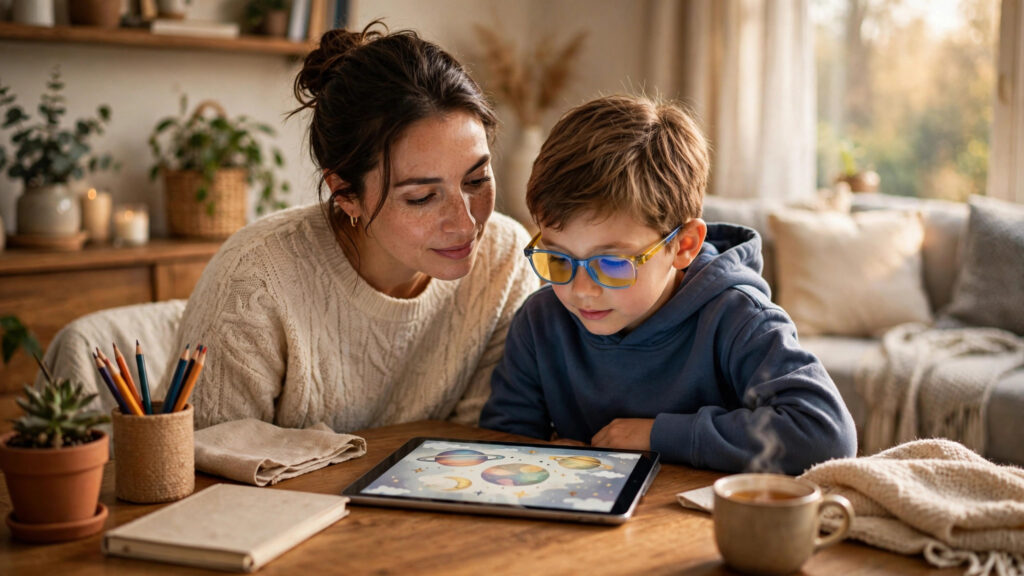
Blue light has become the villain of the digital age — blamed for everything from eye damage to poor grades, with an entire industry selling blue-light glasses to worried parents. But what does the science actually say about blue light and children’s eyes? The answer is more nuanced, and less alarming, than the marketing suggests.
This guide separates fact from hype: what blue light is, where children encounter it, what research shows about eye health and sleep, and what parents should actually do.
Table of Contents
- What Blue Light Is
- Where Children Encounter It
- Blue Light and Eye Damage: The Evidence
- Blue Light and Sleep: The Real Concern
- Blue Light Glasses: Do They Help?
- What Parents Should Actually Do
What Blue Light Is
Blue light is simply the high-energy, short-wavelength portion of the visible light spectrum (roughly 380-500 nanometers). It is not a pollutant or a toxin — it is a normal part of sunlight, and humans evolved under it. The sky looks blue because of scattered blue light; daylight is rich in it.
Not all blue light is equal. The violet-blue band (380-450nm) carries the most energy; the blue-turquoise band (450-500nm) regulates circadian rhythms and alertness. Screens emit mostly in the less-energetic blue-turquoise range, at intensities far below sunlight.
Understanding this context deflates much of the fear: children have always been bathed in blue light every time they step outdoors. The question is not whether blue light is “toxic” but whether the specific doses and timing from screens cause problems — and the evidence points to timing (sleep) far more than toxicity.
Where Children Encounter It
The sun dwarfs all artificial sources: outdoor daylight delivers 10,000+ lux with abundant blue light, while a tablet at typical brightness delivers a few hundred lux. A child playing outside for an hour receives vastly more blue light than from a full day of screen use — along with genuine benefits for myopia prevention and mood.
Indoor sources include LED and fluorescent lighting, tablets, phones, computers, and TVs. Modern screens are LED-backlit and do emit blue light, but at levels well within established safety standards. No consumer screen approaches the blue-light intensities used in laboratory studies of retinal damage.
This dose perspective matters because it reframes the issue: if blue light from screens were meaningfully damaging, outdoor play — with 10-100x the dose — would be catastrophic. Instead, outdoor time is the single most protective factor for children’s developing vision.
Blue Light and Eye Damage: The Evidence
Laboratory studies have shown that intense blue light can damage retinal cells in petri dishes and in animals exposed to extreme intensities. These findings get cited in marketing — but they do not translate to human screen use. The intensities in those studies exceed screen emissions by orders of magnitude, and the eye’s natural defenses (the cornea and lens filter much blue light; the macular pigment absorbs more) were absent in cell cultures.
No credible epidemiological study has linked screen use to retinal damage, macular degeneration, or any structural eye injury in humans. The American Academy of Ophthalmology does not recommend blue-light glasses for eye protection, stating there is no scientific evidence that blue light from screens damages eyes.
Digital eyestrain — dryness, fatigue, headaches — is real, but it is caused by reduced blinking, sustained focusing, and poor ergonomics, not by blue light photons injuring the retina. Treating the actual causes (breaks, blinking, correct prescriptions) works; filtering blue light does not address them.
Blue Light and Sleep: The Real Concern
Here the science is solid: blue-turquoise light in the evening suppresses melatonin, delays sleep onset, and degrades sleep quality. Children’s eyes transmit more blue light to the retina than adults’ (their lenses are clearer), and their circadian systems are more sensitive — making them more vulnerable to evening screen effects.
Studies show that screen use in the hour before bed is associated with later bedtimes, shorter sleep duration, and poorer sleep quality in children and teens. Poor sleep, in turn, affects learning, mood, behavior, and even myopia progression — making this the blue-light issue genuinely worth parental attention.
The mechanism is about timing, not toxicity: daytime blue light is beneficial (alertness, mood, circadian entrainment), while evening blue light confuses the brain’s clock. This is why “no screens an hour before bed” is among the most evidence-backed rules in pediatric health guidance.
Blue Light Glasses: Do They Help?
Blue-light-filtering glasses are marketed as protecting eyes from screen damage — a claim without scientific support for the damage part. Randomized trials have found no meaningful reduction in eyestrain from blue-light lenses compared to clear lenses. What they do reliably: give a slight yellow tint to the world and lighten wallets.
For sleep, the evidence is mixed but slightly more favorable: wearing amber-tinted glasses that block most blue light in the evening may modestly improve sleep onset in some people. But free alternatives — night mode settings, dimming screens, and simply stopping screen use before bed — achieve the same or better results without special eyewear.
If your child needs prescription glasses, adding a blue-light coating is harmless but should not be sold as eye protection. Spend the money instead on features with proven benefit: impact-resistant polycarbonate lenses, proper fit, and a backup pair.
What Parents Should Actually Do
Focus on what the evidence supports: enforce a screen curfew (no screens 60 minutes before bed; charge devices outside bedrooms overnight), use night-mode/warm-color settings in the evening, keep daytime screen sessions broken up with the 20-20-20 rule, and prioritize 2+ hours of outdoor time daily.
Ensure screens are not the scapegoat for correctable vision problems: a child with headaches during screen schoolwork may need an updated prescription or binocular vision assessment, not a blue-light filter. Regular comprehensive eye exams catch these issues.
The National Eye Institute advises parents to focus on healthy screen habits rather than blue-light products. Save the blue-light anxiety for the marketing departments — and put the energy into sleep hygiene, outdoor play, and real eye care instead.