
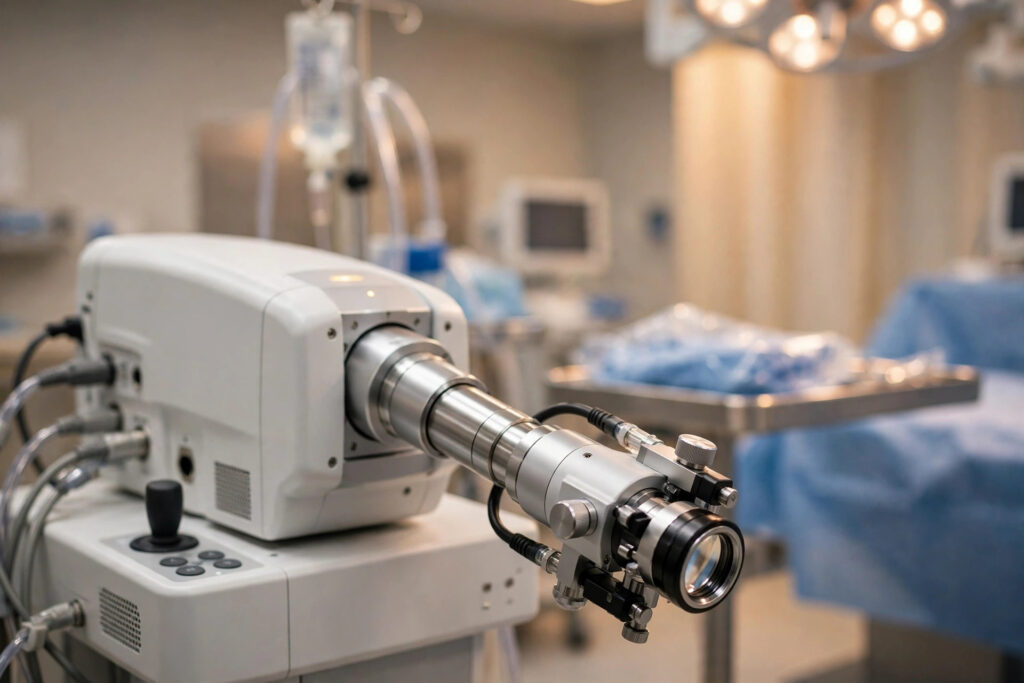
Bladeless LASIK, also called all-laser LASIK, is the modern standard for creating the corneal flap: instead of a mechanical blade, a femtosecond laser carves the flap with pulses of light. The term “bladeless” can be confusing, since a second laser still does the vision-correcting reshaping, so this article explains exactly what the femtosecond laser does, how it differs from the older blade method, and what it means for safety and results.
In 2026, the overwhelming majority of reputable LASIK practices use femtosecond technology for flap creation, and the blade-based microkeratome has become rare. Understanding the technology helps you ask better questions at your consultation. As with any elective procedure, discuss your individual suitability with a qualified refractive eye surgeon.
Table of Contents
- What “Bladeless LASIK” Means
- How the Femtosecond Laser Works
- Blade vs. Laser Flap Creation
- Benefits of the Femtosecond Approach
- Considerations and Limits
- Is Bladeless Right for You?
What “Bladeless LASIK” Means
All LASIK involves two distinct steps: creating the thin corneal flap, and reshaping the tissue beneath it with an excimer laser. “Bladeless” refers only to the first step. In bladeless LASIK, a femtosecond laser creates the flap; in traditional LASIK, a mechanical instrument called a microkeratome, essentially a precise oscillating blade, cut it. The reshaping laser is the same in both approaches.
The name is partly marketing, but the technology difference is real. A femtosecond is one quadrillionth of a second, and the laser delivers its energy in pulses so brief that tissue is separated with minimal heat and minimal effect on surrounding areas. This precision is what allows the laser to work at a programmed depth inside the cornea without cutting from the outside in.
Because femtosecond flap creation has become the norm, many clinics no longer bother with the “bladeless” label at all; it is simply how LASIK is done. If a clinic still offers a blade-based option, usually at a lower price, it is worth understanding exactly what you would be giving up before choosing it on cost alone.
How the Femtosecond Laser Works
The femtosecond laser focuses ultrashort pulses of infrared light at a precise depth within the cornea, typically around one tenth of a millimeter beneath the surface. Each pulse creates a microscopic bubble of gas and water vapor; millions of these bubbles placed side by side form a cleavage plane that separates the flap from the underlying tissue. The laser then cuts the flap’s edge in a near-complete circle, leaving a small hinge of uncut tissue.
The whole flap creation takes roughly twenty to thirty seconds per eye. During it, a suction ring steadies the eye and your vision dims briefly, the same pressure sensation patients experience in any LASIK procedure. The surgeon then lifts the flap, which separates cleanly along the bubble plane, and proceeds with the excimer reshaping step.
What makes this remarkable is the programmability. The surgeon sets the flap’s diameter, thickness, hinge position, and edge angle in software before the laser fires, and the laser reproduces those parameters with a consistency no hand-guided blade can match. Advances in Anti-Scratch Coating on Glasses: Is It Worth It?“>lens technology get more attention in eyewear, but this is precision optics applied inside the eye itself.
Blade vs. Laser Flap Creation
The microkeratome cut flaps by drawing an oscillating blade across the cornea, with flap thickness determined by the blade head and the pressure applied. In skilled hands it worked well for many years and millions of successful procedures were performed with it. But thickness varied more from eye to eye, and the meniscus-shaped flaps it produced were thinner at the edges, a geometry associated with a higher rate of certain complications.
Femtosecond flaps are planar, meaning uniform thickness across the whole flap, and the thickness actually achieved matches the programmed thickness far more closely. The edge can be cut at an angle that helps the flap lock back into place, and the hinge can be positioned to suit the eye. Studies comparing the two methods consistently show more predictable flap dimensions and fewer flap-related complications with the laser.
The practical upshot is that femtosecond technology expanded the pool of safe candidates slightly: eyes with thinner corneas or flatter or steeper curvatures that were marginal for a blade flap can often be treated safely with a precisely programmed thin laser flap. Your surgeon still applies conservative safety margins, but the margins can be measured rather than estimated.
Benefits of the Femtosecond Approach
Precision is the headline benefit. Predictable flap thickness means the surgeon knows exactly how much tissue remains beneath the flap, which is the key safety number in LASIK planning. That predictability is a major reason serious complications from flap creation have become rarer as the technology has spread.
The uniform planar shape and angled edge geometry contribute to better flap stability and smoother healing. Surgeons also value the customization: flap diameter can be matched to pupil size and treatment zone, and the hinge can be placed to avoid disrupting nerves in a pattern that suits the individual eye. Some evidence suggests this customization contributes to the lower rates of post-operative dry eye reported with femtosecond flaps compared to blade flaps, though dry eye remains possible with either.
There is also a workflow benefit patients rarely see: because the laser is computer-guided, the outcome depends less on the surgeon’s manual dexterity during flap creation and more on the planning. That does not make surgeon experience irrelevant, far from it, but it standardizes the step that historically carried the most variability. A comprehensive What Happens During an Eye Exam? Step by Step“>eye exam and careful treatment planning remain the surgeon’s real craft.
Considerations and Limits
Bladeless LASIK is not risk-free, and honest clinics say so. The suction required for femtosecond flap creation briefly raises eye pressure, which is why retinal screening is part of the consultation. A small number of patients experience transient light sensitivity in the days after surgery, a femtosecond-specific effect that is usually mild and resolves with standard aftercare.
Cost is the other consideration. Femtosecond platforms are expensive to buy and maintain, and bladeless LASIK typically costs more than blade-based LASIK where both are offered. Most surgeons and most published comparisons consider the premium justified by the precision and safety gains, but it is a legitimate factor in the decision, and bargain pricing on laser vision correction of any kind deserves skepticism.
It is also worth keeping perspective: the femtosecond laser perfects only the flap step. The quality of the vision outcome still depends on the accuracy of the measurements, the appropriateness of the treatment plan, the excimer laser’s calibration, and the surgeon’s judgment. A clinic with the newest femtosecond platform but sloppy screening is a worse choice than a careful surgeon using established equipment. The FDA’s overview of laser vision correction procedures puts the technology in the context of overall procedure safety.
Is Bladeless Right for You?
For the large majority of LASIK candidates in 2026, bladeless is simply what they will receive, and there is no real decision to make; the question answers itself. The choice matters mainly if you encounter a clinic offering a cheaper blade-based option, or if you are comparing quotes and wondering what the price difference buys. In most cases, it buys measurable precision and a better safety profile.
There are eyes for which neither LASIK variant is appropriate: thin or irregular corneas, significant dry eye, unstable prescriptions, and the other standard contraindications apply equally to bladeless procedures. The femtosecond laser does not rescue a poor candidate; it only makes a good candidate’s surgery more predictable. Candidacy screening remains the gatekeeper.
At your consultation, reasonable questions include which laser platform the clinic uses, how the surgeon decides flap parameters for your eyes, and what the clinic’s enhancement policy covers. And keep the alternatives in view: for some eyes, surface procedures or implantable lenses outperform any LASIK variant, and excellent How to Choose Eyeglass Frames for Your Face Shape: 2026 Guide“>eyeglasses remain a perfectly good outcome. The American Academy of Ophthalmology’s LASIK resource is a useful pre-consultation read.