
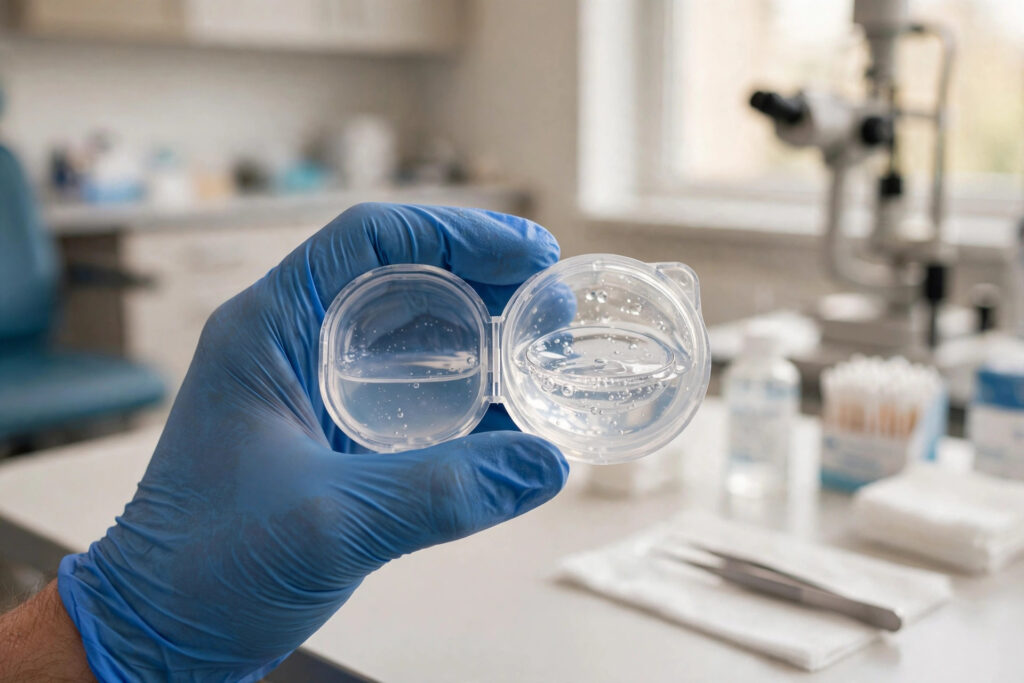
Most contact lenses sit directly on the cornea. Scleral lenses don’t — they vault completely over it, resting on the white of the eye (the sclera) and bathing the cornea in a reservoir of sterile saline. If you’ve been told regular contacts “just won’t work” for your eyes, scleral lenses might be the answer you haven’t heard of yet.
These large-diameter rigid lenses sound intimidating, but wearers consistently rate them among the most comfortable lenses available. Here’s who needs them, how they work, and what the fitting process involves.
Table of Contents
- How Scleral Lenses Work
- Keratoconus and Irregular Corneas
- Severe Dry Eye Disease
- Post-Surgical and Other Indications
- The Fitting Process
- Daily Life With Scleral Lenses
How Scleral Lenses Work
A scleral lens is a rigid gas-permeable lens, typically 14-20 mm in diameter — much larger than a standard 9-10 mm corneal rigid lens. Because it lands on the relatively insensitive sclera instead of the highly sensitive cornea, most wearers feel little to nothing once it’s settled. The space between the lens and the cornea fills with preservative-free saline during insertion, creating a liquid bandage that never dries out.
This vault serves two purposes: optically, the smooth front surface of the lens plus the fluid layer neutralizes corneal irregularities, delivering crisp vision even on distorted corneas; therapeutically, the constant fluid bath protects and hydrates the ocular surface all day. It’s an elegant solution that modern lens technology has made increasingly precise through advanced corneal mapping.
Keratoconus and Irregular Corneas
Keratoconus — a progressive thinning and cone-shaped bulging of the cornea — is the classic scleral lens indication. As the cornea distorts, glasses stop working and standard soft lenses drape over the irregularity without correcting it. Scleral lenses vault the entire cone, and the fluid reservoir optically erases the irregularity, often restoring 20/20 vision.
The same principle helps other irregular corneas: post-LASIK ectasia, corneal scarring, pellucid marginal degeneration, and irregular astigmatism after transplants. For these patients, scleral lenses aren’t a convenience — they’re often the only path to functional vision. Anyone with a corneal irregularity diagnosis should ask their specialist about scleral options during regular eye health monitoring.
Severe Dry Eye Disease
For severe dry eye — including Sjögren’s syndrome, graft-versus-host disease, and Stevens-Johnson syndrome — scleral lenses function as medical devices. The fluid reservoir keeps the cornea continuously bathed, relieving the burning and foreign-body sensation that makes daily life miserable and protecting against corneal breakdown.
Many dry eye patients who abandoned all contact lenses years ago find scleral lenses completely different: there’s no lens-cornea friction, no tear film to disrupt, just constant hydration. The National Eye Institute lists scleral lenses among management options for severe ocular surface disease, and eye doctors increasingly prescribe them for dryness that hasn’t responded to drops, plugs, or prescription therapy.
Post-Surgical and Other Indications
Scleral lenses help after corneal transplants, where the graft-host junction creates irregularity that glasses can’t fix, and after refractive surgery complications that leave the cornea irregular. They’re also used for high refractive errors that exceed the range of soft lenses, and for athletes or workers who need the stability of a lens that essentially can’t dislodge.
Less common indications include exposure keratopathy (where the lids don’t fully close), neurotrophic corneas that can’t feel damage occurring, and chemical burn recovery. In each case, the lens doubles as a protective therapeutic device — vision correction plus ocular surface protection in one.
The Fitting Process
Scleral fitting is a specialty service requiring corneal topography or tomography, trial lens sets, and often custom design software. Expect several visits: initial measurements and diagnostic fitting, then follow-ups to assess the vault clearance (typically 100-300 microns over the cornea), landing zone alignment on the sclera, and vision quality.
The learning curve for insertion and removal is real — filling the bowl with saline without spilling, then placing it on the eye, takes practice. Most patients master it within a week or two with in-office training. A skilled fitter is essential; this isn’t a service every practice offers, so ask specifically about scleral lens experience when choosing a provider.
Because scleral fitting is specialized, seek a practitioner with specific experience — ask how many scleral fits they perform monthly. An experienced fitter resolves issues faster and achieves better outcomes, particularly for complex corneas where the design tolerances are tightest.
Daily Life With Scleral Lenses
Daily scleral wear involves a morning ritual: fill each lens with preservative-free saline, insert, and go. Midday fogging — debris accumulating in the fluid reservoir — affects some wearers and is fixed by removing, rinsing, and reinserting. Evening removal, cleaning with prescribed solutions, and proper storage complete the routine.
Lenses typically last one to two years with proper care, and annual eye exams with vault reassessment keep the fit optimal as eyes change. The upfront cost is higher than standard lenses, but for people who need them, scleral lenses don’t just improve vision — they restore activities, careers, and comfort that irregular corneas or severe dryness had taken away.