
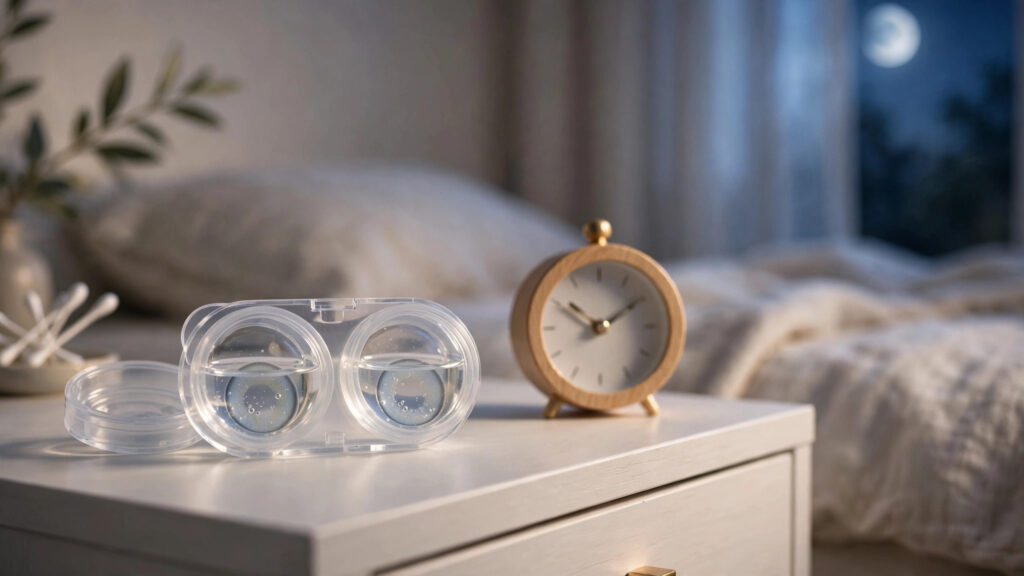
Imagine putting in special contact lenses at bedtime and waking up with clear vision — no glasses, no daytime lenses. That’s the promise of ortho-k lenses, the overnight vision correction method formally known as orthokeratology. It’s real, it’s been around for decades, and it’s gaining new attention for slowing myopia progression in children.
Ortho-k uses rigid gas-permeable lenses worn only while you sleep to gently reshape the cornea. This guide explains how it works, who it’s for, what results to expect, and the safety considerations that come with overnight wear.
Table of Contents
- How Orthokeratology Works
- Who Is a Good Candidate for Ortho-K?
- Myopia Control in Children
- What to Expect: Timeline and Results
- Safety, Risks, and Hygiene
- Cost and Long-Term Commitment
How Orthokeratology Works
Ortho-k lenses are custom-designed rigid gas-permeable lenses with a reverse-geometry shape: flatter in the center than a standard lens. Worn overnight, they apply gentle, precise pressure that redistributes corneal epithelial cells — flattening the central cornea to correct nearsightedness. Remove them in the morning, and the reshaped cornea focuses light correctly all day.
The effect is temporary and reversible. Skip a night or two and the cornea gradually returns to its original shape, which is both the safety net and the commitment: ortho-k only works with nightly wear. The reshaping is painless for most wearers after an initial adaptation period of a few nights, during which the rigid lens may feel noticeable with eyes closed.
Who Is a Good Candidate for Ortho-K?
Ideal candidates have mild to moderate myopia (typically up to about -6.00 diopters, depending on the design), low astigmatism, and healthy corneas. Athletes, swimmers, and people in dusty or dry occupations love ortho-k because daytime is completely lens-free — no dryness, no debris under lenses, no fogged glasses.
Children as young as six or seven can be fitted, which matters enormously for myopia control (more below). Poor candidates include those with high astigmatism, corneal irregularities like keratoconus, chronic dry eye, or anyone unlikely to follow strict overnight hygiene. A comprehensive fitting with corneal topography mapping determines candidacy — this is a specialty service, not a standard eye exam add-on.
Myopia Control in Children
Ortho-k’s most exciting role is slowing myopia progression in kids. Research shows orthokeratology can reduce the rate of myopia worsening by roughly 40-60% compared with standard glasses or daytime contacts, likely because the reshaped cornea changes peripheral focus in a way that signals the eye to slow its elongation.
This matters because high myopia raises lifetime risks of retinal detachment, glaucoma, and myopic maculopathy. For parents watching their child’s prescription climb every year, ortho-k offers a dual benefit: freedom from daytime correction plus a genuine intervention in the progression itself. The American Academy of Ophthalmology recognizes orthokeratology among evidence-based myopia control options, alongside low-dose atropine and specialized spectacle and soft lens designs.
What to Expect: Timeline and Results
Most wearers notice dramatically better unaided vision after the first night, with full correction typically achieved within one to two weeks of nightly wear. Early on, some people experience halos or glare around lights at night — this usually fades as the treatment zone stabilizes and the brain adapts.
The fitting process involves several visits: initial topography and trial lens assessment, then follow-ups at one day, one week, and one month to verify the corneal reshaping pattern. Lenses are typically replaced annually. Daytime vision generally lasts a full waking day; some wearers with higher prescriptions may notice slight regression by evening, which their fitter addresses with design tweaks.
Safety, Risks, and Hygiene
Any overnight lens wear carries a higher infection risk than daily wear, and ortho-k is no exception. Microbial keratitis, while uncommon with proper care, is the serious risk every ortho-k wearer must respect. Rigid lenses also require meticulous cleaning — protein and debris buildup affects both comfort and the precision of the corneal reshaping.
The non-negotiable rules: wash and dry hands before handling, use only the prescribed cleaning and conditioning solutions, never use tap water on lenses or cases, and attend every follow-up visit. Children need parental supervision of the entire routine — studies show supervised young wearers have excellent safety records. Ongoing eye health monitoring is built into ortho-k care by design, with regular topography checks confirming the cornea stays healthy.
Cost and Long-Term Commitment
Ortho-k costs more upfront than standard contacts — typically $1,000 to $2,000 for the initial fitting and first lenses, plus annual lens replacements and follow-up care. It’s rarely covered by basic vision plans, though some plans contribute. Spread over years of lens-free days, many families find the math reasonable, especially factoring in myopia control value.
The commitment is nightly wear indefinitely — stop, and the myopia returns within days. For adults, that’s a lifestyle choice; for children, it’s a years-long partnership between parents, child, and eye doctor. Modern lens technology keeps improving ortho-k designs, with wider treatment zones and better centration than early generations. If the idea of lens-free days appeals to you, a consultation with an ortho-k experienced fitter is the right first step.