
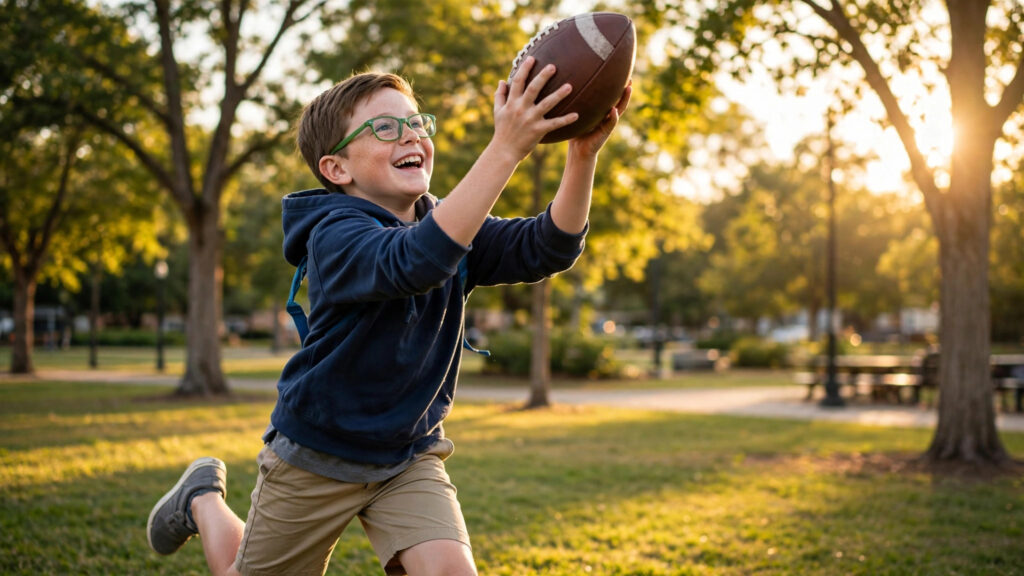
Childhood myopia (nearsightedness) is rising worldwide at an unprecedented rate — and it is not just about stronger glasses. Higher myopia significantly increases the lifetime risk of retinal detachment, glaucoma, and myopic maculopathy. Myopia control aims to slow how fast children’s eyes grow, reducing their final prescription and lifelong risk.
This guide explains the proven myopia control methods available in 2026, how each works, what the evidence shows, and how parents can discuss options with their eye doctor.
Table of Contents
- Why Myopia Control Matters
- Low-Dose Atropine Drops
- Orthokeratology (Overnight Lenses)
- MiSight and Multifocal Contacts
- Myopia Control Glasses
- Outdoor Time and Lifestyle
- Choosing the Right Approach
Why Myopia Control Matters
Myopia occurs when the eyeball grows too long, focusing light in front of the retina. Once it starts — typically between ages 6 and 12 — it usually progresses until the late teens. The concern is not the glasses; it is the elongated eye. Every additional diopter of myopia raises the risk of sight-threatening complications: retinal detachment risk climbs steeply above -6.00, and myopic maculopathy can cause irreversible central vision loss.
Standard glasses and contacts correct blur but do nothing to slow eye growth — the prescription keeps marching stronger each year. Myopia control interventions, by contrast, target the growth signal itself, typically slowing progression by 30 to 60 percent compared to single-vision correction.
The window for action is childhood. Eye growth slows naturally in the late teens, so interventions during the progression years (roughly ages 6-16) have the greatest lifetime impact. This makes early detection through regular pediatric eye exams the critical first step.
Low-Dose Atropine Drops
Low-dose atropine (typically 0.01% to 0.05%) is the most studied pharmaceutical approach. Originally a dilation drug, atropine at micro-doses slows eye elongation through mechanisms still being clarified — likely involving retinal signaling pathways rather than just relaxing focusing muscles. Children use one drop per eye nightly.
Major trials (ATOM, LAMP) show 0.05% atropine slows myopia progression by roughly 50-60% over two years, with 0.01% showing more modest but still meaningful effects and fewer side effects. Higher concentrations work better but cause more light sensitivity and near blur; the field has converged on balancing efficacy with tolerability.
Side effects at low doses are generally mild: slight pupil enlargement and light sensitivity (manageable with sunglasses outdoors), and occasional near focusing difficulty. Treatment typically continues through the progression years with periodic reassessment. Atropine requires a prescription and compounding or specialty pharmacy access in many regions — discuss availability with your eye doctor.
Orthokeratology (Overnight Lenses)
Orthokeratology (ortho-k) uses rigid gas-permeable lenses worn overnight to gently reshape the cornea. The child removes them in the morning and sees clearly all day without glasses or contacts — while the reshaping simultaneously creates the peripheral defocus signal that slows eye growth.
Studies show ortho-k slows axial elongation by approximately 40-50% compared to single-vision glasses. The dual benefit — daytime freedom from eyewear plus myopia control — makes it popular with active children and teens. It requires meticulous lens hygiene and regular follow-ups, since overnight wear carries a higher infection risk than daily disposable soft lenses.
Ortho-k suits motivated families: lenses must be worn every night, cleaned carefully, and replaced on schedule. Not every cornea is a candidate — very high prescriptions or irregular corneas may not qualify. The fitting is specialized, so seek a practitioner experienced in pediatric ortho-k specifically.
MiSight and Multifocal Contacts
MiSight 1 day by CooperVision is the first contact lens with FDA approval specifically for myopia control (approved 2019). These daily disposable soft lenses use concentric optical zones that simultaneously correct central vision and impose myopic defocus in the periphery — the optical signal that tells the eye to slow its growth.
The landmark clinical trial showed MiSight slowed myopia progression by 59% and axial elongation by 52% over three years compared to single-vision contacts. As daily disposables, they offer the safest soft-lens wearing modality for children: a fresh sterile lens every day, no cleaning, minimal infection risk.
Multifocal soft contacts (using center-distance designs) prescribed off-label for myopia control show similar efficacy in studies like BLINK. The choice between MiSight and multifocal designs often comes down to availability, cost, and the child’s prescription parameters. Either way, professional fitting and ongoing lens supervision are essential for young wearers.
Myopia Control Glasses
Special spectacle lenses — including DIMS (Defocus Incorporated Multiple Segments, as in Hoya MiYOSMART) and HAL (Highly Aspherical Lenslets, as in Essilor Stellest) — embed hundreds of tiny defocusing segments around a clear central zone. The child sees clearly through the center while the peripheral lenslets deliver the growth-slowing defocus signal.
Clinical trials show 50-60% slowing of progression with good compliance. Glasses have obvious advantages for younger children: no lens handling, no infection risk, and full-time wear is easier to enforce than contact lens hygiene. They look like ordinary glasses, which helps acceptance.
The trade-off is peripheral visual quality — the defocus zones can cause slight ghosting in side vision, though children adapt quickly. These lenses cost more than standard lenses and require precise fitting. For children too young for contacts, they are currently the leading option.
Outdoor Time and Lifestyle
The most accessible intervention is free: time outdoors. Large studies consistently show that 2+ hours of daily outdoor time reduces the risk of myopia onset, likely due to bright light stimulating retinal dopamine that regulates eye growth. The effect on onset is stronger than on progression, but outdoor time remains recommended for all myopic children.
Near-work habits matter too. The 20-20-20 rule (every 20 minutes, look 20 feet away for 20 seconds), good reading distance (no closer than elbow-to-fist length), and adequate lighting reduce accommodative stress. While no lifestyle change matches optical or pharmaceutical interventions for slowing progression, the combination is better than any single approach.
Limit recreational screen time and encourage distance-vision activities — sports, outdoor play, hiking. These habits support overall eye health beyond myopia, including reducing dry eye and digital eyestrain.
Choosing the Right Approach
There is no single best method — the right choice depends on the child’s age, prescription, lifestyle, and family preferences. Many practitioners now combine approaches: low-dose atropine plus ortho-k or MiSight, for example, may offer additive benefits, though combination therapy research is still maturing.
Start the conversation early. If your child’s prescription is worsening by 0.50 diopters or more per year, ask specifically about myopia control — not all practices offer it proactively. Seek a practitioner with demonstrated myopia management experience and access to axial length measurement (biometry), which tracks eye growth more precisely than prescription changes alone.
The American Academy of Ophthalmology and the American Optometric Association both recognize myopia control as evidence-based care. With myopia rates projected to affect half the world’s population by 2050, acting during childhood is one of the highest-value investments in lifelong vision.