
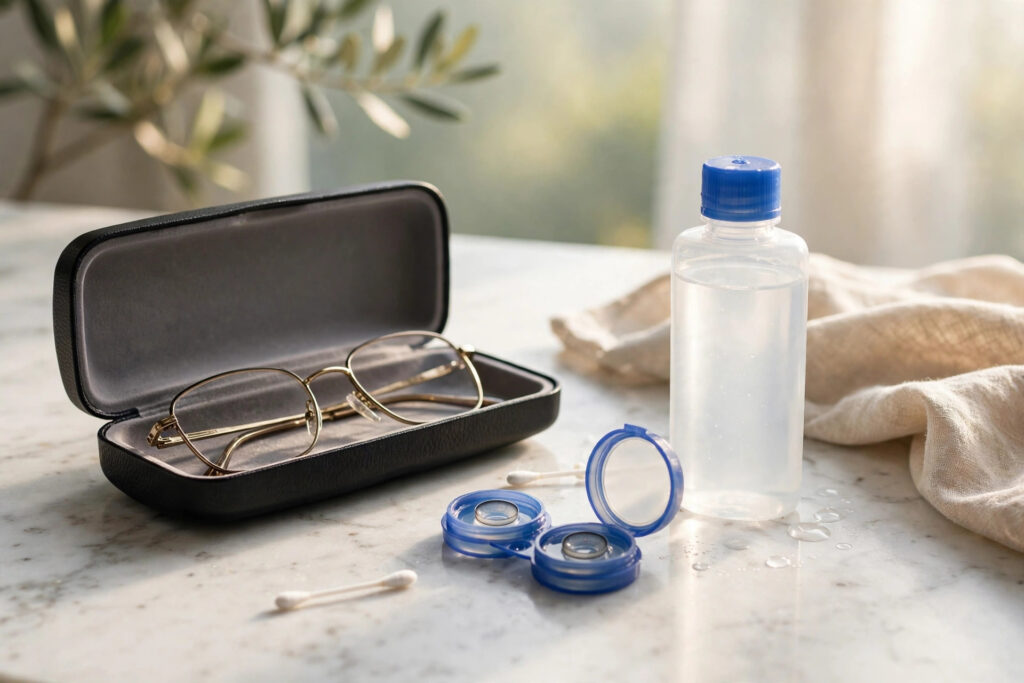
Making the switch from glasses to contacts feels like a big leap — touching your own eye, trusting something invisible to correct your vision, relearning your morning routine. But millions of glasses wearers make the transition every year, and almost all of them wonder why they waited so long.
This guide walks you through the entire process: the fitting visit, the adaptation period, handling techniques that actually work for beginners, and the mindset shifts that turn a nervous first-timer into a confident daily wearer.
Table of Contents
- Step One: The Contact Lens Fitting
- Choosing Your First Lens Type
- Mastering Insertion and Removal
- The Adaptation Timeline
- Building a Beginner-Friendly Routine
- Keeping Glasses in Your Life
Step One: The Contact Lens Fitting
Switching starts with a contact lens fitting — a separate visit from your glasses exam. The doctor measures your corneal curvature, evaluates your tear film, and places trial lenses on your eyes to check fit, movement, and vision. You’ll leave with trial lenses and a follow-up visit to assess how your eyes responded.
Be honest during the fitting about your lifestyle: screen hours, sports, allergies, dryness, and how many hours a day you want to wear lenses. These details determine which lens your doctor prescribes. The American Optometric Association recommends against buying lenses without this fitting — fit affects both comfort and corneal health.
Choosing Your First Lens Type
Most beginners start with daily disposables, and for good reason: no cleaning, no cases, a fresh sterile lens every morning, and the lowest infection risk. They’re the most forgiving option while you’re learning handling, because a dropped or inside-out lens is simply discarded, not rescued.
Your prescription may dictate the choice — high astigmatism needs toric lenses, presbyopia needs multifocals — but within those constraints, simpler is better at first. Reusable lenses save money long-term, and you can always switch modalities later. Discussing current lens technology with your fitter helps you understand what comfort features are available in beginner-friendly designs.
Mastering Insertion and Removal
Insertion terrifies every beginner and becomes automatic within two weeks — that’s the universal experience. The technique: wash and dry hands, place the lens on your index fingertip, use the other hand to hold upper lashes against the brow (this defeats the blink reflex), pull down the lower lid, look straight ahead, and place the lens gently on the eye. Look down, release, blink.
Removal is the mirror image: look up, pull down the lower lid, and slide the lens down onto the white of the eye before pinching it off with the pads of your fingers. Practice over a clean table with the drain closed. Your doctor’s office will coach you until you succeed — nobody leaves a fitting without showing they can handle lenses confidently, so the pressure is lower than you think.
The Adaptation Timeline
Expect an adaptation period of a few days to two weeks. At first you’ll be aware of the lenses — mild awareness, occasional dryness, maybe the urge to rub. This fades as your eyelids and cornea adjust. Most fitters recommend starting with 4-6 hours of wear and adding a couple of hours each day.
Vision may feel slightly different from glasses: no frame edges, a wider field of view, and objects at true size rather than minified or magnified by spectacle lenses. High prescriptions notice this most — it’s usually an improvement, but the brain needs a few days to recalibrate. If awareness turns into persistent discomfort, that’s a fit or material issue to report at your follow-up, not something to endure.
Building a Beginner-Friendly Routine
Anchor lens handling to existing habits: insert after your morning face wash, remove before your evening routine. Keep rewetting drops in your bag for dry moments. If you chose reusable lenses, make the rub-rinse-store sequence non-negotiable from day one — cutting corners early builds bad habits that raise infection risk.
Set phone reminders for replacement schedules until they’re automatic. And learn the red-flag symptoms that mean lenses come out immediately: pain, unusual redness, discharge, light sensitivity, or sudden vision changes. Good eye health habits established in month one protect you for years of comfortable wear.
One more beginner tip: practice handling with clean, dry hands in good lighting, and don’t rush. Most insertion struggles come from hurrying or from touching the eye with a dry fingertip instead of placing the lens smoothly. Slow, deliberate movements beat fast, tense ones every time — speed comes naturally within a couple of weeks.
Keeping Glasses in Your Life
Switching to contacts doesn’t mean retiring your glasses. Keep an updated pair for lens-free days, eye infections, allergy flare-ups, and late nights when your eyes are tired. Your glasses prescription should stay current through regular eye exams — think of glasses as your reliable backup system, not a relic.
Many successful wearers end up hybrid: contacts for work, sports, and social life; glasses for lazy weekends and evenings. That’s not failure — it’s using each correction where it shines. The goal of switching was never to prove something; it was to give yourself options. Welcome to having both.