
After a long day, the last thing you want is a struggle with your contact lenses. Fortunately, removing lenses is easier than inserting them for most wearers, and a few proven techniques make the process quick and comfortable. This guide explains how to remove contact lenses easily and safely, whether you wear soft lenses or rigid gas permeable lenses.
You will learn the standard removal methods, what to do when lenses feel stuck or dry, how to care for lenses after removal, and the mistakes that cause most removal problems. With the right technique, both lenses should be out in under a minute.
Table of Contents
- Prepare for Removal
- The Pinch Method for Soft Lenses
- Alternative Soft Lens Methods
- Removing Rigid Gas Permeable Lenses
- When Lenses Feel Stuck or Dry
- After Removal: Cleaning and Storage
- Common Removal Mistakes to Avoid
Prepare for Removal
As with insertion, removal starts with clean hands. Wash with soap and water and dry thoroughly with a lint-free towel. Have your lens case open and filled with fresh multipurpose solution before you begin, so you can place each lens directly into solution the moment it comes out.
Remove lenses before removing makeup at night, and always take them out before sleeping unless your doctor has specifically prescribed extended wear. Working in front of a mirror in good light makes the process easier, especially while you are still learning.
If your eyes feel dry at the end of the day, use a rewetting drop approved for contact lenses and wait a minute or two before removing them. A well-hydrated lens slides off easily; a dry lens clings and resists. This single tip solves most removal difficulty and protects your eye health by reducing the friction of removal.
The Pinch Method for Soft Lenses
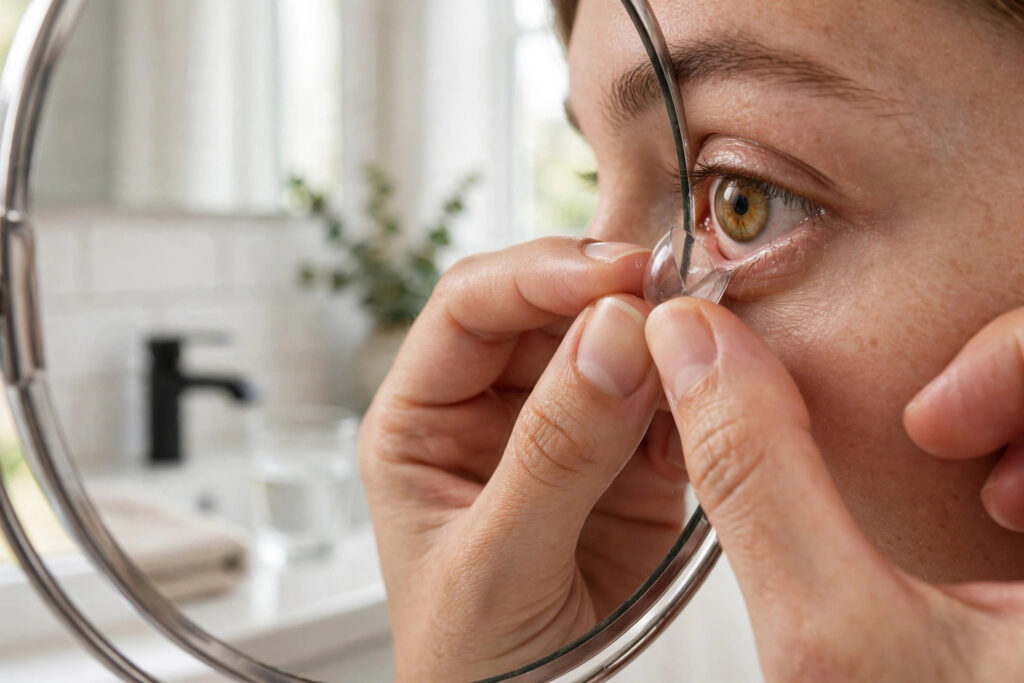
The pinch method is the standard technique for how to remove contact lenses easily, and it works for the vast majority of soft lens wearers. Look straight into the mirror. With the middle finger of your dominant hand, pull your lower eyelid down. Optionally, use your other hand to hold the upper lid up, though many wearers skip this once experienced.
Bring your index finger and thumb toward the lens from opposite sides, aiming for the lower edge of the lens rather than the center. Gently pinch the lens between your fingertips and lift it away from your eye. The lens should fold slightly and come off the cornea with minimal effort.
The key is gentle pressure and dry fingertips. Wet fingers slide off the lens surface instead of gripping it, which is why thorough hand drying matters so much. Keep your nails trimmed and use the pads of your fingers, not your nails, to avoid scratching the lens or your eye.
Alternative Soft Lens Methods
If pinching feels awkward, try the slide method. Look upward, place your index finger on the lower edge of the lens, and slide the lens down onto the white of your eye. Once it is on the sclera, it pinches off much more easily because the white of the eye is less sensitive and the lens edge is more accessible.
Some wearers prefer the two-finger eyelid technique: place your index fingers at the outer corners of your eyelids and gently pull outward while blinking. The eyelid pressure can pop the lens out. This method takes practice but works well for people who dislike touching the lens directly.
Experiment to find which method feels most natural for you. There is no single correct technique, only the one that removes your lenses comfortably and consistently. If you are still learning insertion too, our beginner’s insertion guide pairs well with these removal methods. And remember that different lens materials can feel slightly different during removal.
Removing Rigid Gas Permeable Lenses
Rigid gas permeable (RGP) lenses require a different approach because they are smaller, firmer, and sit differently on the eye. Never use the pinch method on RGP lenses; pinching can chip the lens edge or scratch your cornea.
The standard RGP removal method uses eyelid pressure. Place your index finger at the outer corner of your eye and pull the lid outward and slightly upward, toward your ear. Then blink firmly. The eyelid tension against the rigid lens edge pops it out of the eye. Cup your other hand below to catch it.
Alternatively, some RGP wearers use a small suction-cup plunger designed for rigid lenses. Moisten the plunger, touch it to the center of the lens, and lift gently. Your eye doctor can demonstrate this tool and confirm it suits your lens type. RGP lenses are more durable than soft lenses but also more expensive to replace, so handle them carefully over a towel or closed sink.
When Lenses Feel Stuck or Dry
A lens that will not budge is almost always a dry lens. Do not force it. Apply rewetting drops or sterile saline, close your eyes, and wait several minutes for the lens to rehydrate. Then try removal again. Forcing a dry lens risks scratching your cornea or tearing the lens.
If drops do not help, the lens may have shifted. Look in different directions in the mirror to locate it; a lens cannot get lost behind your eye, despite the common fear, because a membrane called the conjunctiva blocks that path. Gently massaging the closed eyelid can help reposition a displaced lens.
For chronically dry end-of-day eyes, talk to your doctor about lenses designed for dryness or about switching to glasses for evening wear. Persistent sticking may also indicate that your lenses are past their replacement date, as old lenses dry out faster and adhere more stubbornly.
After Removal: Cleaning and Storage
Proper after-removal care is what makes reusable lenses safe for tomorrow. Place each lens in your palm, apply fresh multipurpose solution, and gently rub the lens with your fingertip for the time your solution brand recommends, usually around 20 seconds per side. This rubbing step removes deposits and microorganisms that rinsing alone leaves behind.
Rinse the lens with fresh solution and place it in the correct chamber of your case, right lens in the right chamber to avoid prescription mix-ups. Fill the case with fresh solution, never top off yesterday’s, and close it securely. Replace your lens case every three months at minimum; old cases harbor biofilm that resists disinfection.
Daily disposable wearers have the simplest routine: discard each lens after removal. Never save a daily lens for reuse, even if you wore it only briefly. The FDA’s contact lens guidance is clear that reusing single-use lenses significantly raises infection risk.
Common Removal Mistakes to Avoid
The most common mistake is removing lenses with wet hands, which makes fingers slide uselessly over the lens. Dry your hands completely every time. The second most common mistake is using nails instead of finger pads, which can scratch the cornea or tear soft lenses.
Never use tap water on lenses or cases. Tap water can contain Acanthamoeba, a microorganism that causes a rare but severe eye infection. Use only sterile contact lens solution. Similarly, never use saliva to moisten a lens; your mouth harbors bacteria that do not belong in your eyes.
Do not sleep in lenses not approved for overnight wear, and do not exceed the recommended wearing schedule. Overworn lenses are drier, stickier, and harder to remove, creating a cycle of discomfort. The American Optometric Association offers comprehensive contact lens care guidelines that cover these essentials. Master clean, gentle removal and your lenses will serve you comfortably for years.