
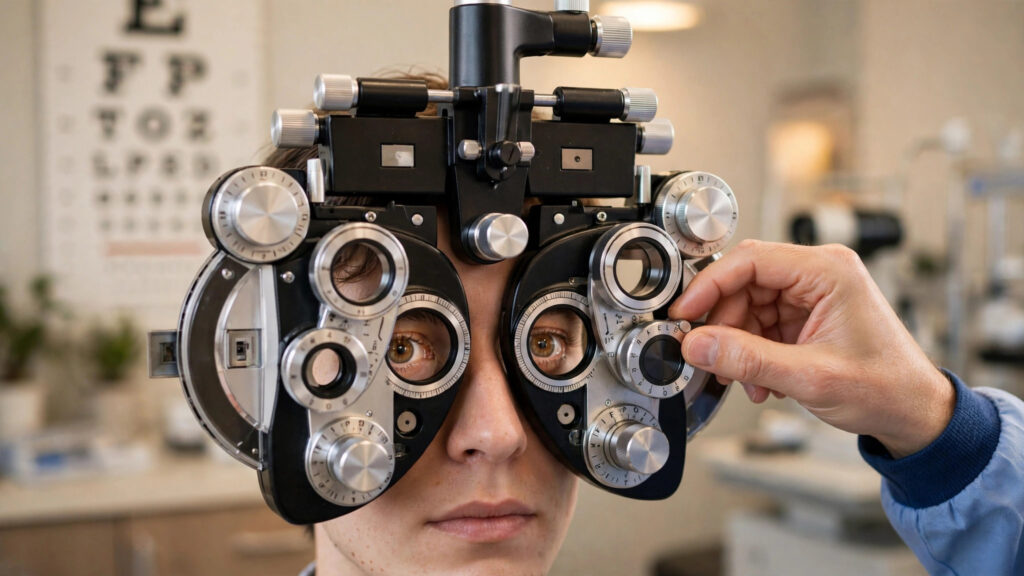
“Which is better — one or two?” If you have ever had an eye exam, you know this question well. It is part of the refraction test, the precise process your eye doctor uses to determine your glasses or contact lens prescription. Behind that simple question lies careful optical science.
This guide explains what a refraction test measures, how the phoropter and autorefractor work, what the “one or two” comparisons accomplish, and why the results sometimes differ slightly from visit to visit.
Table of Contents
- What Refraction Measures
- The Autorefractor: A First Pass
- The Phoropter: Fine-Tuning
- Why “One or Two” Works
- What Your Prescription Numbers Mean
- Why Results Change Between Visits
- Refraction for Contacts vs Glasses
What Refraction Measures
Refraction is the bending of light as it passes through your cornea and lens. In an eye with perfect optics, light focuses precisely on the retina. In eyes with refractive errors — myopia (nearsightedness), hyperopia (farsightedness), astigmatism, or presbyopia — light focuses in front of or behind the retina, producing blur.
A refraction test determines the exact lens power needed to bring light into focus on your retina. The result is your prescription: a set of numbers specifying sphere, cylinder, and axis corrections for each eye. This is separate from tests of eye health — refraction measures optics, not disease — which is why a “20/20 with correction” result does not guarantee healthy eyes.
Accurate refraction is the foundation of comfortable vision. Even small errors can cause eyestrain, headaches, and fatigue, especially for people who spend long hours on screens. Getting it right matters for everything from everyday glasses to contact lenses and surgical planning.
The Autorefractor: A First Pass
Most modern exams begin with an autorefractor — the machine where you look at a picture of a hot air balloon or a road that seems to go in and out of focus. It shines infrared light into your eye, measures how the light reflects off your retina, and calculates an estimate of your prescription in seconds.
The autorefractor’s reading is objective: it requires no input from you and works even for patients who cannot respond reliably, including young children and nonverbal patients. It is fast, consistent, and an excellent starting point. However, it is only an estimate — it does not account for how your brain processes the image or for your visual comfort.
That is why the autorefractor never writes your final prescription on its own. It gives your doctor a highly accurate starting point, dramatically shortening the subjective fine-tuning that follows. For children, where accommodation can skew automated readings, cycloplegic refraction with dilating drops may be used instead — something parents can read about in guides to pediatric eye examinations.
The Phoropter: Fine-Tuning
The phoropter is the large mask-like instrument with rows of lenses that swings in front of your face. Your doctor flips through lens combinations while you compare options and report which looks clearer. This subjective refraction refines the autorefractor’s estimate into a prescription tuned to your actual visual experience.
The process follows a systematic sequence. First, your doctor determines the best spherical power — the overall focusing strength — for each eye. Then they test for astigmatism using a special lens called a Jackson cross cylinder, refining both the amount (cylinder) and orientation (axis) of the correction. Finally, they balance the two eyes together so they work as a team.
Trial lens frames — actual glasses frames into which individual lenses are slotted — serve the same purpose and are sometimes preferred for very high prescriptions or for patients who find the phoropter claustrophobic. The American Optometric Association includes refraction as a core component of the comprehensive adult eye examination.
Why “One or Two” Works
The “which is better, one or two” technique is a forced-choice comparison. Your doctor shows you two lens options in quick succession and asks which gives clearer vision. By bracketing — offering slightly stronger and slightly weaker options around your current best — they converge on the lens power that maximizes your clarity.
This works because the human visual system is excellent at comparative judgment but poor at absolute judgment. You might not be able to say whether a lens is “perfect,” but you can reliably say which of two options is sharper. Repeating these binary choices dozens of times zeroes in on your optimal correction with remarkable precision, often to within a quarter diopter.
If you genuinely cannot tell the difference between options, say so — that is useful information, not a failure. It usually means you are already at (or very near) your best correction, and your doctor will move on. Guessing randomly, by contrast, can push the prescription slightly off and leave you with eyestrain.
What Your Prescription Numbers Mean
Your prescription lists sphere (SPH), cylinder (CYL), and axis for each eye, labeled OD (right eye) and OS (left eye). Sphere corrects nearsightedness (minus numbers) or farsightedness (plus numbers). Cylinder and axis correct astigmatism — an irregular corneal curvature — with the axis indicating its orientation in degrees.
You may also see “ADD” — the additional magnifying power for reading in bifocal, trifocal, or progressive lenses — and “PD” (pupillary distance), the measurement between your pupils used to position lenses correctly. Prism values appear when your eyes need help aligning, and they are measured in prism diopters with a base direction.
Understanding these numbers helps when ordering glasses, but do not try to adjust them yourself. Small changes in axis or cylinder can noticeably affect comfort. If a new prescription feels wrong after a week or two of adaptation, return for a recheck rather than tolerating the discomfort.
Why Results Change Between Visits
Minor prescription fluctuations between exams are normal and do not necessarily mean your eyes are worsening. Time of day matters — many people measure slightly more nearsighted in the evening after a day of near work. Blood sugar levels, hydration, fatigue, and certain medications can all shift readings by a quarter diopter or more.
True refractive change follows life-stage patterns. Children’s prescriptions often change yearly as their eyes grow. Adults are usually stable through their 30s, then presbyopia gradually increases reading ADD power from the early 40s onward. After cataract surgery or during pregnancy, more significant shifts can occur.
Consistency in testing conditions helps. Try to schedule exams at similar times of day, bring your current glasses so the doctor can compare, and mention any new medications or health changes. If your prescription changes dramatically in a short period, your doctor will investigate — rapid shifts can occasionally signal conditions like keratoconus or uncontrolled diabetes.
Refraction for Contacts vs Glasses
A glasses prescription cannot simply be converted into a contact lens prescription. Contacts sit directly on the eye rather than 12 millimeters in front of it, so the effective power differs — especially for strong prescriptions. Contact lens prescriptions also specify base curve and diameter, measurements of the lens fit that have no glasses equivalent.
This is why contact lens wearers need a separate contact lens fitting and evaluation, not just a standard refraction. The fitting assesses how the lens moves on your eye, how your cornea responds, and whether the lens provides stable, comfortable vision. Skipping it risks poor vision, discomfort, and even corneal damage.
Whether you end up in glasses, contacts, or both, the refraction is just the starting point. The FDA regulates contact lenses as medical devices and requires a valid prescription — a reminder that vision correction, in any form, deserves professional oversight rather than guesswork.