
Pupillary distance (PD) is the one measurement your glasses prescription probably doesn’t include — yet it’s essential for ordering glasses online. PD is the distance in millimeters between the centers of your pupils, and it tells the lab exactly where to place the optical center of each lens. Get it wrong, and even a perfect prescription can cause eye strain, headaches, or blurry vision.
The good news: measuring your PD at home is simple, takes about two minutes, and requires nothing more than a mirror and a millimeter ruler. Here’s how to do it accurately.
Table of Contents
- What PD Is and Why It Matters
- Single vs Dual PD
- The Mirror Method: Step by Step
- The Friend-Assisted Method
- PD Apps and Online Tools
- Common Mistakes to Avoid
What PD Is and Why It Matters
Your pupillary distance is measured in millimeters, typically ranging from 54 to 74 mm in adults (children are smaller, usually 43–58 mm). The optical center of a lens is its “sweet spot” — the point of clearest vision. When the optical center aligns with your pupil, you look through the lens exactly as designed. Misalignment forces your eyes to look through off-center lens areas, introducing unwanted prismatic effects.
Small errors (1–2 mm) are usually tolerable, especially in mild prescriptions, but larger errors cause real problems: eye fatigue, headaches, and a sense that your glasses “aren’t right” despite a correct prescription. High prescriptions are less forgiving — a PD error that goes unnoticed at −1.00 can be miserable at −8.00. That’s why accuracy matters, and why a professional measurement during an eye exam remains the gold standard.
Single vs Dual PD
PD comes in two forms. Single (binocular) PD is one number: the total distance between your pupils, e.g., 63 mm. Dual (monocular) PD is two numbers — the distance from each pupil to the center of your nose bridge, e.g., 31.5/31.5. Dual PD is more precise because faces aren’t perfectly symmetrical; most people’s pupils sit slightly off-center.
Many online retailers accept single PD and split it evenly, which is fine for most wearers. But if you know your face is asymmetrical or your prescription is strong, dual PD gives the lab better information. When measuring at home with the methods below, you can capture either — the friend-assisted method naturally yields dual PD if you measure each eye separately.
The Mirror Method: Step by Step
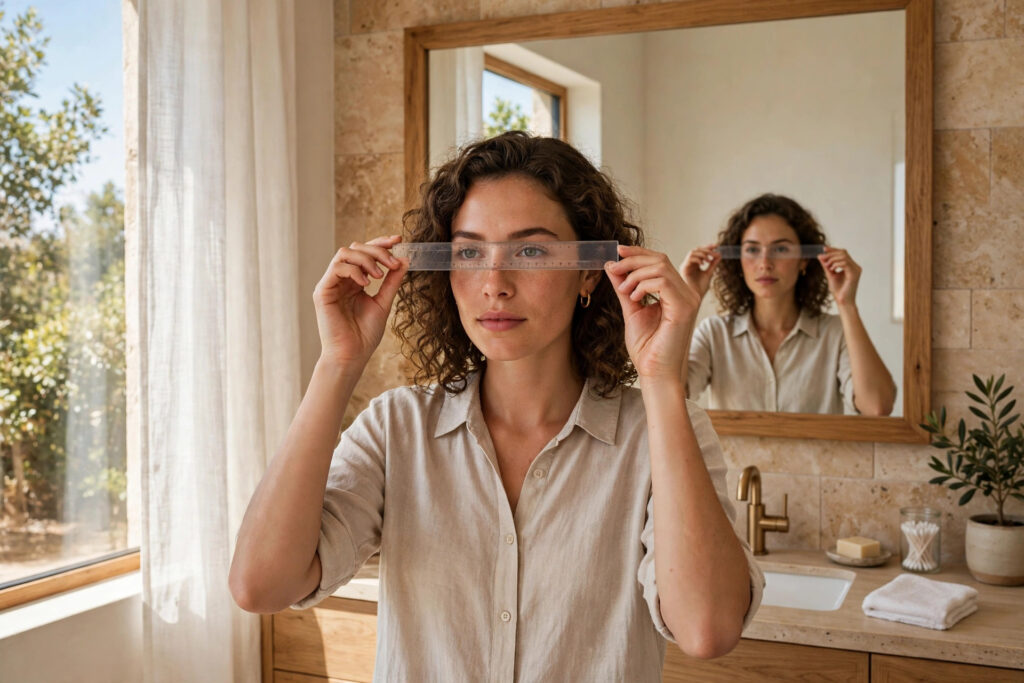
You’ll need a mirror and a ruler marked in millimeters. Stand about 8 inches from the mirror and hold the ruler against your brow, just above your eyes. Close your right eye and align the ruler’s zero mark with the center of your left pupil. Then open your right eye, close your left, and read the millimeter mark aligned with the center of your right pupil. That’s your distance PD.
Repeat the measurement three times and average the results — consistency within 1 mm means you’re doing it right. Keep your head still and look straight ahead; tilting or shifting changes the reading. For near PD (used for reading glasses), focus on a close object instead of your mirror reflection, which typically yields a number 2–3 mm smaller. Most online orders use distance PD, which also works fine for comparing eyewear options like single-vision reading glasses.
The Friend-Assisted Method
Having someone else measure is more accurate than doing it yourself, because you can look straight ahead naturally instead of focusing on a mirror. Sit facing your friend at eye level, about arm’s length apart. Look straight ahead at a distant object (not at your friend’s face, which can cause your eyes to converge slightly).
Your friend holds the millimeter ruler across your brow and measures from the center of one pupil to the center of the other — or, for dual PD, from each pupil’s center to the bridge of your nose. Ask them to take the measurement twice to confirm. This method typically beats self-measurement by a millimeter or so of accuracy, which is meaningful for stronger prescriptions.
PD Apps and Online Tools
Several retailers and independent apps now offer PD measurement using your phone’s camera, often with a credit card held to your forehead as a size reference. These tools have improved significantly and can be quite accurate — many users report results within 1 mm of professional measurements. They’re convenient and remove the fiddliness of rulers and mirrors.
Still, treat app results as a good estimate rather than gospel. Lighting, camera angle, and how steadily you hold the reference card all affect accuracy. If an app gives you a number that seems off (outside the typical adult range, or wildly different from a previous measurement), re-measure with the mirror or friend method. And if you wear prescription sunglasses with a strong prescription, consider getting a professional PD measurement to be safe.
Common Mistakes to Avoid
The most common error is measuring while looking at the ruler instead of straight ahead — your eyes converge slightly when focusing close, shrinking the measurement. Always gaze at a distant point during measurement. Second, don’t measure over glasses; the frames distort your view of pupil position. Third, use a millimeter ruler, not a standard inch ruler converted roughly — rounding errors compound.
Finally, don’t confuse PD with other numbers on your paperwork. PD is not your prescription, not your frame size, and not your segment height. If your eye doctor’s office will provide your PD, that’s always the most reliable option — many will share it on request. The All About Vision PD guide includes helpful diagrams if you want a visual walkthrough of the techniques above.