
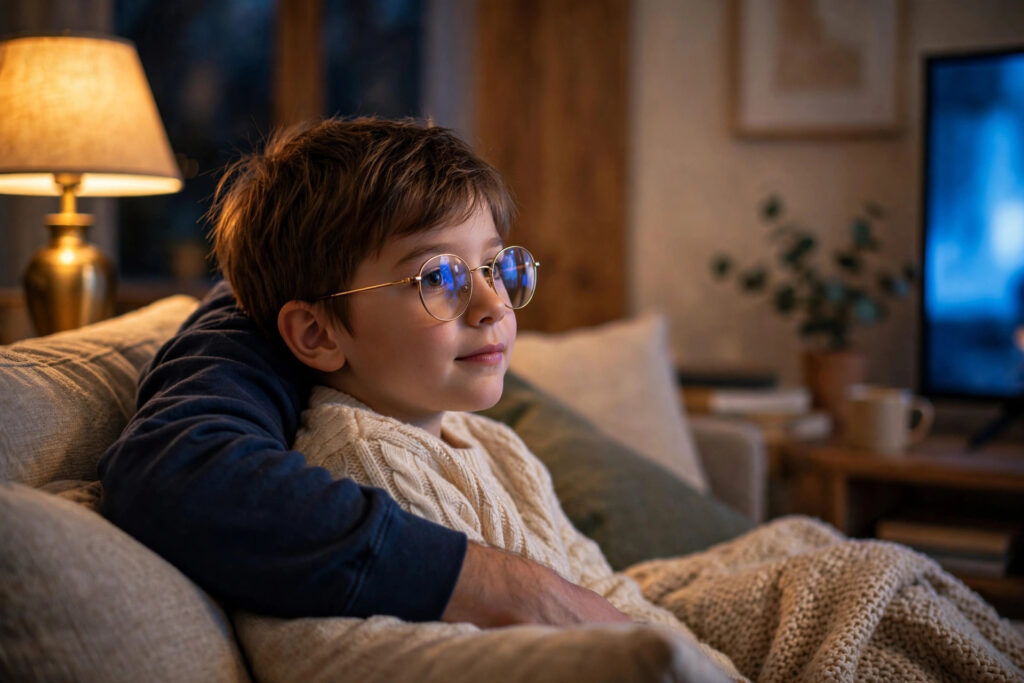
Parents have worried about television and children’s eyes since the first flickering black-and-white sets — “don’t sit so close, you’ll ruin your eyes!” But does TV damage children’s eyes in any lasting way? The reassuring answer from eye doctors is no: watching TV does not cause permanent eye damage or change a child’s prescription.
That doesn’t mean unlimited screen time is harmless. The real concerns are subtler — eye strain, disrupted sleep, and what screen time replaces. Here’s what the evidence actually says.
Table of Contents
- The Short Answer From Eye Doctors
- Why the “Sitting Too Close” Myth Persists
- Real Concerns About Screen Time
- TV vs Tablets vs Phones
- Healthy Viewing Habits for Kids
- When Screen Habits Signal a Vision Problem
The Short Answer From Eye Doctors
No credible research shows that watching television damages the eyes, causes myopia, or weakens vision in children. The light emitted by modern TVs is far below levels that could harm the retina, and focusing on a screen doesn’t reshape the eyeball. Eye doctors are consistent on this point: TV viewing is not a cause of eye disease.
This holds for reasonable viewing in normal conditions. The old cathode-ray TVs of the 1960s briefly raised radiation concerns, but that was resolved decades ago — modern LED and OLED screens emit no harmful radiation. If your child watches TV at a comfortable distance in a lit room, their eyes are not being damaged. Regular children’s eye exams remain the best way to catch genuine vision problems, which have nothing to do with TV habits.
Why the “Sitting Too Close” Myth Persists
Here’s the twist: children who habitually sit very close to the TV may already be nearsighted. Myopic children sit close because distant objects look blurry to them — the behavior is a symptom, not a cause. So when a parent notices their child creeping toward the screen, the right response isn’t to ban the TV; it’s to schedule an eye exam.
Sitting close can cause temporary eye fatigue — the focusing muscles work harder at near distances — but it doesn’t make myopia worse or damage the eyes permanently. Still, if close viewing is new behavior, or your child squints, tilts their head, or complains the screen looks blurry, those are classic signs of uncorrected refractive error. A pair of properly prescribed kids’ glasses solves the problem the TV never caused.
Real Concerns About Screen Time
While TV doesn’t damage eyes, heavy screen time has real downsides worth managing. Digital eye strain: prolonged viewing reduces blink rate, causing dry, tired, irritated eyes and occasional headaches — temporary and relieved by breaks. Sleep disruption: evening screen exposure, especially interactive screens, suppresses melatonin and delays sleep onset in children. Displacement: every hour in front of a screen is an hour not spent outdoors — and outdoor time is one of the strongest known protectors against myopia development.
There’s also emerging research linking very high near-work time (reading, handheld devices) with faster myopia progression in already-myopic children. TV viewed at distance counts far less as “near work” than a phone held 20 cm from the face — another reason TV is the least concerning screen. Supporting overall eye-healthy habits matters more than policing any single device.
TV vs Tablets vs Phones
Not all screens are equal for young eyes. Television is typically viewed from 2–3 meters away, which demands little focusing effort. Tablets are held at 30–40 cm, and phones at 20–30 cm — much more demanding for the focusing and eye-teaming systems, and more likely to cause strain during long sessions.
For young children, favor the biggest screen at the greatest comfortable distance: TV over tablet, tablet over phone. Whatever the device, the 20-20-20 rule helps — every 20 minutes, look at something 20 feet away for 20 seconds. For TV specifically, keep the room softly lit rather than pitch dark (reduces contrast strain), position the screen at or slightly below eye level, and maintain a viewing distance of roughly 1.5–2.5 times the screen’s diagonal.
Healthy Viewing Habits for Kids
Pediatric guidelines focus on balance, not prohibition. Keep screens out of bedrooms to protect sleep. Set consistent daily limits appropriate to age — and model them yourself. Prioritize at least 1–2 hours of outdoor time daily, which benefits both vision and general health. Encourage breaks during long viewing sessions, and make sure the room lighting is comfortable.
Content matters too: co-view when you can, choose age-appropriate programming, and avoid using screens as the default response to boredom. None of this is about eye damage — it’s about raising healthy kids whose eyes get the varied visual diet (distance viewing outdoors, near work, breaks) that supports good vision development.
When Screen Habits Signal a Vision Problem
Watch for behaviors that suggest your child isn’t seeing clearly: consistently sitting very close to the TV, squinting, covering or closing one eye, complaining of headaches after viewing, rubbing eyes frequently, or avoiding activities that require distance vision like sports. Any of these merit an eye exam — not a lecture about screen distance.
The American Academy of Ophthalmology confirms that screens don’t cause permanent eye damage in children, while emphasizing healthy viewing habits. So relax about the TV itself — and pay attention to what your child’s viewing behavior might be telling you about their vision.