Laser vision correction has entered a new era with the arrival of WaveLight Plus InnovEyes, a system developed by Alcon that its makers describe as the first fully personalized LASIK treatment. Instead of applying a standard correction based mainly on your glasses prescription, it builds a detailed three-dimensional digital model of your entire eye and uses artificial intelligence and ray-tracing calculations to design a treatment unique to you.
This guide explains what WaveLight Plus InnovEyes is, how the technology works, what the clinical studies show, who may be a candidate, and what recovery looks like. As with any elective eye surgery, the decision should be made with a qualified refractive surgeon after a thorough evaluation.
Table of Contents
- What Is WaveLight Plus InnovEyes?
- How the Technology Works
- What Clinical Studies Show
- How It Differs From Standard LASIK
- Who May Be a Candidate
- Recovery and Aftercare
- Frequently Asked Questions
What Is WaveLight Plus InnovEyes?
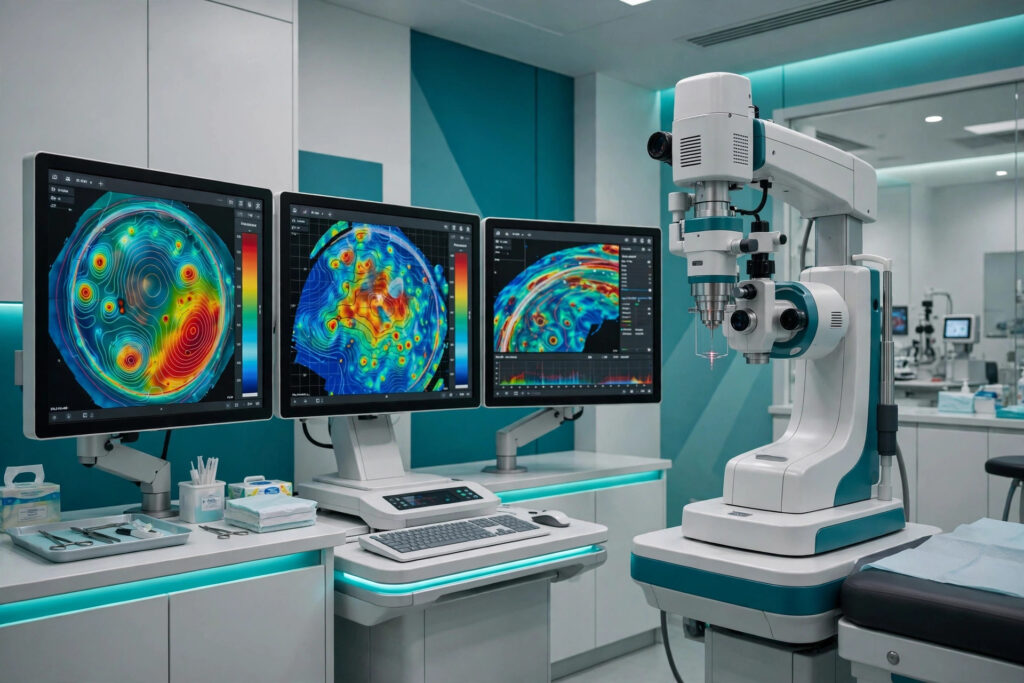
WaveLight Plus InnovEyes is a laser vision correction system that combines two Alcon technologies: the InnovEyes Sightmap diagnostic platform and the WaveLight EX500 excimer laser. The Sightmap device captures more than 100,000 data points from your eye, including ocular wavefront, corneal tomography, and biometry measurements. Software then uses ray-tracing — modeling how light travels through your cornea, lens, and the full length of your eye — to compute a fully individualized ablation profile.
The result is sometimes described as a “digital eye twin”: a virtual model of your eye on which the treatment is planned before the laser fires a single pulse. The system received US FDA premarket approval, and has been introduced in markets across North America, Europe, Asia-Pacific, and China.
How the Technology Works
The process has three main stages. First, diagnostics: the InnovEyes Sightmap scans your eyes, recording corneal shape, wavefront aberrations (including higher-order aberrations such as coma and spherical aberration that glasses cannot correct), eye length, and lens position. Second, planning: AI-driven software processes these measurements into a personalized treatment plan, accounting for the unique optical fingerprint of each eye — no two treatments are identical. Third, treatment: the WaveLight EX500 excimer laser, one of the fastest excimer lasers available, reshapes the cornea beneath a thin flap created at the start of the procedure, guided by multi-dimensional eye tracking that follows eye movements during treatment.
The laser application itself typically takes seconds per eye, and the entire procedure is usually completed in about 10 to 15 minutes.
What Clinical Studies Show
In the FDA premarket approval study of ray-tracing LASIK with the InnovEyes Sightmap, outcomes at 12 months in eyes treated for myopia (with or without astigmatism) included 94.4% of eyes achieving uncorrected distance visual acuity of 20/20 or better, and 70.2% achieving 20/16 or better. All pre-specified safety and efficacy endpoints exceeded their targets, with no device-related adverse events reported in the study.
Other published clinical data reported at 3 months showed 100% of treated myopic eyes reaching 20/20, with a high proportion achieving 20/16 or better, and most patients reporting they would choose the procedure again. Individual results vary, and published study outcomes do not guarantee personal results.
How It Differs From Standard LASIK
Conventional LASIK corrects your prescription — sphere and cylinder — using treatment profiles derived from population averages and surgeon nomograms. WaveLight Plus InnovEyes instead corrects the measured optical system of your specific eye, including higher-order aberrations responsible for glare, halos, and reduced contrast sensitivity, particularly at night. In principle, this can deliver visual quality beyond what glasses provided before surgery. Like standard LASIK, it is a flap-based procedure: a thin corneal flap is created, tissue beneath is reshaped, and the flap is repositioned. The flap architecture carries the same category of considerations as conventional LASIK, which your surgeon should explain. For context on the conventional procedure, see our What to Bring to Your First Eye Exam“>LASIK candidacy guide.
Who May Be a Candidate
Candidacy follows the same foundations as LASIK: adults with stable prescriptions, healthy corneas of adequate thickness, and no disqualifying eye conditions such as advanced keratoconus, uncontrolled dry eye, or certain autoimmune disorders. The personalized mapping may extend treatment to eyes with higher-order aberrations or irregular corneas that standard profiles handle less well — but only a comprehensive screening with the actual diagnostic platform can determine eligibility. Pregnant or nursing patients are generally advised to wait, and prescriptions should be stable for at least a year.
Recovery and Aftercare
Recovery resembles standard LASIK: many patients notice dramatically clearer vision within hours, with functional vision often returning the next day. Expect a schedule of follow-up visits, medicated eye drops (antibiotic and anti-inflammatory), and instructions to avoid eye rubbing, swimming, and eye makeup for a defined period. Dry-eye symptoms are common in the early weeks and usually managed with lubricating drops. Attend every follow-up — early detection of flap or healing issues is part of what makes outcomes reliable.
Frequently Asked Questions
Is WaveLight Plus InnovEyes better than SMILE? They are different architectures: InnovEyes is a personalized flap-based LASIK, while SMILE is a flapless lenticule procedure. “Better” depends on your eyes and priorities — discuss both with a surgeon who offers them. Our Gradient Tint Lenses: Complete Guide“>SMILE vs LASIK comparison covers the trade-offs.
How long do results last? The corneal reshaping is permanent, but eyes can still change with age (presbyopia, cataract). Long-term stability data continues to accumulate.
Does it hurt? Numbing drops are used; most patients report pressure rather than pain during the brief procedure, with some scratchiness for hours afterward.
For authoritative background on laser vision correction, see the American Academy of Ophthalmology’s LASIK overview and the FDA’s LASIK information page.