
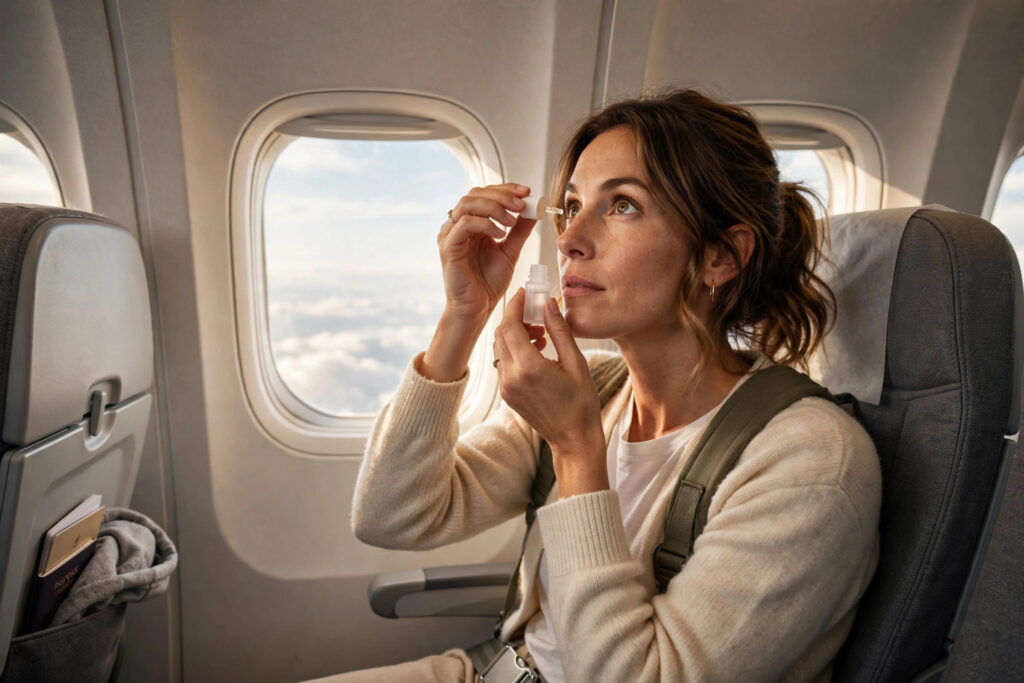
Flying after LASIK is one of the most common travel questions refractive patients ask, and the reassuring news is that air travel itself does not harm a healing cornea. Cabin pressure changes do not damage the LASIK flap, and there is no altitude at which your eyes are in danger from the flight itself. What does matter is timing — flying too soon can complicate your follow-up care — and comfort, because dry recycled cabin air is tough on eyes that are still recovering.
This article covers when it is safe to fly after LASIK, how to handle dry cabin air, what to pack in your carry-on, and how to manage long-haul flights and layovers. As with all post-operative guidance, your own surgeon’s instructions come first: this is general information to help you plan, not a substitute for their clearance.
Table of Contents
- Is Flying Safe After LASIK?
- When You Can Fly After Surgery
- Cabin Air and Dry Eyes
- Packing the Right Eye Supplies
- Airport Security and Post-Op Eyewear
- Long-Haul Flights and Layovers
- Warning Signs to Watch Mid-Journey
Is Flying Safe After LASIK?
Yes — flying after LASIK is considered safe by refractive surgeons, and commercial cabin pressure poses no threat to the corneal flap. This is a common worry because some other eye procedures, such as certain retinal surgeries involving gas bubbles, do restrict flying. LASIK involves no gas, no injected substances, and no pressure-sensitive implants, so the physics of the cabin are irrelevant to your healing.
The real question is not whether the plane hurts your eyes but whether the trip hurts your recovery. The first days after LASIK include scheduled follow-up visits — typically at 24 hours and again within the first week — where your surgeon checks flap position and healing. Flying away before these checks are complete means missing the window when problems are easiest to catch and fix. That is the main medical reason surgeons ask you to stay local for the first few days.
Comfort is the second factor. Aircraft cabins are pressurized to an equivalent altitude of several thousand feet with very low humidity, often under 20 percent. Dry air accelerates tear evaporation, and post-LASIK eyes already have a less stable tear film for weeks or months. The result is not damage, but it can be genuinely uncomfortable: grittiness, burning, and blurred vision that clears with blinking. Knowing this in advance lets you prepare rather than suffer.
When You Can Fly After Surgery
Many surgeons clear patients to fly as early as the day after the 24-hour check-up, assuming healing looks normal. That early clearance surprises some patients, but it reflects the confidence surgeons have once the flap position is confirmed. Still, “can fly” and “should fly” are different: a short domestic hop a few days out is a different proposition from a 14-hour international journey in the first week.
A practical approach is to keep the first week local if you can. This keeps you near your surgeon for the early follow-ups and avoids compounding travel stress — disrupted sleep, dehydration, recycled air — with early healing. If travel is unavoidable, short flights after your first check-up are generally manageable with preparation. Long-haul and multi-leg international trips are more comfortably scheduled from the second week onward, when dryness has usually started to settle.
Before booking anything, confirm the plan at your pre-operative Visual Field Test Explained“>eye exam or consultation. Tell your surgeon about upcoming travel so the follow-up schedule can be arranged around it. Some clinics can coordinate a check-up with a partner practice at your destination if needed, though most prefer to see you themselves for the critical early visits. Never skip a scheduled post-operative visit to make a flight.
Cabin Air and Dry Eyes
The dryness of cabin air is the single biggest comfort issue when flying after LASIK. Humidity in a cruising aircraft can drop to desert levels, and your eyes — already producing a less stable tear film during recovery — feel it quickly. Symptoms include a sandy or gritty sensation, intermittent blurring that improves with a hard blink, and increased light sensitivity.
The fix is straightforward: preservative-free artificial tears, used liberally. Most surgeons recommend bringing single-use vials rather than multi-dose bottles for travel, since they stay sterile and pass easily through security. Use the drops before boarding, every hour or two during the flight, and again after landing. Do not wait until your eyes feel dry — by then the tear film has already broken down, and prevention works far better than rescue.
A few cabin habits help beyond drops. Drink water steadily through the flight, since systemic dehydration worsens eye dryness. Blink deliberately and fully — people blink less when reading, watching screens, or dozing, all common in-flight activities. Consider wearing your glasses instead of nothing at all if you need vision correction for reading; many travelers find that Best Glasses for Oval Faces“>eyeglasses act as a mild wind shield against the overhead air vents. Aim the vent away from your face or close it entirely.
Packing the Right Eye Supplies
Pack your eye supplies in your carry-on, never in checked luggage. At a minimum, bring preservative-free artificial tears (more than you think you need), your prescribed medicated drops if you are still using them, and the sunglasses you will wear on arrival. A small clean case or zip bag keeps everything together and easy to find mid-flight.
If you are still in the phase of wearing eye shields at night, pack those too — hotel pillows and unfamiliar beds make unconscious eye rubbing more likely, not less. A sleep mask worn over the shields can add darkness without pressure, though make sure nothing presses on your eyes. Some travelers also pack a pair of moisture-chamber glasses or wraparound sunglasses for the terminal, where air conditioning and rushing air from doors can be surprisingly drying.
Bring your surgeon’s contact information and your post-operative instruction sheet, ideally saved on your phone as well as on paper. If you are traveling internationally, note the time-zone math for any drop schedule you are still following. And keep a written list of your drops’ generic names in case you need to replace them abroad — brand names vary by country. The American Academy of Ophthalmology’s LASIK overview is a good reference to review before you travel.
Airport Security and Post-Op Eyewear
Airport security scanners, including millimeter-wave body scanners and X-ray baggage machines, have no effect on LASIK results or healing eyes. There is nothing about the screening process that interacts with the cornea, so walk through normally. Your eye drops in containers under the standard liquid limit pass through security like any other liquid; medically necessary liquids are generally permitted in reasonable quantities, but keeping them in the clear quart bag with everything else avoids questions.
Sunglasses are your most important travel eyewear in the weeks after LASIK. Airports and destinations involve bright lights, reflective surfaces, and long stretches outdoors — all harder on light-sensitive healing eyes. Wear quality Best Prescription Sunglasses: 2026 Buying Guide“>sunglasses with full UV protection from the terminal to the taxi to the beach. This is not cosmetic: UV exposure during early healing is something surgeons consistently advise minimizing.
If you needed glasses before LASIK for residual correction or for specific tasks, keep a backup pair in your carry-on during the first months. Vision can fluctuate slightly as healing settles, and having a fallback for night driving in an unfamiliar city or for long reading sessions removes stress — a thin modern backup pair weighs almost nothing in a travel case.
Long-Haul Flights and Layovers
Long-haul flights multiply the dryness problem by duration, so preparation scales up accordingly. Pack extra vials of artificial tears — a good rule is twice what you would use on the ground for the same number of hours. Set a quiet phone reminder to use drops regularly, since it is easy to lose track of time across zones. An aisle seat makes it simpler to get up, stretch, and visit the restroom to splash your face without climbing over neighbors.
Sleeping on a long flight deserves care in the first weeks after LASIK. Use your night shields if your surgeon still wants them, and choose a sleep mask that sits on the brow and cheekbones without pressing on the eyes — contoured cup-style masks are better than flat ones. Try not to sleep face-down against the tray table or with your face pressed into a pillow; pressure on the eye is exactly what the shields are meant to prevent.
Layovers are an opportunity, not just a delay. Use the time to reapply drops, wash your hands, drink water, and give your eyes a break from the dry terminal air in a quieter corner. If a layover stretches for hours, a lounge or rest area with humidified air is noticeably kinder to healing eyes than a busy gate area under blasting air conditioning. The National Eye Institute’s refractive error resources explain the underlying vision science for curious travelers.
Warning Signs to Watch Mid-Journey
Most post-LASIK flights pass without incident, but know the warning signs that mean “call your surgeon now” rather than “wait until you are home.” These include sharp or worsening eye pain, a sudden decrease in vision in one eye, new flashes of light or a shower of floaters, increasing redness, discharge, or extreme light sensitivity that does not ease with drops and rest.
If something feels wrong mid-flight, do not rub the eye, do not remove anything from it, and use preservative-free tears for comfort while you alert the cabin crew if you need assistance. After landing, contact your surgeon’s office or emergency line promptly — describe what happened, when it started, and what you were doing. Early evaluation is the key factor in managing the uncommon complications of LASIK, whether you are at home or abroad.
For most patients, flying after LASIK quickly becomes a non-event: a few extra drops, sunglasses on arrival, and the quiet satisfaction of reading the departure board without glasses. Plan the timing around your follow-ups, pack your supplies in your carry-on, and keep your surgeon’s number handy. With those basics covered, the trip itself is the easy part — and seeing your destination clearly is one of the best payoffs of the procedure.