
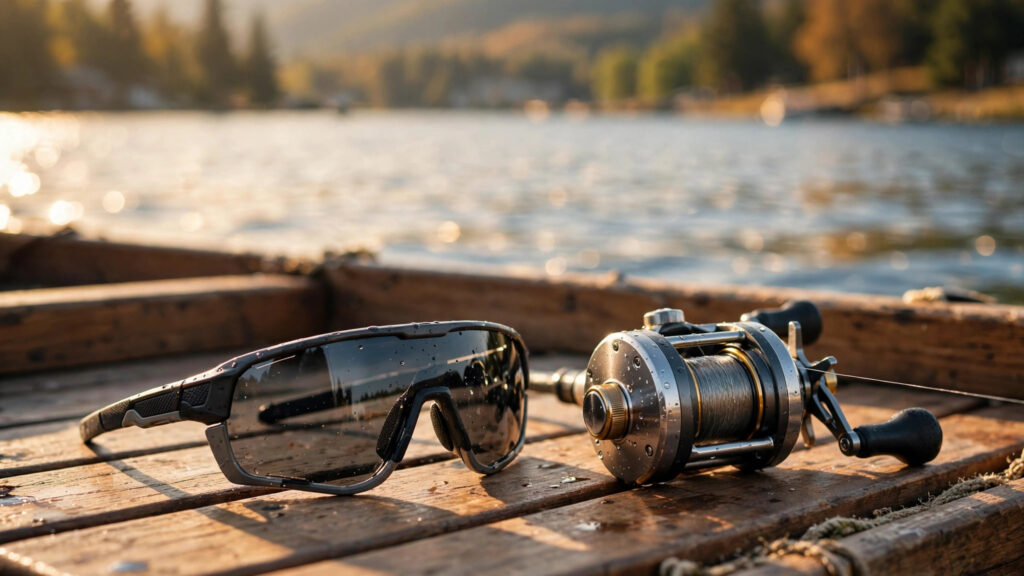
On the water, sunglasses aren’t accessories — they’re equipment. The best sunglasses for fishing and boating cut the blinding glare bouncing off the surface, let you see beneath it, and stay on through wind, spray, and long hours in intense reflected sunlight.
Water reflects and intensifies UV exposure, making proper eye protection genuinely important for anyone who spends serious time on boats, kayaks, or shorelines. The National Eye Institute identifies UV exposure as a contributor to cataracts, underscoring why on-water protection matters. Here’s how to choose sunglasses that work as hard as you do on the water.
Table of Contents
- Why Polarization Is Non-Negotiable
- Best Lens Colors for Water
- Frame Features for Marine Use
- Seeing Below the Surface: Fishing-Specific Tips
- Prescription Solutions for Boaters
- Care in Salt and Sun
Why Polarization Is Non-Negotiable
Sunlight reflecting off water becomes horizontally polarized glare — the intense, eye-squinting brightness that makes it impossible to see the surface clearly. Polarized lenses contain a filter that blocks this oriented light while passing useful vertical light, effectively deleting the glare layer. The difference is dramatic: with polarization you see into the water; without it you see only the shine.
For boaters, polarization also cuts dashboard and windshield glare, improving safety at speed. The technology is mature and reliable — quality polarized lens technology blocks 99%+ of reflected glare. Non-polarized sunglasses on the water are barely better than squinting; polarization is the single most important feature in this category.
Best Lens Colors for Water
For general boating and bright offshore conditions, gray or gray-green polarized lenses preserve true color while cutting glare — ideal when you need accurate color perception for navigation markers and charts. Copper, amber, and brown tints boost contrast, making them favorites for inshore fishing where reading shallow structure matters.
Low-light and overcast days call for lighter tints: yellow or light amber lenses maximize available light while retaining polarization’s glare cut. Many serious anglers carry two pairs or use interchangeable-lens systems — dark gray-green for midday sun, copper for variable light. Mirrored finishes add extra brightness reduction for tropical and high-glare environments.
Frame Features for Marine Use
Look for wraparound coverage that blocks peripheral glare and wind — side light on the water is intense. Hydrophilic nose pads and temple grips keep frames stable when spray and sweat hit. Floating frames (or a floating retainer strap) are cheap insurance against losing expensive glasses overboard; more sunglasses are lost to the sea than to breakage.
Corrosion resistance matters in salt environments: look for stainless steel, titanium, or high-grade nylon frames rather than cheap alloys that pit and weaken. Vented designs reduce fogging when moving between air-conditioned cabins and humid decks. And a secure retainer — a floating strap or cable temples — should be considered mandatory, not optional.
Seeing Below the Surface: Fishing-Specific Tips
Anglers use polarized sunglasses as a fish-finding tool. With glare removed, you can spot cruising fish, beds, weed lines, and depth changes that are invisible to the naked eye. Copper and amber tints excel here because they heighten contrast against green-brown water backgrounds.
Position matters: a hat with a brim plus wraparound sunglasses creates a glare-blocking system that’s dramatically more effective than glasses alone. Polarized lenses also reveal subsurface hazards — shallow rocks, sandbars — that matter for wading and shallow-water navigation. It’s a genuine safety tool, protecting both your catch rate and your eye health during long reflective hours.
Prescription Solutions for Boaters
Prescription wearers have strong options: direct prescription polarized lenses in wraparound frames (freeform surfacing handles the curved optics well), prescription inserts behind a non-prescription polarized shield, or contact lenses with quality non-prescription polarized sunglasses over them. Each works; the best choice depends on your prescription strength and budget.
Keep prescriptions current — reading distant markers, other vessels, and channel signs demands sharp distance vision, so don’t let an outdated prescription compromise safety. Regular eye exams are part of responsible boating preparation, right alongside checking the life jackets.
Consider a backup pair for the boat. Sunglasses and water have a way of parting — a wave, a gust, a moment of inattention. A floating retainer on your primary pair plus an affordable polarized backup in the dry box means a lost pair never ruins a trip. Many experienced boaters consider the backup as essential as the primary.
Early morning and late evening — prime fishing times — call for lighter tints. Keep a copper or amber pair accessible for these low-angle-sun windows when dark gray lenses would be too dim. Matching tint to the hour is a small detail that separates comfortable anglers from squinting ones.
Care in Salt and Sun
Salt is the enemy: rinse sunglasses with fresh water after every saltwater outing before wiping, since dried salt crystals scratch lenses and corrode frames. Clean with microfiber and lens-safe spray, store in a hard case out of direct heat (a boat dashboard in summer can warp frames), and inspect hinges and pads seasonally.
For young anglers, start the protection habit early — UV damage is cumulative over a lifetime, and kids on the water get intense exposure. Our kids vision guide covers youth-specific sunglass advice. Quality water sunglasses are among the highest-value gear purchases a boater or angler makes; treat them accordingly.