
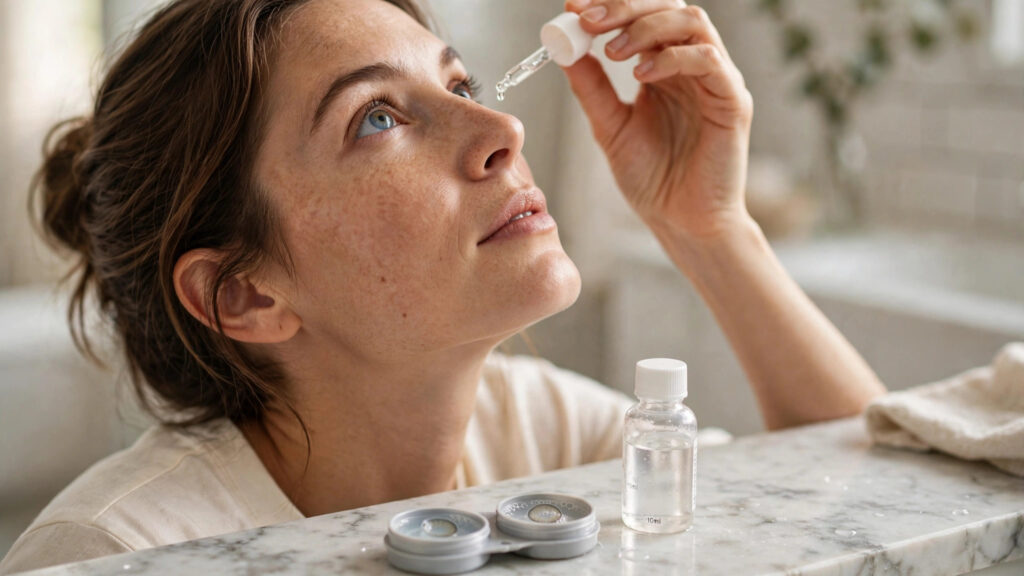
If you’re wondering, “why do my contacts feel dry by 3 p.m. every day?” — you’re far from alone. Contact lens-related dryness is the number one reason people reduce their wearing time or give up lenses entirely. The good news: most causes are identifiable and fixable.
Dryness happens when the lens disrupts your tear film, the thin layered coating that keeps the eye surface smooth and comfortable. Once you know what’s breaking that film down — the lens, the environment, your eyes, or your habits — you can target the fix instead of just tolerating the grit.
Table of Contents
- How Contact Lenses Affect Your Tear Film
- Lens-Related Causes of Dryness
- Environmental and Lifestyle Causes
- Eye Conditions Behind the Dryness
- Proven Fixes That Actually Work
- When Dryness Means See Your Doctor
How Contact Lenses Affect Your Tear Film
Your tear film has three layers: oil, water, and mucin. A contact lens splits this film in two, creating a thinner pre-lens film that evaporates faster and a post-lens film that the lens presses against the cornea. The result is inherently less stable tear coverage than the naked eye enjoys.
Every blink must re-spread tears over the lens surface, and any lens that doesn’t wet evenly creates dry spots. This is basic physics, not a product defect — but lens design, material, and your personal tear chemistry determine how severely you feel it. People with borderline dry eye often feel fine in glasses and miserable in lenses for exactly this reason.
Lens-Related Causes of Dryness
The lens itself is the first suspect. Overworn lenses accumulate deposits that roughen the surface and repel tears. High-water-content hydrogels can dehydrate as the day wears on, paradoxically making dryness worse in the very lenses marketed as “moist.” A poor fit — too tight or too flat — disrupts tear exchange under the lens.
Material choice matters enormously here. Silicone hydrogels with built-in wetting agents generally maintain comfort longer into the day than older materials, and daily disposables sidestep deposit buildup entirely. If dryness creeps in on a predictable schedule each afternoon, your lens material or replacement schedule is the likely culprit — a topic where current lens technology offers better options than ever.
Environmental and Lifestyle Causes
Your surroundings may be drying your lenses faster than your eyes can compensate. Air conditioning, forced-air heating, airplane cabins, and windy outdoor conditions all accelerate tear evaporation. Offices with low humidity are classic dryness amplifiers — the lens-wearing equivalent of working in a desert.
Screen time compounds the problem. Studies show blink rate can drop by half or more during concentrated screen use, and incomplete blinks fail to refresh the tear film over the lens. The 20-20-20 rule (every 20 minutes, look 20 feet away for 20 seconds) helps, as does consciously blinking fully. Contact lens wearers who stare at screens all day should treat blinking as part of their eye health routine, not an afterthought.
Eye Conditions Behind the Dryness
Sometimes the lens is innocent and the eye is the issue. Meibomian gland dysfunction — clogged oil glands along the eyelids — destabilizes the tear film’s oil layer and is extremely common in lens wearers. Allergies, certain medications (including antihistamines and some antidepressants), hormonal changes, and autoimmune conditions can all reduce tear production.
Age plays a role too; tear production naturally declines over time. If dryness appeared gradually and now affects you even on lens-free days, the underlying cause is probably ocular surface disease rather than the lenses themselves. The National Eye Institute notes that dry eye affects millions of Americans and often coexists with contact lens wear, each worsening the other.
Proven Fixes That Actually Work
Start with the simple wins: preservative-free rewetting drops formulated for contacts, used proactively before dryness peaks. Replace lenses on schedule — no stretching a monthly into week six. Consider switching to daily disposables, which eliminate deposit-related dryness and give you a fresh, fully wettable surface every morning.
For persistent cases, talk to your eye doctor about a material change, a different lens design, or treating the underlying ocular surface. Warm compresses and lid hygiene help meibomian gland dysfunction; prescription drops or punctal plugs address aqueous deficiency. Scleral lenses, which vault over the cornea in a reservoir of fluid, are a game-changer for severe dry eye — but that’s a specialty fitting conversation, not a drugstore fix.
When Dryness Means See Your Doctor
See your eye doctor if dryness persists despite drops and schedule compliance, if you need drops more than four times a day, or if dryness comes with pain, redness, light sensitivity, or fluctuating vision. These can signal corneal damage or inflammation that needs treatment, not just lubrication.
Don’t quietly quit lenses without mentioning it — “I stopped wearing them because they hurt” is valuable diagnostic information your doctor needs. Regular eye exams catch the gradual changes behind dryness before they force you out of lenses entirely. Most dryness is solvable; it just needs the right diagnosis first.