
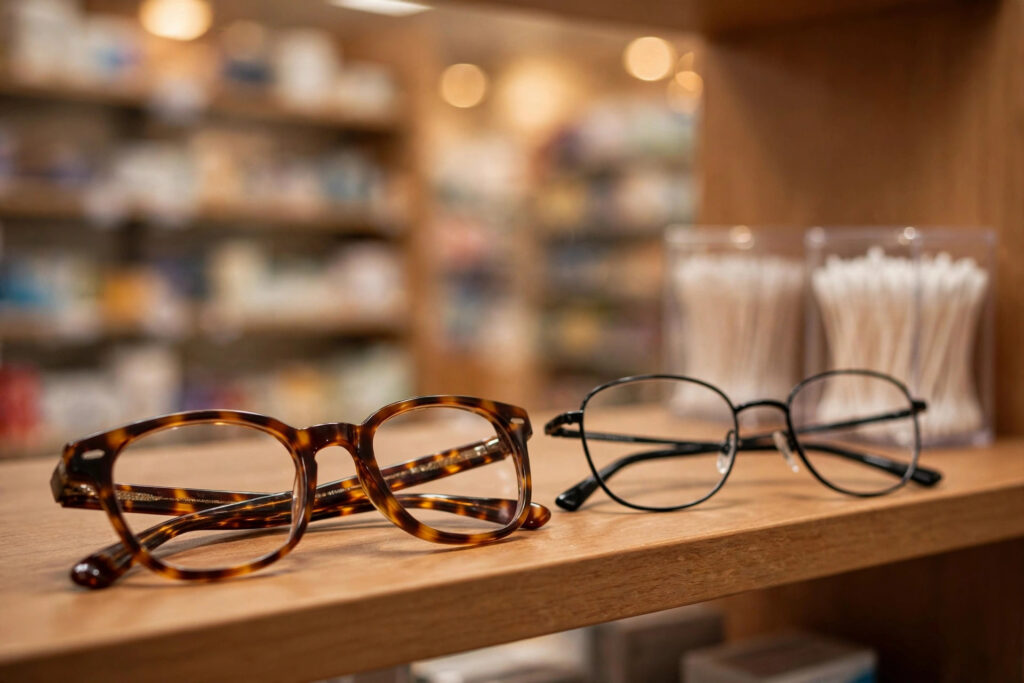
Once presbyopia sets in — usually in your mid-40s — reading menus, labels, and phone screens gets harder. The quick fix is a $15 pair of reading glasses from the drugstore. But your optician offers “prescription readers” that cost ten times more. What’s the actual difference, and when does it matter?
This guide explains what drugstore readers do well, where they fall short, and how to know which option your eyes actually need.
Table of Contents
- What Drugstore Readers Are
- What Prescription Readers Are
- When Drugstore Readers Are Fine
- When You Need Prescription Readers
- Risks of One-Size-Fits-All Readers
- Alternatives to Readers
What Drugstore Readers Are
Over-the-counter reading glasses are simple magnifiers: both lenses carry the same plus power (from +1.00 to +3.50 in 0.25 steps), with no correction for astigmatism, no customization for the difference between your eyes, and a standardized pupillary distance. They’re mass-produced optical aids, not medical devices fitted to you.
They work by doing one thing: adding converging power that compensates for your aging eyes’ reduced ability to focus up close. For the narrow task of reading at a typical distance, that single function is often enough — which is why millions of people use them happily. But “often enough” isn’t “optimal,” and the gaps matter more for some wearers than others.
What Prescription Readers Are
Prescription readers are custom-made single vision lenses optimized for near work, built from your actual prescription. They correct each eye independently (including different powers per eye), incorporate your astigmatism correction, position the optical centers at your measured PD, and can be tuned to your specific working distance — computer, book, or craft work each have different ideal focal lengths.
They’re made in your choice of lens materials and coatings — anti-reflective coating alone makes a noticeable difference for reading under lamps — and fitted in frames adjusted to your face. In short: everything drugstore readers aren’t. The result is sharper, more comfortable near vision, especially for extended reading sessions.
When Drugstore Readers Are Fine
Drugstore readers are reasonable when: your eyes have nearly identical prescriptions with minimal astigmatism, you need them only for brief tasks (menus, price tags, quick phone checks), your eyes feel comfortable using them, and — critically — you’ve had a recent comprehensive eye exam confirming your eyes are healthy.
Think of them as a convenience tool, not a vision solution. Keep a pair in the car, one at the office, one by the bed — their disposability is the point. Many people use drugstore readers for years without issue, provided their underlying prescription is simple and their eyes are healthy.
When You Need Prescription Readers
Upgrade to prescription readers when: your eyes differ by more than a small amount, you have meaningful astigmatism, you read or do close work for hours daily, drugstore readers cause headaches or eye strain, or you need a specific working distance (musicians, crafters, and computer workers all benefit from customized focal lengths).
Also consider prescription readers if drugstore pairs never seem “quite right” — that vague discomfort is usually the standardized PD or uncorrected astigmatism at work. People who primarily wear contact lenses for distance often find prescription readers (or multifocal contacts) more convenient than juggling drugstore pairs.
Risks of One-Size-Fits-All Readers
The real risk of drugstore readers isn’t the lenses — it’s what they let you skip. Reaching for readers instead of getting an eye exam means missed diagnoses: glaucoma, diabetic eye changes, macular degeneration, and cataracts all develop silently, and presbyopia age is exactly when screening matters most. Readers treat a symptom while the exam protects your sight.
Secondary risks: wrong-power readers (people routinely buy too strong, which feels “clearer” but strains the eyes), uncorrected astigmatism causing chronic headaches blamed on “getting old,” and poor optical quality in the cheapest pairs. None of this means drugstore readers are dangerous — it means they’re no substitute for professional eye care. The AAO’s reading glasses guidance covers safe use.
Alternatives to Readers
Readers aren’t the only answer to presbyopia. Progressive lenses handle distance, intermediate, and near in one pair — ideal if you also need distance correction. Bifocals offer a budget multifocal option. Multifocal contact lenses free you from glasses entirely for many activities. And monovision (one eye corrected for distance, one for near) works well for some contact lens wearers.
Each alternative has trade-offs in cost, convenience, and visual quality. The right choice depends on your full prescription, lifestyle, and budget — exactly the kind of personalized decision an eye doctor helps you make. Whatever you choose, keep the exam schedule: your eyes change, and your correction should change with them.
A practical path many people follow: start with drugstore readers for occasional use, and upgrade to prescription readers or progressives when near work becomes a daily hours-long activity. There’s no prize for tolerating eye strain — the moment readers feel like a compromise rather than a convenience, it’s time for a proper fitting.