
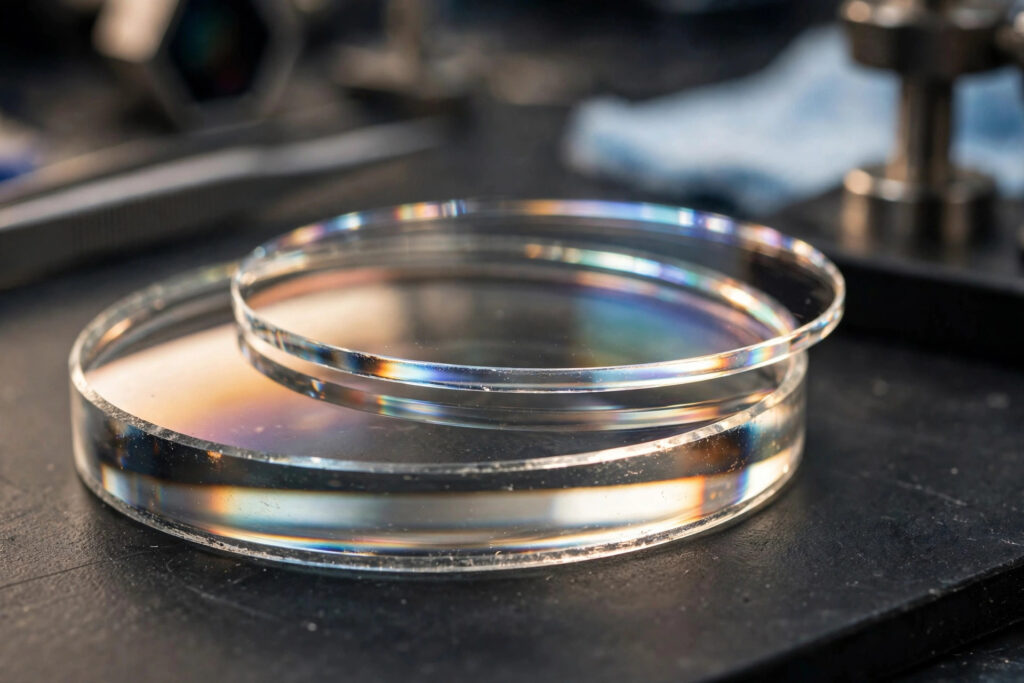
When you buy glasses, the lens material decision matters more than most people realize — and two options dominate the conversation: polycarbonate and Trivex. Both are lightweight, impact-resistant plastics that are dramatically tougher than standard CR-39. Both are thinner and lighter than basic plastic. So which one deserves your money?
The honest answer: they’re more similar than different, but the small differences matter for specific wearers. This comparison breaks down impact resistance, optical clarity, weight, tinting, and cost, so you can pick the right material for your prescription, your lifestyle, and your budget.
Table of Contents
- Polycarbonate Lenses: Overview
- Trivex Lenses: Overview
- Impact Resistance Comparison
- Optical Clarity and Abbe Value
- Weight, Thickness, and Cost
- Which Should You Choose?
Polycarbonate Lenses: Overview
Polycarbonate was originally developed for aerospace applications — it’s the same family of material used in bulletproof glass and astronaut helmet visors. In eyewear, it’s the most impact-resistant lens material available, roughly ten times more shatter-resistant than standard plastic. It’s also naturally UV-protective, blocking 100% of UV rays without any added coating, and it’s thinner and lighter than CR-39.
Because of its toughness, polycarbonate is the default recommendation for children’s glasses, sports eyewear, and safety glasses. Most optical shops stock it widely, which keeps prices competitive. The main knock against polycarbonate is optical: it has a relatively low Abbe value (around 30), which can produce slight chromatic aberration — faint color fringing — at the edges of stronger prescriptions. For mild to moderate prescriptions, most wearers never notice.
Trivex Lenses: Overview
Trivex is a newer urethane-based lens material developed as a military-grade alternative — it was originally created for Apache helicopter windshields. Like polycarbonate, it’s exceptionally impact-resistant and naturally blocks 100% of UV light. It’s slightly lighter than polycarbonate and, crucially, has a higher Abbe value (around 43–45), which translates to sharper peripheral optics with less chromatic aberration.
Trivex’s standout advantage is how well it handles drill-mounted rimless frames: it resists cracking around drill holes better than polycarbonate, making it the preferred material for rimless designs. It’s also easier to tint precisely, which matters for custom sunglass tints. The trade-offs are availability and price — fewer labs stock Trivex, and it typically costs more than polycarbonate. Families comparing options for children’s glasses often find polycarbonate the easier, cheaper default.
Impact Resistance Comparison
Both materials pass the FDA’s drop-ball impact test required for dress eyewear, and both far exceed the toughness of standard plastic or glass. In practical terms, either one will survive drops, bumps, and the general abuse that glasses endure. Polycarbonate has a slight edge in raw impact strength in laboratory testing, which is why it dominates the safety-eyewear market where ANSI Z87.1 certification is required.
For everyday life, the difference is negligible — you’re unlikely to notice which is tougher unless you’re in genuinely hazardous environments. Where it does matter: if you need certified eye protection for work or high-impact sports, confirm the specific ANSI or sports rating for your eye protection rather than relying on the material name alone. Both polycarbonate and Trivex can meet rigorous standards when manufactured and tested properly.
Optical Clarity and Abbe Value
This is where Trivex pulls ahead. The Abbe value measures how much a material disperses light into its component colors; higher is better. Trivex’s Abbe value of ~43–45 sits close to CR-39’s excellent 58, while polycarbonate’s ~30 is noticeably lower. In stronger prescriptions, polycarbonate wearers may perceive subtle rainbow fringing at the lens periphery, especially in high-contrast situations like white text on dark backgrounds.
Does it matter for you? With mild prescriptions (under ±3.00), the difference is essentially invisible — the center of the lens, where you look most, is sharp in both materials. With stronger prescriptions or large frames, Trivex’s clearer periphery becomes a genuine comfort upgrade. If you’re sensitive to visual artifacts or spend long hours in visually demanding work, Trivex’s optical edge is worth the premium. The All About Vision lens materials guide has a useful side-by-side breakdown of Abbe values across materials.
Weight, Thickness, and Cost
Both materials are meaningfully lighter and thinner than standard CR-39 plastic. Trivex is marginally lighter than polycarbonate, though the difference is small enough that most wearers can’t feel it. In terms of thickness, polycarbonate (index 1.59) and Trivex (index 1.53) are close; neither competes with true high-index materials (1.67+) for slimming strong prescriptions, so very high powers may still call for high-index lenses instead.
On cost, polycarbonate wins. It’s produced at massive scale, stocked everywhere, and often included as a standard or low-cost upgrade. Trivex typically adds a noticeable premium and may involve longer turnaround times since fewer labs process it. If budget is a factor and your prescription is mild-to-moderate, polycarbonate delivers 90% of the benefit at a lower price.
Which Should You Choose?
Choose polycarbonate if: you want maximum impact resistance at the lowest price, you’re buying for an active child, you need safety-rated eyewear, or your prescription is mild-to-moderate. It’s the practical workhorse — tough, affordable, UV-protective, and available everywhere.
Choose Trivex if: you want the sharpest peripheral optics, you’re mounting lenses in a rimless frame, you need precise custom tints, or you have a stronger prescription where chromatic aberration might bother you. It’s the refined choice — nearly as tough as polycarbonate with visibly better clarity. Either way, pair your choice with a quality anti-reflective coating and a current prescription from a comprehensive eye exam, and you’ll have lenses built to perform.