
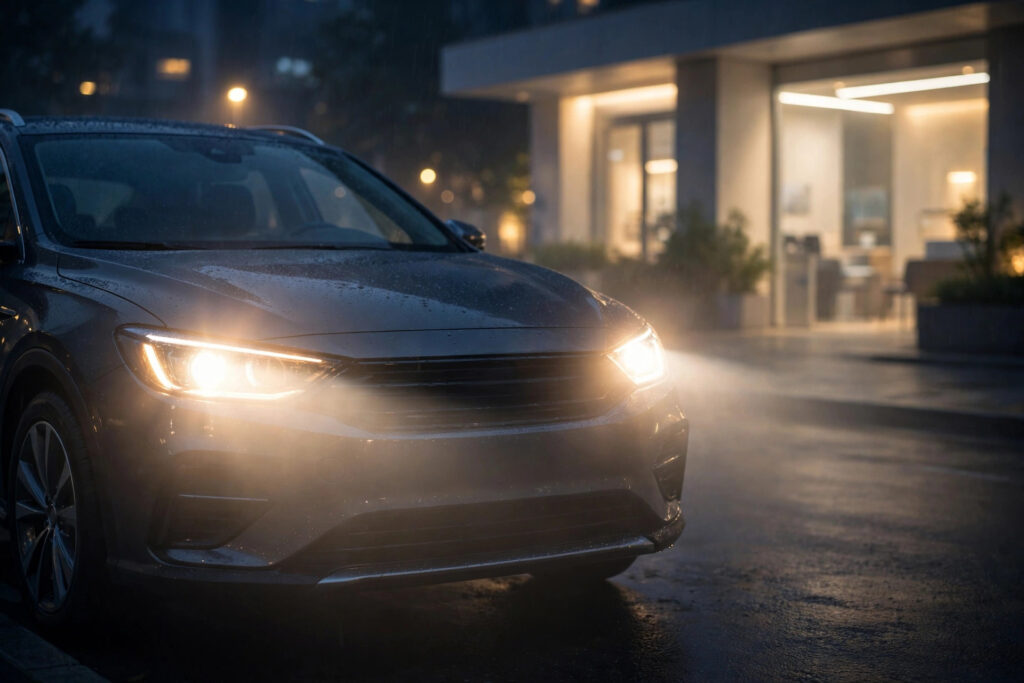
One of the most talked-about side effects of LASIK is also one of the most visual: halos, glare, and starbursts around lights at night. Almost everyone notices some degree of it in the early weeks after surgery. For most patients it fades as the eyes heal; for a small minority it lingers. If you drive at night, work evenings, or simply want to know what to expect, this is the side effect to understand before surgery, not after.
This article explains why night vision disturbances happen, which patients are most susceptible, the typical recovery timeline, and practical steps that help. It is general information, not medical advice. Discuss your personal risk, especially your pupil size and prescription, with a qualified refractive eye surgeon during your evaluation.
Table of Contents
- What Halos, Glare, and Starbursts Actually Are
- Why They Happen After LASIK
- Who Is Most Affected
- How Long They Last
- How Modern Technology Reduced the Problem
- Practical Help for Night Driving
- When to Talk to Your Surgeon
What Halos, Glare, and Starbursts Actually Are
These three terms describe related but distinct visual phenomena. Halos are rings or circles of light seen around a light source, like a glowing ring around each streetlamp. Glare is a more general scattering or washing-out of vision in the presence of bright light, the headlight that seems to flood your whole field of view. Starbursts are radiating spikes or rays extending outward from point light sources, turning a single taillight into a small sunburst.
They are most noticeable in low-light conditions: driving at night, walking through a lit parking lot, or looking at oncoming traffic. In daylight, when pupils are small, most patients notice nothing at all. That day-night split is the key clue to the underlying optics, and it is why surgeons pay such close attention to how your pupils behave in the dark.
It is worth distinguishing these effects from simple blur. Night vision disturbances are about how light is distributed across the retina, not about the sharpness of the focused image. A patient can read the 20/20 line perfectly in a bright exam room and still see starbursts around headlights on the drive home. Both facts can be true at once, which is why the standard eye chart does not tell the whole story.
Why They Happen After LASIK
The core issue is a mismatch between the treated zone and the pupil. LASIK reshapes only the central portion of the cornea, the optical zone, typically around six millimeters or so in diameter. In bright light your pupil is smaller than that zone, so all incoming light passes through treated cornea and focuses cleanly. In darkness the pupil dilates, and if it opens wider than the treated zone, some light enters through the untreated peripheral cornea and focuses differently, creating the scattered images perceived as halos and starbursts.
Healing adds a temporary layer. In the early weeks, microscopic swelling and surface irregularity scatter light further, which is why night symptoms are usually at their worst soon after surgery and then improve. Dryness compounds the effect too: an unstable tear film creates an irregular optical surface that scatters light, so the dry eye phase and the halo phase often overlap and resolve together.
There is also a perceptual component. Before surgery, many patients wore glasses or contacts that produced their own minor aberrations, and the brain had years to adapt. After LASIK, the optical system is new, and the brain needs time to recalibrate. Some of the early improvement patients report is genuine healing; some is neural adaptation, the visual system learning the new optics.
Who Is Most Affected
The two measurable risk factors are pupil size in dim light and the size of the original prescription. People whose pupils dilate widely in the dark are more likely to exceed the treated optical zone, and surgeons measure scotopic pupil size specifically to assess this. Very high prescriptions require more tissue removal and historically correlated with more night vision complaints, though modern laser profiles have narrowed this gap considerably.
Pre-existing night vision quirks matter as well. Patients who already noticed halos around lights while wearing glasses or contacts, which is common with high prescriptions, may simply be more sensitive to these phenomena and more likely to notice them after surgery. Age plays a smaller role, though the eye’s natural lens changes over time can add their own glare effects independent of LASIK.
This is one of the risks where screening genuinely predicts outcome, so the consultation discussion should be specific. Ask what your dim-light pupil measurement was and how it compares to the planned optical zone. A surgeon who has measured carefully and explains the relationship is giving you a real risk assessment, not a generic reassurance.
How Long They Last
The typical trajectory is reassuring. Night vision disturbances are most pronounced in the first days and weeks, improve noticeably over the first one to three months as swelling resolves and the tear film stabilizes, and continue fading for up to six months or occasionally longer. The large majority of patients end up with night vision they consider normal or only mildly different from before.
A small percentage of patients report persistent bothersome symptoms beyond the first year. Persistent cases are more common among those with the risk factors above and were more common with earlier generations of laser technology. When symptoms do persist, they tend to stabilize rather than worsen, and management options exist, from treating coexisting dryness aggressively to, in select cases, enhancement procedures that enlarge or refine the optical zone.
Keeping expectations calibrated helps. Some increase in light scatter at night is a normal, expected part of early healing, not evidence of a problem. The question is never whether you notice anything in week two; it is how the trend looks at month three and month six. Track the direction, not the day-to-day fluctuations.
How Modern Technology Reduced the Problem
Night vision complaints were significantly more common in the early days of LASIK, and the improvement since then is one of refractive surgery’s genuine success stories. Larger optical zones mean the treated area now covers most patients’ dilated pupils. Wavefront-guided and topography-guided treatments map each eye’s unique optical imperfections and correct the subtle higher-order aberrations that contribute to halos and glare, rather than applying a one-size-fits-all profile.
Femtosecond laser flap creation also contributed by making flaps more precise and uniform than the mechanical blades of earlier eras. And better screening simply keeps the highest-risk eyes, extreme pupils combined with extreme prescriptions, toward alternative procedures or away from surgery. Each of these advances chipped away at the problem from a different direction.
None of this means the issue is solved for everyone, and marketing claims of “halo-free LASIK” should be treated skeptically. But a patient treated in 2026 with a modern wavefront-guided profile, a generously sized optical zone, and proper screening faces meaningfully lower risk than a patient treated two decades ago. Advances in Blue Light Filter Lens Technology: Does It Help?“>lens technology more broadly, including the diagnostic devices that map your cornea before surgery, are part of the same story.
Practical Help for Night Driving
While healing progresses, a few practical measures make night driving more comfortable. Keep your windshield and glasses, if you still use them for any task, scrupulously clean; film and smudges scatter light and amplify every halo. Dim the dashboard lights, use the night setting on the rearview mirror, and look slightly away from oncoming headlights rather than directly at them, a habit that helps every driver.
Anti-reflective coatings matter more than many people realize. If you wear any Rimless vs Full-Rim Glasses: Which Should You Choose?“>eyeglasses for residual correction or simply for protection, a quality anti-reflective coating cuts the internal reflections that add ghost images to night scenes. The same principle applies to the Best Sunglasses for Hiking and the Outdoors“>sunglasses habit during the day: protecting healing eyes from UV and wind supports the tear film recovery that night vision depends on.
Most importantly, be honest with yourself about comfort. If night driving feels difficult in the early weeks, limit it while healing progresses. This is temporary for the vast majority of patients, and giving your eyes a few weeks of easier conditions costs nothing. The American Academy of Ophthalmology’s LASIK page discusses night vision effects among the standard risks worth understanding before surgery.
When to Talk to Your Surgeon
Most night vision symptoms after LASIK are part of normal healing and improve with time. But certain patterns deserve a prompt conversation with your surgeon: symptoms that are worsening rather than improving after the first couple of months, a sudden new onset of severe glare or halos long after they had resolved, or night vision problems accompanied by significant pain or vision loss. These are not typical healing patterns.
At follow-up visits, describe your night vision specifically rather than just reporting your daytime chart results. Mention driving, since it is the real-world test that matters most. Surgeons can check for residual refractive error, assess the tear film, and examine the cornea’s healing, and each of these has a corresponding fix if it turns out to be contributing.
For patients still in the considering stage, the single most useful step is a candid pre-operative discussion of your pupil measurements and what they imply. Night vision after LASIK is not a lottery; it is largely predictable from the data your screening already collects. A surgeon who walks you through that data is offering the best possible version of informed consent, and you should expect nothing less before an elective procedure on your eyes.