
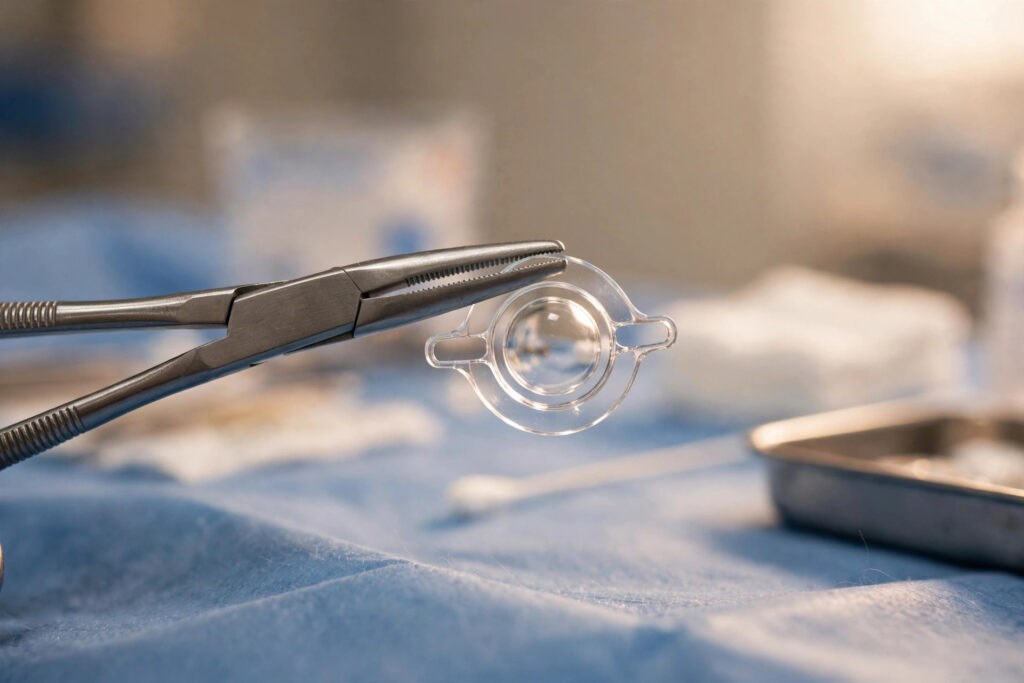
ICL and LASIK are the two leading options for permanent vision correction, but they work in fundamentally different ways. LASIK reshapes the cornea with a laser to change how the eye focuses light. ICL — the implantable collamer lens — places a thin, biocompatible lens inside the eye, in front of the natural lens, leaving the cornea essentially untouched. Both can free suitable patients from glasses and contacts, yet they suit different eyes and different priorities.
This article compares ICL vs LASIK across the dimensions that matter: how each works, vision quality and treatable prescriptions, candidacy, safety and reversibility, recovery, and long-term outlook. There is no universal winner — the better choice is the one matched to your eyes. Discuss your individual suitability with a qualified refractive eye surgeon.
Table of Contents
- How ICL and LASIK Work Differently
- Vision Quality and Prescription Range
- Candidacy: Who Qualifies for Each
- Safety, Risks, and Reversibility
- Recovery Compared
- Cost and Long-Term Outlook
How ICL and LASIK Work Differently
LASIK is a subtractive procedure: the excimer laser removes microscopic amounts of corneal tissue to reshape the cornea’s curvature, changing its focusing power. The correction is carved into the cornea itself, which is why adequate corneal thickness is a non-negotiable requirement — tissue removed cannot be replaced.
ICL is an additive procedure: nothing is removed from the cornea. The surgeon inserts a soft, foldable lens made of collamer — a biocompatible material containing collagen — through a tiny incision, positioning it behind the iris and in front of the eye’s natural crystalline lens. The implant stays in place indefinitely, correcting vision much like a permanent internal contact lens. Modern designs include a central port that allows natural fluid circulation, eliminating the need for a separate iris procedure that older versions required.
This philosophical difference drives everything else. LASIK’s limits are corneal: thickness, shape, and healing. ICL’s limits are anatomical: the eye’s internal dimensions must accommodate the lens, and the natural lens and retina must be healthy. A patient ruled out of LASIK for thin corneas may be an excellent ICL candidate, while a patient with a shallow anterior chamber may be steered the other way.
The procedures also differ in setting and duration. LASIK takes minutes per eye with the patient awake under numbing drops. ICL implantation is a short intraocular surgery — still brief, typically under half an hour — performed in a surgical suite with similar anesthesia. Both are outpatient, but ICL’s intraocular nature means a different risk profile and a different follow-up rhythm.
Vision Quality and Prescription Range
Both procedures deliver excellent visual outcomes in suitable patients, and head-to-head comparisons generally show high satisfaction with either. ICL is often noted for exceptional quality of vision — crisp contrast and good night vision — partly because it leaves the cornea’s natural aspheric shape undisturbed rather than reshaping it. LASIK, particularly with modern wavefront-guided or topography-guided platforms, also achieves outstanding quality of vision for appropriate candidates.
Where they diverge most clearly is treatable range. LASIK’s correction ceiling is set by corneal thickness: very high nearsightedness may require removing more tissue than is safe. ICL has no such corneal budget to spend, so it can correct higher degrees of myopia than LASIK typically can — often the primary option for patients whose prescriptions exceed safe laser limits. ICL models also correct astigmatism (toric versions), widening its applicability.
Farsightedness is treatable by both within their respective approved ranges, though availability of specific ICL models for hyperopia varies by region and regulatory approval. Presbyopia — the age-related loss of near focusing — is not solved by either procedure’s standard form; patients approaching their mid-40s should discuss monovision strategies or lens-based options with their surgeon.
Dry eye considerations also separate them. Because ICL avoids reshaping the cornea and severs no corneal nerves, it typically induces less dry eye than LASIK. Patients with significant pre-existing dryness who still want surgical correction often find ICL the more comfortable path — though the dry eye should be evaluated and managed regardless, and Contact Lens Solution Types Explained“>contact lenses remain a workable non-surgical alternative for many.
Candidacy: Who Qualifies for Each
LASIK candidacy centers on the cornea: adequate thickness, normal topography with no signs of keratoconus, a stable prescription, healthy tear film, and an anterior eye free of disease. Age, prescription stability, and general eye health complete the picture. A comprehensive pre-operative Slit Lamp Exam: What It Shows“>eye exam with corneal mapping is the gatekeeper.
ICL candidacy centers on internal anatomy: sufficient anterior chamber depth to house the lens safely, healthy endothelium (the cornea’s inner cell layer, which the lens sits near), a normal iris and natural lens, and no glaucoma or significant cataract. Stable prescription and good general eye health apply equally. Sizing is critical — the lens must match the eye’s dimensions precisely, measured with specialized imaging — because an incorrectly sized lens can cause complications.
The classic ICL patient is the highly nearsighted adult whose corneas are too thin for LASIK, or whose prescription exceeds safe laser range. But ICL is not only a fallback: some patients with perfectly LASIK-suitable eyes choose ICL for its reversibility, its UV-protective lens material, or its minimal dry-eye impact. Conversely, patients with shallow chambers or low endothelial cell counts may be excellent LASIK candidates but poor ICL candidates.
Age guidance is similar for both: adults with stable prescriptions, generally 21 and older, who understand that reading glasses will still arrive with presbyopia. Neither procedure is recommended during pregnancy or nursing, or with unstable prescriptions. The surgeon’s measurements — not patient preference alone — determine which doors are open.
Safety, Risks, and Reversibility
Both procedures have strong safety records in properly selected patients, but their risk profiles reflect their different natures. LASIK’s risks are corneal: flap complications (largely historical with modern femtosecond flaps), dry eye, night-vision disturbances, and rare ectasia in poorly screened corneas. Decades of data and refined screening have made serious complications uncommon.
ICL’s risks are intraocular: because the lens sits inside the eye near delicate structures, potential issues include elevated eye pressure, cataract formation (less common with modern central-port designs), endothelial cell loss over time, and incorrect sizing. These are manageable with proper sizing, surgical skill, and follow-up — but they are categorically different from LASIK’s risks, and they explain why ICL demands a surgeon experienced specifically in the procedure.
Reversibility is ICL’s signature advantage. The lens can be removed or exchanged if vision needs change, if a better technology arrives, or if any issue arises — the eye returns essentially to its pre-operative state. LASIK’s corneal reshaping is permanent; while enhancements are possible, the tissue cannot be put back. For younger patients whose prescriptions might still evolve, or for anyone who values an exit route, this distinction carries real weight.
Long-term monitoring differs accordingly. ICL patients need periodic checks of eye pressure, endothelial cell health, and lens position — a light but lifelong follow-up commitment. LASIK patients need routine eye care like everyone else. Neither procedure prevents age-related eye conditions such as cataracts or glaucoma, and both leave the door open to future treatments, including cataract surgery if it ever becomes needed.
Recovery Compared
LASIK recovery is famously fast: hazy vision clearing within hours, functional sight by the next morning, and return to desk work within a day or two. Dryness and light sensitivity are the main early companions, managed with drops and Best Sunglasses for Running and Sports“>sunglasses.
ICL recovery is similarly quick — often quicker in terms of visual clarity, since there is no corneal healing interface to clear. Many patients see remarkably well the same day. The first 24 hours may include mild pressure sensation or light sensitivity, and surgeons monitor eye pressure closely in the early days. Drops (antibiotic and anti-inflammatory) follow a short course, and activity restrictions are brief.
Where the experiences differ is in the weeks that follow. LASIK patients manage the familiar arc of resolving dryness and stabilizing tear film over weeks to months. ICL patients typically have less dryness to manage but attend scheduled pressure and lens-position checks. Both groups protect their eyes from trauma and UV light during healing, and both should report anything unusual — sudden vision changes, significant pain, or persistent redness — promptly.
For most patients, the practical recovery burden of either procedure is light: a few days of taking it easy, diligent drops, and scheduled follow-ups. Recovery speed alone rarely decides between them; the decision rests far more on candidacy, prescription range, and how each patient weighs reversibility against LASIK’s longer track record.
Cost and Long-Term Outlook
ICL typically costs more than LASIK — often substantially — reflecting the customized implanted lens, the surgical facility, and the specialized expertise required. LASIK pricing varies by technology tier, with wavefront-guided and topography-guided treatments at the premium end. For both, compare all-inclusive pricing: screening, procedure, follow-ups, and enhancement or exchange policies.
The long-term outlook for both is strong. LASIK’s multi-decade history provides deep reassurance about stability, with most patients maintaining their correction for many years; natural age-related changes like presbyopia and cataracts affect everyone regardless. ICL’s track record, while shorter than LASIK’s, is extensive and reassuring, with the added comfort of reversibility if circumstances change.
Thinking long-term also means thinking about the decades ahead. A 25-year-old choosing vision correction is buying 20-plus years before presbyopia and potentially 40-plus before cataracts. ICL’s removability appeals to long-horizon thinkers; LASIK’s permanence appeals to those who prefer a one-and-done solution. Neither is wrong — they are different answers to different priorities.
Start with neutral references — the FDA’s overview of laser and alternative vision correction procedures and the American Academy of Ophthalmology’s refractive surgery resources — and remember that premium eyeglasses remain a perfectly good choice too. Then bring your measurements, your prescription history, and your priorities to a qualified refractive eye surgeon, and let the recommendation follow your eyes rather than a marketing brochure.