
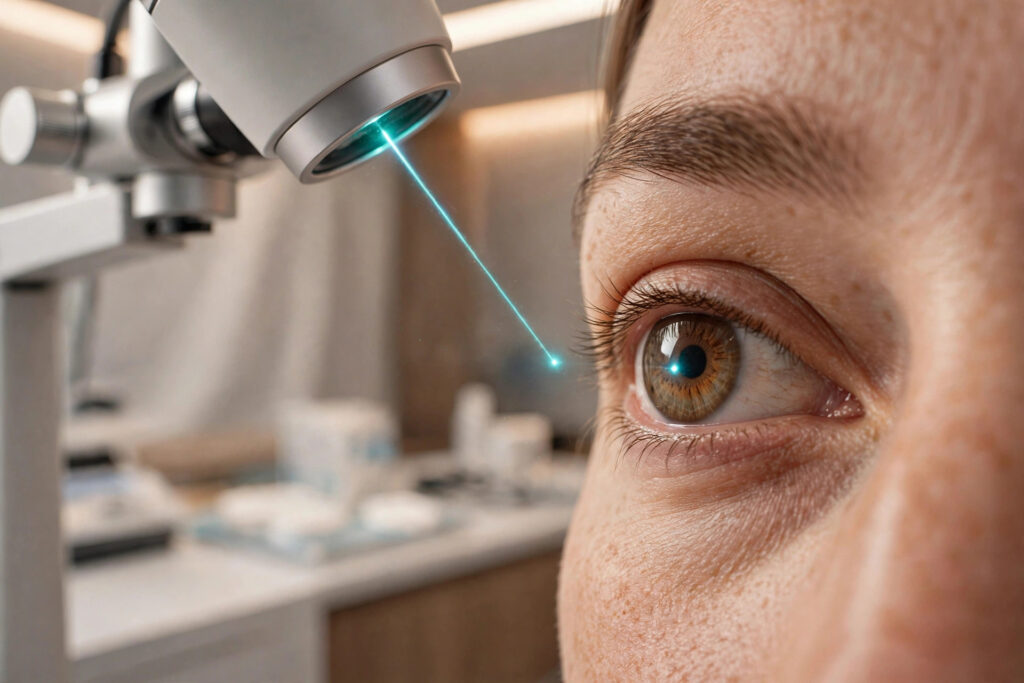
Trans-PRK, short for transepithelial photorefractive keratectomy, is a surface-based laser vision correction in which the laser removes the cornea’s thin outer layer and reshapes the underlying tissue in one continuous, no-touch step. No flap is created, and unlike traditional PRK, no instrument or alcohol solution ever touches the eye. For patients who are not LASIK candidates, it is one of the most discussed alternatives in 2026.
This guide explains how Trans-PRK works, how it differs from PRK, LASIK, and SMILE, who it suits best, what the longer recovery involves, and where its limits lie. It is general information, not medical advice. Candidacy depends on your individual corneas and prescription, so discuss every option with a qualified refractive eye surgeon.
Table of Contents
- What Trans-PRK Is
- How the No-Touch Procedure Works
- Trans-PRK vs PRK, LASIK, and SMILE
- Who Trans-PRK Suits Best
- Recovery Timeline
- Risks and Limitations
- Is Trans-PRK Right for You?
What Trans-PRK Is
All laser vision correction reshapes the cornea so light focuses correctly on the retina. The procedures differ mainly in how the surgeon reaches the tissue to be reshaped. LASIK cuts a flap; SMILE extracts a lenticule through a tiny incision; surface procedures like PRK work on the cornea’s surface after removing its thin outer skin, the epithelium. Trans-PRK is the most automated member of the surface family: a single excimer laser first ablates the epithelium and then reshapes the stroma beneath, with no manual step in between.
The “trans” in the name means transepithelial, describing that the laser passes through the epithelium rather than a surgeon scraping or chemically loosening it. Because the epithelium regenerates naturally within days, the trade-off of every surface procedure is a longer, less comfortable early recovery in exchange for leaving the cornea’s deeper structure completely untouched.
Trans-PRK is sometimes marketed under platform-specific brand names, but the underlying technique is the same regardless of branding. When a clinic advertises a named “no-touch” procedure, ask which laser platform it uses and how the surgeon’s protocol works; the fundamentals matter more than the trademark. The American Academy of Ophthalmology’s PRK overview covers the surface-procedure family that Trans-PRK belongs to.
How the No-Touch Procedure Works
On procedure day, numbing drops are applied and you recline under the laser. The surgeon centers the eye using the laser’s tracking system, and the excimer laser begins: first it vaporizes the epithelium across the treatment zone, then, without pause, it sculpts the stromal tissue according to your prescription. The whole laser sequence typically takes well under a minute per eye, during which you stare at a target light.
Because nothing touches the eye, the procedure is sometimes described as the most “hands-off” laser correction available. After the laser finishes, the surgeon places a soft bandage contact lens over the cornea to protect it while the epithelium regrows, and prescribes the usual post-operative drops. You will not feel the laser working; afterward, as the numbing wears off, the familiar surface-procedure discomfort begins.
Follow-up starts the next day and continues over the first week while the surface heals. A thorough pre-operative Online Eye Exams vs In-Person: Pros and Cons“>eye exam with corneal topography is essential beforehand, since surface procedures depend on accurate mapping of the cornea’s shape. Discuss the full protocol with your surgeon so you know exactly what the first week will demand of your schedule.
Trans-PRK vs PRK, LASIK, and SMILE
Compared with traditional PRK, Trans-PRK’s advantage is consistency: the laser removes the epithelium in a uniform, precisely controlled layer, whereas manual removal can be uneven and alcohol-assisted removal adds a chemical step. Many surgeons report smoother early healing and slightly faster visual recovery with the transepithelial approach, though both are surface procedures with the same basic healing profile.
Against LASIK, the comparison is structural. Trans-PRK creates no flap, so there is no flap to dislodge and no flap-related complications, and it preserves more tissue in thin corneas where a flap would consume too much. The cost of that safety is recovery: LASIK patients often see clearly the next day, while Trans-PRK patients typically need several days to a week of healing before vision becomes functional, with more discomfort in the first few days.
Against SMILE, Trans-PRK trades the small incision for a surface approach entirely, which some surgeons prefer for patients with certain corneal shapes or occupations with eye-injury risk. SMILE generally offers faster visual recovery, while Trans-PRK avoids any intrastromal manipulation. There is no universal ranking; each procedure has eyes it serves best. Advances in Anti-Fog Coating for Glasses: Guide“>lens technology also keep improving the glasses and contact lens alternatives for patients who decide against surgery.
Who Trans-PRK Suits Best
Trans-PRK’s classic candidate is the patient with corneas too thin for a safe LASIK flap, or with corneal shapes that make flap creation less attractive. Contact-sport athletes, military personnel, and people in dusty or high-impact occupations are often steered toward surface procedures because there is no flap to be traumatically displaced years later. Adults with stable prescriptions and healthy eyes who can accommodate a longer recovery are the core group.
It treats nearsightedness, farsightedness within limits, and astigmatism, with ranges broadly similar to PRK. It is not suitable for everyone: very high prescriptions, keratoconus or other corneal irregularities, significant dry eye, corneal scarring, and autoimmune healing disorders generally rule it out. Pregnancy, nursing, and unstable prescriptions are reasons to wait, as with all laser procedures.
Expectations matter as much as anatomy. The ideal Trans-PRK patient understands that the first week will be uncomfortable, that vision fluctuates during healing, and that the payoff arrives over weeks rather than hours. Patients who need rapid visual recovery for work may find that trade-off difficult; those who prioritize long-term corneal integrity often find it worthwhile.
Recovery Timeline
The first three to four days are the hardest. As the epithelium regrows, patients typically experience grittiness, light sensitivity, watering, and a burning sensation that peaks around day two or three. Oral pain relief, frequent lubricating drops, and resting in a darkened room are the standard coping strategy. The bandage contact lens stays in place during this phase and is removed by the surgeon once the surface has closed.
Vision during the first week is blurry and variable; most patients need several days off work, and driving is out of the question until the surgeon clears you. By the end of the first week to ten days, the surface has typically healed and functional vision returns, though it may still fluctuate. Desk work with frequent breaks is usually feasible at this stage.
Full stabilization takes longer than with LASIK, generally several weeks to a few months, during which dryness and night-vision effects like halos gradually settle. Follow-up visits track the healing, and protecting the eyes from UV exposure with quality Polarized vs Non-Polarized Sunglasses: Key Differences“>sunglasses is especially important after surface procedures. Patience is the single most useful thing a Trans-PRK patient can bring to recovery.
Risks and Limitations
The longer, more uncomfortable recovery is Trans-PRK’s main drawback, and it is significant enough to rule the procedure out for some patients. Beyond comfort, surface procedures carry a small risk of corneal haze, a clouding of the healing tissue that modern protocols, including the use of mitomycin-C during surgery in higher corrections, have made uncommon but not impossible.
As with all laser correction, there are risks of under- or over-correction, dry eye, night-vision disturbances, and infection, though serious complications are rare in properly screened patients. Enhancements are possible if needed, typically performed as a repeat surface procedure once the eye has fully stabilized. The FDA’s page on LASIK risks describes complications that apply across the laser vision correction family.
A practical limitation is surgeon and platform availability: not every clinic offers Trans-PRK, and protocols vary. When comparing providers, ask how many transepithelial procedures the surgeon performs and what their enhancement policy covers. For patients who wore contact lenses for years, remember that lenses must be left out for a specified period before screening so corneal measurements are accurate.
Is Trans-PRK Right for You?
Trans-PRK earns its place as the no-touch, flap-free option for patients whose corneas or lifestyles make LASIK inadvisable. Its strengths are structural safety and a fully automated treatment; its price is a longer, less comfortable recovery. Neither side of that trade-off is trivial, and the right answer depends on your eyes, your prescription, your occupation, and your tolerance for downtime.
The decision process should start with comprehensive screening and an honest conversation about all suitable options, not just the one the clinic markets most heavily. A good surgeon will explain why a particular procedure fits your eyes and will be comfortable recommending against surgery if the risk profile does not favor it.
Bring a list of questions to the consultation: candidacy, expected recovery timeline for your prescription, haze prevention protocol, enhancement policy, and total cost. Take notes, compare clinics on equal terms, and give yourself time to decide. Laser vision correction is elective, and the best outcomes come to patients who chose deliberately rather than hurriedly.