Wavefront-guided LASIK, often shortened to wavefront LASIK, is a form of laser vision correction that tailors the treatment to the unique optical fingerprint of each eye. Conventional LASIK corrects your glasses prescription — sphere, cylinder, and axis — but wavefront technology goes further. It measures how light actually travels through your entire optical system, capturing subtle irregularities that standard prescriptions cannot describe, and then shapes the laser treatment around that full picture.
The promise is a more personalized ablation profile that, for many patients, delivers sharper vision and fewer visual disturbances such as glare and halos than older conventional treatments. This article explains what wavefront technology measures, how the procedure differs in practice, who tends to benefit most, and where its limitations lie. As with any elective eye surgery, your individual suitability should be discussed with a qualified refractive eye surgeon.
Table of Contents
- What Wavefront-Guided LASIK Is
- How Wavefront Mapping Works
- Wavefront vs Conventional LASIK
- Who Benefits Most from Wavefront LASIK
- The Procedure and Recovery
- Limitations and Considerations
What Wavefront-Guided LASIK Is
Every eye has optical imperfections, and they fall into two broad groups. Lower-order aberrations are the familiar ones — nearsightedness, farsightedness, and astigmatism — the errors your glasses or How to Put In Contact Lenses: A Beginner’s Guide“>contact lenses correct. Higher-order aberrations are subtler distortions with names like coma, trefoil, and spherical aberration. They affect how crisp and clean your vision feels, especially in dim light, and they cannot be corrected by standard lenses.
Wavefront-guided LASIK measures both groups before surgery and builds a treatment plan that addresses the full set. The excimer laser then removes corneal tissue in a pattern derived from that measurement, rather than from a simplified prescription alone. Think of it as the difference between a suit cut from standard sizes and one tailored to your exact measurements.
This technology became widely available in the early 2000s and has been refined steadily since. By 2026, wavefront-guided and wavefront-optimized treatments are the default offering at many refractive practices, with conventional treatments largely reserved for unusual cases. When a clinic advertises “custom LASIK,” it is usually referring to a wavefront-guided or wavefront-optimized platform.
It helps to know there are two related but distinct approaches. Wavefront-guided treatment uses an actual wavefront measurement of your eye to drive the laser. Wavefront-optimized treatment does not use your individual wavefront map; instead, it applies a standard profile designed to preserve the cornea’s natural aspheric shape and minimize the induction of new higher-order aberrations. Both are considered “custom” in marketing terms, but only the guided version is truly built from your eye’s own data.
How Wavefront Mapping Works
The measurement device is called a wavefront aberrometer, and the scan takes only seconds per eye. You look into the instrument at a target while it sends a gentle beam of light into your eye. The light reflects off your retina and travels back out through the cornea, lens, and other optical structures. Sensors capture the shape of that outgoing wavefront — perfectly flat in an ideal optical system, distorted in a real one.
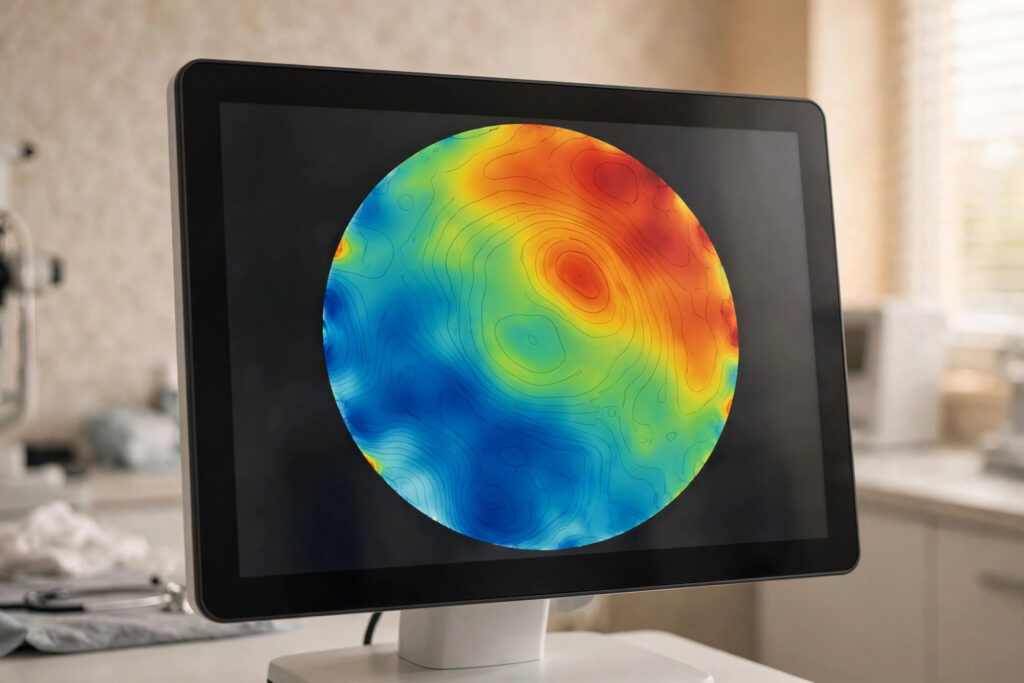
The instrument analyzes the distortion and expresses it as a set of mathematical terms. Lower-order terms correspond to your familiar prescription. Higher-order terms describe the subtle irregularities. The result is a detailed optical map, sometimes visualized as a colorful three-dimensional surface, showing exactly where light is being bent off course as it passes through your eye.
This map becomes the treatment blueprint. Sophisticated software converts the aberration data into a laser ablation profile — a precise plan for where the excimer laser should remove more tissue and where it should remove less. The data is transferred to the laser platform, and eye-tracking systems keep the treatment aligned with your eye even as it makes tiny involuntary movements during the procedure.
One important detail: the wavefront measurement must be taken under conditions that reflect how you actually see. Pupil size matters enormously, because higher-order aberrations grow as the pupil dilates in the dark. Reputable clinics measure in controlled lighting and verify that the pupil size during measurement matches the conditions the treatment needs to correct. A rushed or poorly calibrated measurement undermines the entire advantage of the technology.
Wavefront vs Conventional LASIK
Conventional LASIK applies a treatment based on your manifest refraction — the “which is better, one or two” prescription from the exam chair. It treats the lower-order errors accurately but ignores higher-order aberrations entirely. In some patients, the conventional ablation can actually increase higher-order aberrations, which is one reason early LASIK patients sometimes reported new night-vision complaints after surgery.
Wavefront-guided LASIK treats both, and studies comparing the two have generally found that guided treatments preserve or improve contrast sensitivity and night vision more reliably. Patients with significant pre-existing higher-order aberrations tend to show the clearest advantage. For patients whose optics are already relatively clean, the difference between guided and conventional outcomes can be modest.
Wavefront-optimized treatments sit in between. They do not correct your existing higher-order aberrations, but their standard profile is designed not to create new ones. For straightforward prescriptions with small pupils and minimal higher-order errors, optimized treatments deliver excellent results and are the workhorse choice at many clinics.
The practical takeaway is that the label matters less than the measurement. A thorough pre-operative workup — including wavefront aberrometry, corneal topography, and pupil measurement — is what enables a good outcome regardless of the specific platform. If a clinic offers “custom” treatment but cannot show you your own wavefront map, it is worth asking which technology is actually being used.
Who Benefits Most from Wavefront LASIK
Patients with larger pupils and significant higher-order aberrations are the classic beneficiaries. If you notice starbursts, halos, or ghosting around lights at night even with your best How to Choose Eyeglass Frames for Your Face Shape: 2026 Guide“>eyeglasses prescription, a wavefront measurement will often reveal the higher-order aberrations responsible — and a guided treatment can address them directly.
People with demanding visual needs also tend to value the technology: night drivers, pilots, photographers, and anyone whose work or hobbies depend on crisp vision in low light. Athletes who need the sharpest possible contrast sensitivity may likewise prefer a guided treatment. That said, suitability still depends on the standard candidacy factors — stable prescription, adequate corneal thickness, healthy eyes, and no conditions such as keratoconus that rule out corneal reshaping.
Wavefront-guided LASIK is not a rescue option for everyone. Patients with very irregular corneas, severe dry eye, or thin corneas may not be candidates for any LASIK variant, guided or otherwise. And patients who are already excellent candidates with minimal higher-order aberrations may do just as well with a wavefront-optimized treatment at lower cost. The wavefront map itself is part of the screening — it helps the surgeon decide which approach fits your eyes.
A final consideration is expectations. Wavefront technology improves the odds of excellent quality of vision, but it cannot promise perfect vision or freedom from reading glasses with age. A candid surgeon will frame it as an optimization of your particular optics, not a guarantee of superhuman sight. If your eyes turn out to be poor candidates, modern Mirror Coating on Sunglasses Explained“>lens technology in glasses and contacts remains a strong non-surgical path to clear vision.
The Procedure and Recovery
The surgical experience of wavefront-guided LASIK is essentially the same as conventional LASIK. After numbing drops, the surgeon creates a thin corneal flap, the excimer laser applies the wavefront-derived treatment in under a minute per eye, and the flap is repositioned. The customization lives in the laser’s instructions, not in anything you feel during the procedure.
Recovery follows the familiar LASIK timeline: hazy vision immediately afterward that sharpens within hours, a check-up the next day, and rapid return to normal activities. Most patients are back at desk work within a day or two. Lubricating drops, UV protection, and avoiding eye rubbing apply exactly as with conventional LASIK.
Where patients sometimes notice the wavefront difference is in the quality of the result rather than the speed of healing — crisper night vision and better contrast in dim conditions as the eyes settle over the first weeks. Follow-up visits track both the prescription outcome and the patient’s subjective quality of vision, and enhancements, if ever needed, follow the same protocols as conventional LASIK.
One practical note: because the treatment is derived from your individual measurement, the pre-operative scan appointment matters. Arrive without contact lenses worn for the period your clinic specifies, since lenses temporarily reshape the cornea and distort the map. A measurement taken on a distorted cornea produces a distorted treatment plan.
Limitations and Considerations
Wavefront-guided LASIK is only as good as its measurement, and the measurement captures your eye at a single moment. Tear film instability, accommodation, and minor eye movements can all introduce noise. Good clinics repeat measurements, check consistency, and will postpone treatment rather than proceed on questionable data. The technology assists the surgeon; it does not replace judgment.
Cost is another consideration. Wavefront-guided treatments typically cost more than conventional or wavefront-optimized procedures at a given clinic. Whether the premium is worth it depends on your eyes: for a straightforward low prescription with small pupils, the incremental benefit may be small, while for complex optics it can be meaningful. Ask the surgeon to show you your higher-order aberration values and explain what they mean for your case.
Finally, wavefront-guided LASIK shares all the standard limitations of LASIK itself: it cannot treat presbyopia’s underlying cause, it requires adequate corneal thickness, and long-term regression or enhancement needs are possible. It is an excellent refinement of a proven procedure, not a different category of surgery. The American Academy of Ophthalmology’s LASIK overview and the FDA’s guidance on LASIK risks and surgeon selection are solid neutral references before any consultation. Take your time, compare what screening each clinic performs, and choose the surgeon — not just the laser — with care.