
LASIK has an excellent track record, and most people who have it enjoy sharp, glasses-free vision for many years afterward. But eyes are living tissue, and a minority of patients notice their vision drifting over time — distance vision softening, mild astigmatism creeping back, or night halos returning. When that happens, the answer is often a LASIK enhancement: a second, usually quicker laser procedure that fine-tunes the original correction.
An enhancement is not a sign that the first surgery failed. Refractive surgeons consider touch-ups a normal, planned-for part of laser vision correction, and many clinics include them in their care packages for a defined period. This article explains what a lasik enhancement involves, why vision sometimes regresses, when a touch-up is appropriate, how the procedure works, what recovery looks like, and which risks to weigh. Only a qualified refractive eye surgeon who examines your eyes can determine whether you are a candidate.
Table of Contents
- What a LASIK Enhancement Is
- Why Vision Sometimes Regresses
- When a Touch-Up Is Needed
- How the Enhancement Is Performed
- Recovery After an Enhancement
- Risks and Considerations
What a LASIK Enhancement Is
A LASIK enhancement is a repeat laser treatment performed on an eye that has already had LASIK. The surgeon re-accesses the original corneal flap — which can often be lifted cleanly even many years after the first procedure — and applies a small additional amount of laser reshaping to correct the residual or regressed prescription. Because only a fine adjustment is needed, the laser time is typically shorter than the original treatment.
In cases where lifting the old flap is not advisable — for example, if the remaining corneal tissue is thin — the surgeon may instead perform a surface ablation over the flap, a technique similar to PRK. The choice depends on corneal measurements, the size of the correction needed, and the surgeon’s judgment. Either way, the goal is the same: nudge the prescription back to the intended target.
Why Vision Sometimes Regresses
The most common reason for regression is simply that eyes change. Patients who had LASIK in their early twenties, when prescriptions can still be shifting, are more likely to see myopia return gradually than those treated after their prescription had been stable for years. Higher original prescriptions also tend to regress slightly more than mild ones, as the eye’s healing response is more active.
Healing itself plays a role. After any corneal reshaping, the surface layer of the cornea (the epithelium) can thicken slightly as it remodels, which can shift the prescription by a small amount. This usually stabilizes within the first year. Separately, the natural aging process brings presbyopia in the mid-forties — the loss of near focusing — which an enhancement cannot fix, since it is a lens problem, not a corneal one. Understanding which change is happening matters, because only corneal prescription shifts are correctable with a touch-up.
When a Touch-Up Is Needed
Surgeons generally consider an enhancement when three conditions are met: the prescription has been stable for at least six to twelve months, there is enough corneal tissue remaining for a safe second treatment, and the patient’s expectations are realistic. A small residual prescription is the classic scenario, especially when it meaningfully affects night driving or distance clarity.
Sometimes the right answer is not surgery. If the remaining prescription is tiny and only bothers you occasionally, thin glasses for night driving may be the simpler solution. And if presbyopia is the real complaint, an enhancement will not restore near vision; reading glasses or other strategies are the appropriate fix. A careful surgeon will say no to an enhancement when the benefit does not justify another procedure — that restraint is a mark of quality care, not a brush-off.
How the Enhancement Is Performed
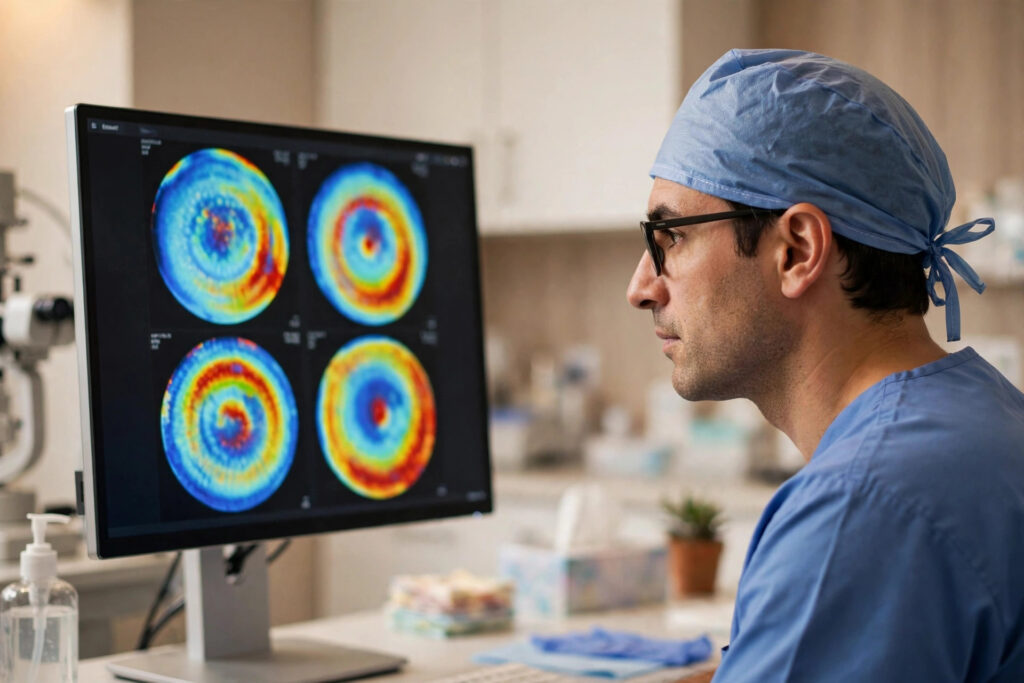
The workup mirrors the original LASIK evaluation: corneal topography, thickness mapping, tear film assessment, and a dilated exam to rule out other causes of vision change such as early cataract. This screening is non-negotiable, because treating the wrong problem — say, reshaping the cornea when a cataract is developing — would be a mistake. A comprehensive How Long Does an Eye Exam Take?“>eye exam with these measurements determines whether the eye can safely accept more laser treatment.
The procedure itself follows the familiar LASIK rhythm: numbing drops, a reclined position, the flap lifted or the surface prepared, a brief laser application, and the flap repositioned. Patients often find the experience less eventful than their first surgery simply because they know what to expect. The whole visit is usually short, and most people return to normal routines on a timeline similar to their original recovery.
Recovery After an Enhancement
Recovery after an enhancement is typically comparable to, or a little easier than, the original LASIK recovery. Vision is often functional within a day, though mild fluctuation and haziness are normal for the first week as the cornea settles. Lubricating drops are used generously, and surgeons usually advise against eye rubbing, swimming, and eye makeup for the period they specify.
One difference worth knowing: dry eye symptoms can return temporarily even in patients whose dryness had fully resolved after the first surgery, because the corneal nerves are disturbed again. This usually settles with time and drops. Follow-up visits let the surgeon confirm the flap is healing cleanly and the prescription is landing where intended. Shielding the eyes from bright sun with quality Cheap vs Expensive Sunglasses: What’s the Difference?“>sunglasses during the healing weeks is standard advice.
Risks and Considerations
Enhancements carry the same general risks as primary LASIK — dry eye, infection (rare), and under- or over-correction — plus one specific to re-lifting a flap: epithelial ingrowth, where surface cells grow beneath the flap edge. It is uncommon and usually treatable, but it is the reason surgeons are selective about flap lifts and may choose surface ablation instead. A second treatment also consumes more corneal tissue, so the safety margin for any future procedure shrinks.
Practical matters deserve attention too. Many clinics include enhancements in their pricing for a set number of years, while others charge separately — ask about the enhancement policy before your first surgery, not after you need one. And remember that non-surgical vision correction keeps improving: advances in How Photochromic Lenses Work“>lens technology mean that lightweight glasses remain a perfectly respectable alternative to a second procedure. The FDA’s LASIK information page and the American Academy of Ophthalmology’s LASIK guide are solid neutral references as you weigh the decision with your surgeon.