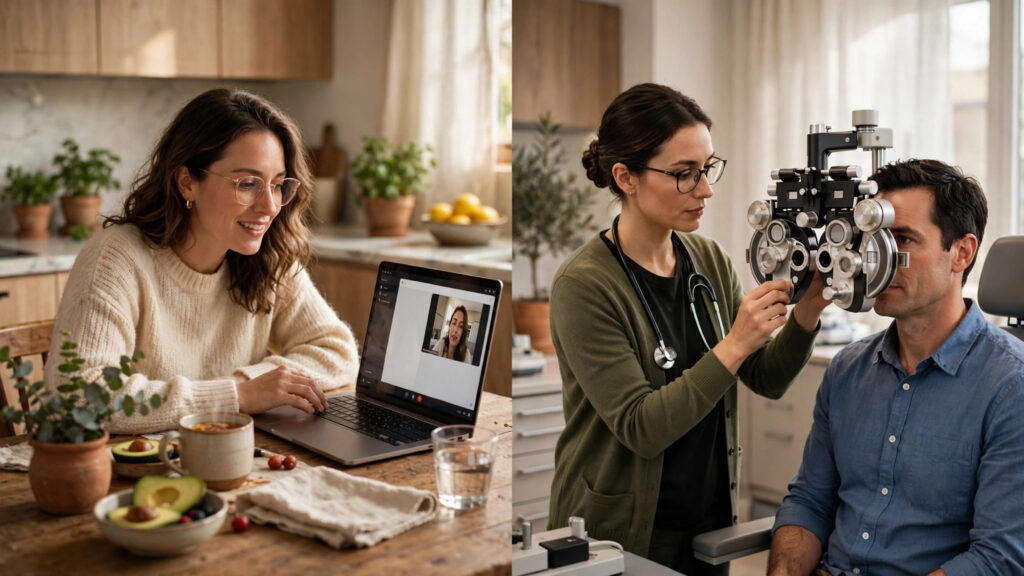
Online eye exams promise a new glasses prescription from your couch in minutes. In-person exams require travel, waiting rooms, and dilating drops. Both have their place — but they are not interchangeable, and confusing one for the other can leave serious eye conditions undetected.
This balanced guide explains what online vision tests actually do, where they fall short, when they are reasonable to use, and when only a comprehensive in-person exam will do.
Table of Contents
- What Online Eye Exams Offer
- How Online Vision Tests Work
- What Online Exams Cannot Do
- When Online Exams Make Sense
- When In-Person Is Essential
- The Hybrid Approach
- Regulatory and Safety Notes
What Online Eye Exams Offer
Online eye exams — offered by telehealth vision companies — typically provide a refractive assessment: an estimate of your glasses prescription based on a series of on-screen vision tests, sometimes reviewed remotely by a licensed eye doctor. The process takes 10 to 20 minutes and costs significantly less than an in-person visit.
The appeal is obvious: no travel, no waiting room, no dilation, results within a day. For a healthy young adult whose prescription has changed slightly and who simply needs updated glasses, the convenience is genuine.
Some services go further, offering asynchronous consultations where you answer symptom questionnaires and upload photos of your eyes for a doctor’s review. These can triage minor issues — a suspected stye, mild allergy symptoms — and advise whether in-person care is needed.
How Online Vision Tests Work
Most online refraction tests calibrate to your screen size (using a credit card or known object for scale) and your viewing distance (often measured with your phone’s camera or a step-back procedure). You then complete tasks similar to an in-person refraction: reading progressively smaller letters, comparing “which is clearer” options, and testing each eye separately.
The results are typically reviewed by an ophthalmologist or optometrist licensed in your state, who issues a prescription if the data supports one. Reputable services decline to prescribe when results are inconsistent, vision is poor, or red flags appear — and the quality of this safety net varies enormously between providers.
Accuracy depends heavily on your setup: screen calibration errors, incorrect viewing distance, poor lighting, and small phone screens all degrade results. A prescription generated under sloppy conditions may be measurably off — enough to cause eyestrain even if it seems “close.”
What Online Exams Cannot Do
Here is the critical limitation: online exams measure refraction, not eye health. They cannot check your eye pressure, examine your retina, assess your optic nerve, test your peripheral vision, or evaluate how your eyes work together. Glaucoma, diabetic retinopathy, macular degeneration, and retinal tears are all invisible to a screen-based test.
They also cannot perform a proper binocular vision assessment — the tests of eye teaming, focusing stamina, and alignment that explain headaches and reading fatigue in patients with “normal” acuity. Nor can they fit contact lenses, which requires measuring corneal curvature and evaluating lens fit on the living eye.
Children are a particular concern: online tests cannot reliably refract young eyes (whose powerful focusing muscles skew results without cycloplegic drops) and cannot screen for amblyopia or strabismus. Pediatric vision care is firmly in-person territory — see guidance on children’s eye examinations.
When Online Exams Make Sense
Online refraction is most defensible for healthy adults between roughly 18 and 40 who have had a recent comprehensive in-person exam, have no eye diseases or risk factors, and simply need a prescription refresh for glasses. Even then, it should supplement — not replace — the regular exam cycle.
It can also serve as a stopgap: your glasses broke on a trip, your prescription expired, and you need a renewal to order replacements before your scheduled exam. In accessibility terms, telehealth helps patients in rural areas or with mobility limitations obtain basic refractive care they might otherwise skip entirely.
The key discipline is honesty about what you received. An online prescription renewal is not an eye exam. If you treat it as one and skip your comprehensive exam for years, you are gambling that no silent disease is developing — a bet with increasingly bad odds after age 40.
When In-Person Is Essential
Anyone over 40, anyone with diabetes, high blood pressure, or a family history of glaucoma or macular degeneration needs in-person comprehensive exams — no exceptions. These are the populations where silent, sight-threatening disease is most common, and only dilated examination with pressure checks and imaging can rule it out.
New symptoms always warrant in-person evaluation: flashes, new floaters, a curtain over vision, sudden vision loss, eye pain, double vision, or significant redness. These can signal retinal detachment, acute glaucoma, or neurological emergencies where hours matter. An online questionnaire is dangerously inadequate for triaging them.
Children, contact lens wearers (who need corneal health monitoring), post-surgical patients, and anyone with a known eye condition belong in the exam chair. Protecting long-term eye health requires looking inside the eye — something no website can do.
The Hybrid Approach
The smartest model emerging in 2026 is hybrid: use telehealth for what it does well — prescription renewals, triage of minor symptoms, follow-up check-ins — while maintaining in-person comprehensive exams on the recommended schedule. Some practices now offer this themselves, blending virtual visits with periodic office exams under one roof.
Remote monitoring is also growing for chronic conditions: home tonometry for glaucoma patients, photo-based diabetic screening in primary care offices with remote specialist review. These are genuine advances — but note they all involve real diagnostic data reviewed by specialists, not just a screen-based refraction.
Ask your own eye doctor whether they offer telehealth options. A hybrid relationship with a doctor who knows your eyes beats a transactional online prescription from a stranger every time.
Regulatory and Safety Notes
Online vision services operate in a shifting regulatory landscape. Several states have passed or considered laws requiring in-person examinations before prescriptions can be issued, and the American Optometric Association has consistently argued that refraction-only telehealth omits essential health screening. Rules vary by state, so a service legal in one state may not be in another.
Red flags for unsafe services: no licensed doctor review, prescriptions issued purely by algorithm, no screening questions about eye disease or symptoms, and marketing that equates their test with a “complete eye exam.” Reputable providers are transparent about their limitations.
The American Academy of Ophthalmology advises that online vision tests are not a substitute for comprehensive eye exams. Use them judiciously, understand exactly what you are — and are not — getting, and never let convenience become an excuse to skip the exam that could save your sight.