
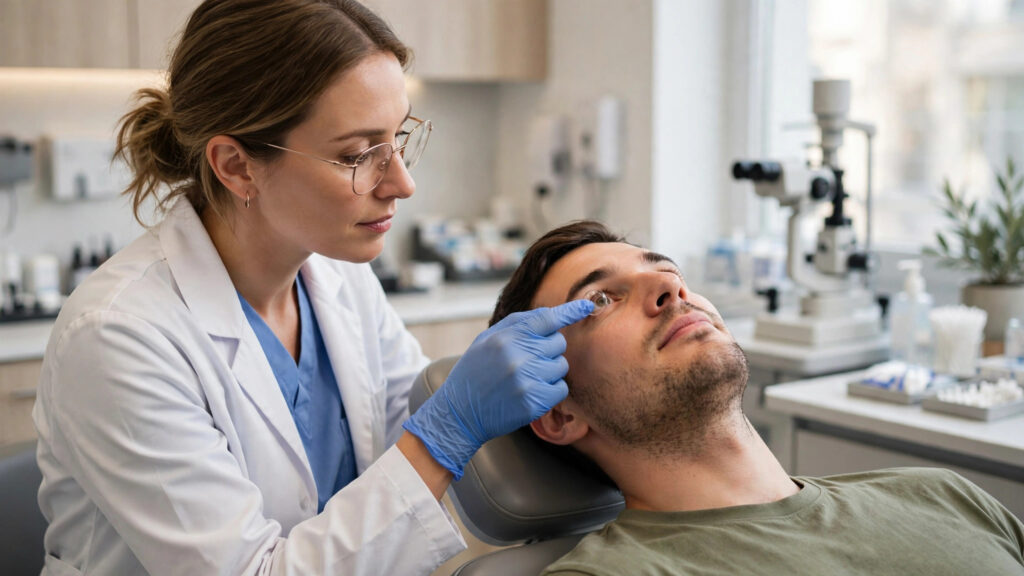
A contact lens fitting is a specialized exam that goes beyond determining your prescription — it measures the shape of your corneas, evaluates your tear film, and tests how trial lenses actually perform on your eyes. It is the reason contact lenses require their own prescription, separate from glasses.
This guide explains what happens during a contact lens fitting exam, why each step matters, what the measurements mean, and how follow-up visits keep your lens-wearing eyes healthy.
Table of Contents
- Why Fittings Are Separate From Eye Exams
- Corneal Measurements
- Tear Film Evaluation
- Trial Lenses and Assessment
- The Contact Lens Prescription
- Follow-Up Visits
- Specialty Fittings
Why Fittings Are Separate From Eye Exams
A glasses prescription describes optics: the lens power needed to focus light on your retina. A contact lens sits directly on your cornea, so the fitting must also describe geometry: how the lens curves, how wide it is, how it moves with each blink, and how your eye tolerates it. Optics alone are not enough.
US law reflects this distinction. The Fairness to Contact Lens Consumers Act requires a separate contact lens prescription with an expiration date (typically one year), and it specifies the exact brand and lens type. You cannot legally fill a contact lens order with a glasses prescription — the FDA classifies contacts as medical devices precisely because a poorly fitting lens can injure the eye.
The fitting also establishes a safety baseline. Your doctor documents your corneal health before lens wear begins, so future changes — dryness, blood vessel ingrowth, micro-abrasions — can be detected early. This monitoring is part of responsible long-term eye health management for lens wearers.
Corneal Measurements
Keratometry measures the curvature of your cornea’s front surface using reflected light patterns (mires). The cornea provides about two-thirds of the eye’s focusing power, and its curvature determines the base curve of your contact lens — the back-surface curve that must align with your eye. Too flat or too steep a fit causes discomfort, unstable vision, or corneal stress.
Corneal topography maps the entire corneal surface in detail, revealing irregularities like astigmatism patterns or early keratoconus that basic keratometry misses. Many practices now include topography in fittings, especially for toric (astigmatism) or multifocal lenses where precise alignment matters.
Your doctor also assesses corneal diameter and eyelid anatomy, which influence lens diameter selection and how the lens positions under the lids. These measurements take minutes with automated instruments and involve no discomfort.
Tear Film Evaluation
Contact lenses float on your tear film, so its quality and quantity directly determine wearing comfort. Your doctor evaluates tear breakup time (how quickly tears evaporate between blinks), tear volume, and the health of your meibomian glands, which produce the oil layer that prevents evaporation.
Patients with significant dry eye may need treatment before lens wear begins — or may be steered toward specific lens materials. Daily disposables, for instance, tend to work better for dry-eye-prone wearers since a fresh, deposit-free lens goes on each morning. High-water-content lenses are not always the answer; silicone hydrogel materials often perform better despite lower water content.
This evaluation also sets expectations honestly. If your tear film is marginal, your doctor might recommend limited wearing hours, specific rewetting drops, or addressing underlying dry eye disease first — a key part of safe, comfortable contact lens wear.
Trial Lenses and Assessment
Based on your measurements, your doctor selects trial lenses — actual lenses you wear during the visit. After 15 to 30 minutes of settling time, the lenses are evaluated at the slit lamp: how they center on the cornea, how much they move with blinks (ideal: about 0.25 to 0.5mm), and whether the edges lift or dig in.
Vision is then tested through the trial lenses, and the fit refined. For astigmatism, toric lenses must maintain rotational stability — if the lens rotates, vision blurs. Your doctor checks the lens orientation markings and may try different brands, since stabilization designs vary and individual eyes respond differently.
Comfort is assessed honestly, not optimistically. Mild initial awareness is normal; sharp pain, significant redness, or immediately blurry vision is not. A good fitter would rather try three lens designs than send you home with a mediocre fit — the lens should feel like almost nothing within the adaptation period.
The Contact Lens Prescription
Your finalized prescription lists: power (often slightly adjusted from your glasses prescription to account for vertex distance), base curve, diameter, brand and lens type, and replacement schedule. Every element matters — substituting a different brand, even with the same power, changes the fit geometry and is not permitted without your doctor’s approval.
The prescription expires after one year under federal law, requiring an annual contact lens evaluation for renewal. This is not a revenue scheme: yearly checks catch the gradual corneal changes, dryness progression, and prescription shifts that occur with ongoing lens wear.
You are entitled to a copy of your prescription after the fitting is complete (once any trial period concludes). Retailers — online or in-store — must verify it with your prescriber before filling the order. Understanding these rights helps you shop for contact lenses confidently and safely.
Follow-Up Visits
New wearers typically return within one to two weeks for a follow-up. Your doctor checks corneal health, lens fit after real-world wear, and your insertion/removal technique and hygiene habits. This visit catches problems — overwear, poor cleaning, early irritation — before they become serious.
Annual evaluations thereafter include corneal health assessment, prescription verification, and discussion of any comfort changes. Many long-term wearers develop gradual dryness or need material changes as their eyes age; the yearly visit is where these adjustments happen.
Between visits, know the red flags that warrant an unscheduled call: persistent redness, pain (beyond mild end-of-day dryness), light sensitivity, discharge, or sudden vision changes. Remove the lenses immediately and call your doctor — and never sleep in lenses not approved for overnight wear, a leading cause of serious corneal infections.
Specialty Fittings
Not all fittings are routine. Keratoconus and irregular corneas often require rigid gas-permeable or scleral lenses — large-diameter lenses that vault over the cornea entirely. These fittings are intricate, sometimes requiring multiple visits and custom lens designs, but the visual results can be transformative.
Multifocal contact lenses for presbyopia demand careful balancing of distance and near vision, with adaptation periods of one to two weeks. Orthokeratology (overnight corneal reshaping lenses) and myopia-control lenses for children involve specialized fitting protocols and closer monitoring — topics parents can explore in pediatric myopia resources.
Whatever your situation, the principle is constant: contact lenses are medical devices fitted to living tissue, not commodities. As All About Vision notes, a thorough fitting is what separates comfortable, safe lens wear from years of avoidable problems.